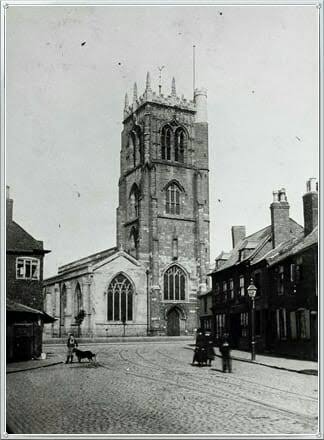
Part one / The life before
Catherine Ayre didn't talk much about where she came from.
What she left her family was a story, told in fragments and carried from one generation to the next. She was Scottish, or so she said. An orphan. A little girl sent across the Atlantic to Canada, alone in a world she could scarcely have understood.
There weren't many details. No grand account of the old country. No stories of a childhood home, the people who lived there, or the circumstances that had brought her halfway around the world.
For years, the family had little more than that.
Whatever happened in Catherine's earliest years, something eventually placed an ocean between her and the place she was born. She would build a life in Canada, marry, raise children, and grow old in a country far removed from whatever she had once called home.
The family would inherit her story.
They would also inherit the questions.
And for generations, those questions refused to go away.
A name / An identity
The Scottish Girl from England.
Catherine identified as Scottish.
It could have been based on her last name, what she was told by the grownups around her, or a distant memory of how her own mother described their heritage.
On April 8, 1913, Catherine married Levi Hilliard. The marriage record describes her as twenty years old, a young bride starting a family of her own. Thomas and Isabella Ayre appear alongside her, too—not in the flesh, but as names jotted down on paper.
This was the artifact that opened the door to a world she may once have known.
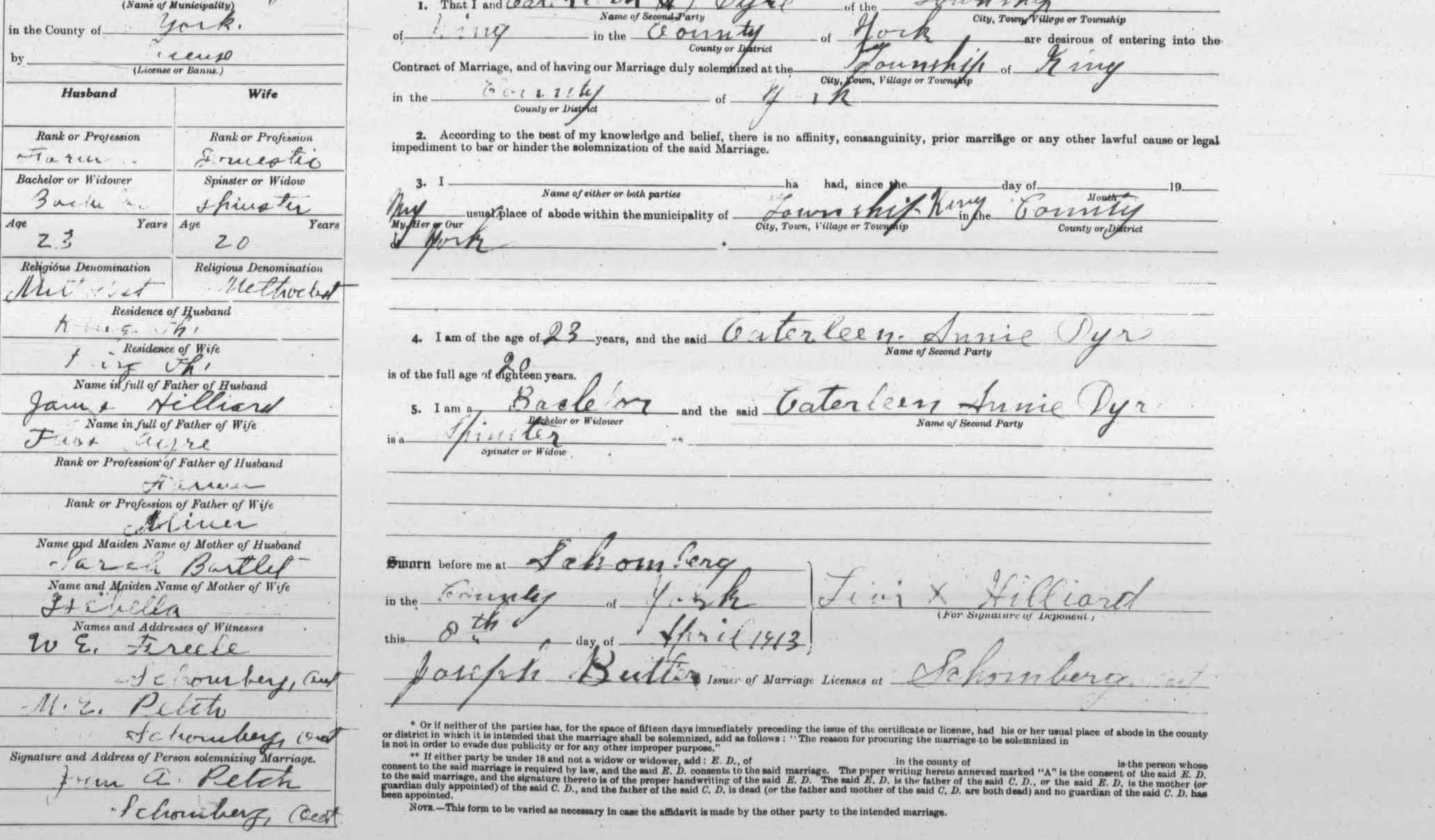
But hidden in the ledgers of a church in northern England, a different story begins to emerge.
The search moves to northern England / 1893
Durham, England.
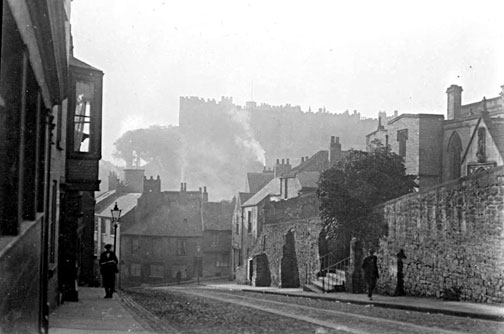
In historic Durham, the narrow streets of Crossgate sit in the shadow of the towering Cathedral.
Durham was a medieval city, struggling to adjust to the crushing demands of the Industrial Revolution. Ancient churches and crowded working-class streets stood within reach of the coalfields that powered much of northern England.
St Margaret of Antioch, where a name was recorded.
At the meeting of Crossgate and South Street stood St Margaret of Antioch.
It was already more than seven hundred years old.
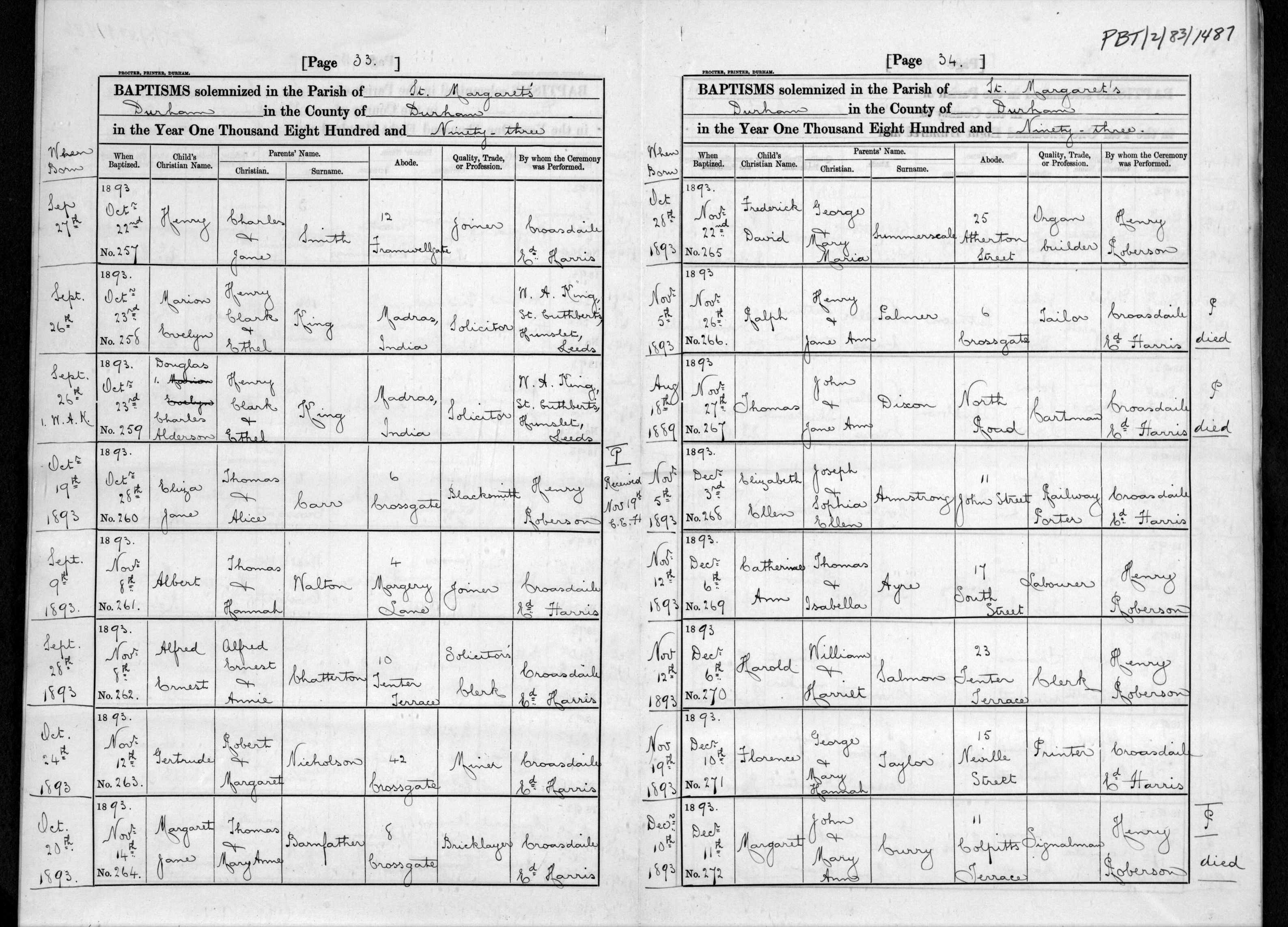
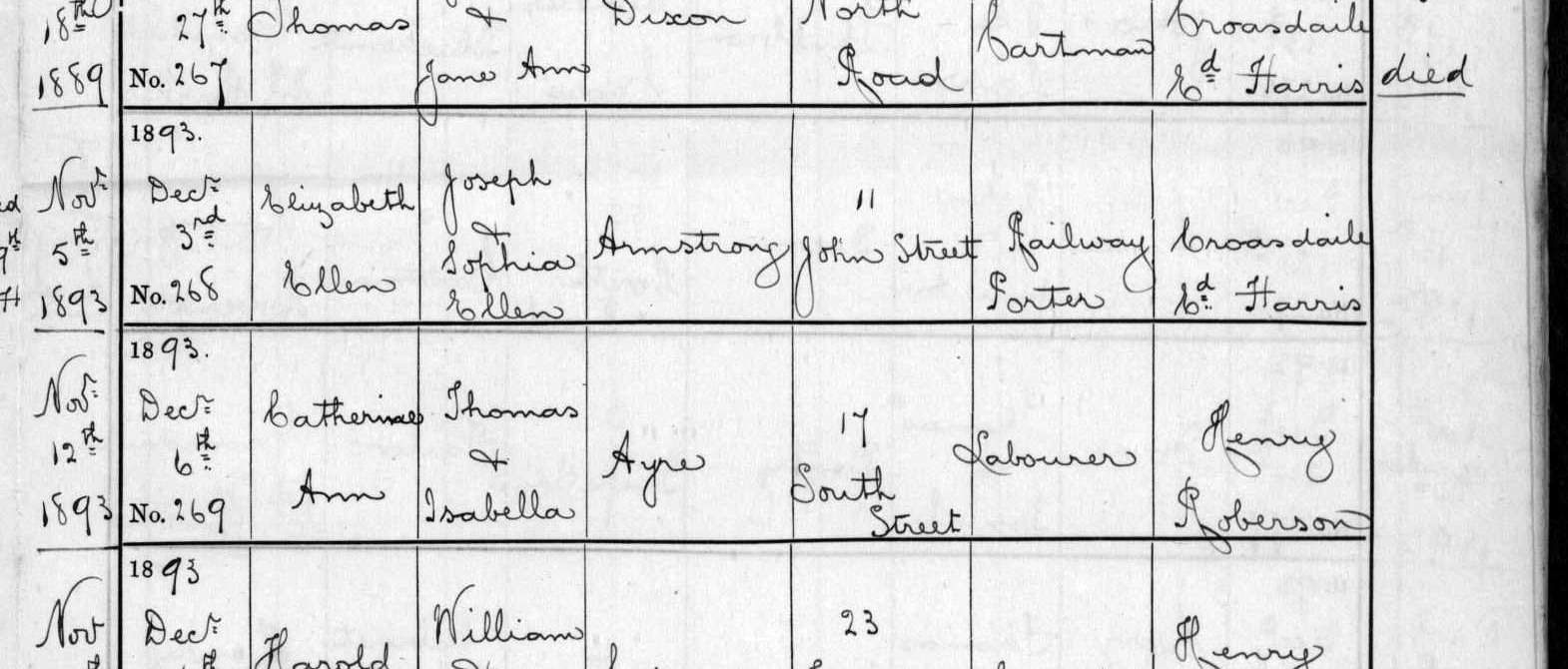
There, in the parish records of St Margaret's Church in Durham, we find a little girl named Catherine Ann Ayre.
Born November 12, 1893.
Baptized December 6.
In the same entry, we find the names Thomas and Isabella Ayre. An occupation: labourer. And a street address:
17 South Street, Durham.
Five small pieces of information, written down by someone who could not possibly have imagined that more than a century later, a family on the other side of the Atlantic would be searching for them.
For one brief moment in December 1893, three names appeared together in the historical record.
Finding them together again would prove considerably more difficult.
People came to the region looking for work. Among them were families from Ireland, driven by poverty or drawn by the promise of wages. Some found steady employment. Others moved between mining communities, rented rooms, or shared houses with people whose circumstances were much like their own.
As coal pits opened across Durham, housing struggled to keep pace with the influx of workers. Mining families frequently took in single men as lodgers. In some cottages, entire families crowded into a single bedroom, while the downstairs kitchen served as living room, sleeping quarters for lodgers, and a place for miners to scrub the coal dust from their bodies after a shift. There was little privacy, and every inch of space had to serve a purpose.
Below ground, conditions were worse. Men and boys spent long hours in cramped, poorly ventilated tunnels, breathing coal dust that could damage their lungs over years of work. Falls of stone, sudden flooding, poisonous gases, and machinery accidents could end a life in moments. Durham's mining records are filled with the names of workers who never returned home, some of them barely into their teens.
It's in these conditions that we find several young men named Thomas Ayre. Miners and labourers, scattered throughout the villages and industrial towns of County Durham.
Of these candidates, one now stands apart: a Hett-born Thomas Ayre who grew up in Isabella Bell’s Crossgate household. His documented life offers our strongest working identification of Catherine’s father, although the link from his 1881 census appearance to Catherine’s 1893 baptism remains unproved.
Of all the details in the register, one gave us somewhere to look next:
17 South Street.
Somewhere along that street, in December 1893, Thomas and Isabella Ayre had given an address when Catherine's baptism was recorded.
Following the address backward, we find a house occupied by the Ashforth family just two years earlier. Coal miners lived under its roof, along with a widowed woman who lodged there.
By 1901, both numbers 16 and 17 South Street were listed as uninhabited.
Number 15 was occupied. So was number 18.
But between them, two empty addresses.
The church register places Thomas and Isabella at number 17 in December 1893. Yet neither the census before nor the one after puts them there.
Three names, one address, and a moment in time.
For many years, the trail appeared to end there.
But another trail leads backward, from South Street to the household where Catherine's likely father grew up, and farther still to Hett. Before following Catherine across the ocean, we can look at the people and places that may have shaped the family she came from.
An earlier chapter / Hett and Butcher Race, 1770–1881
Before Crossgate: the Ayres and Bells of Hett.
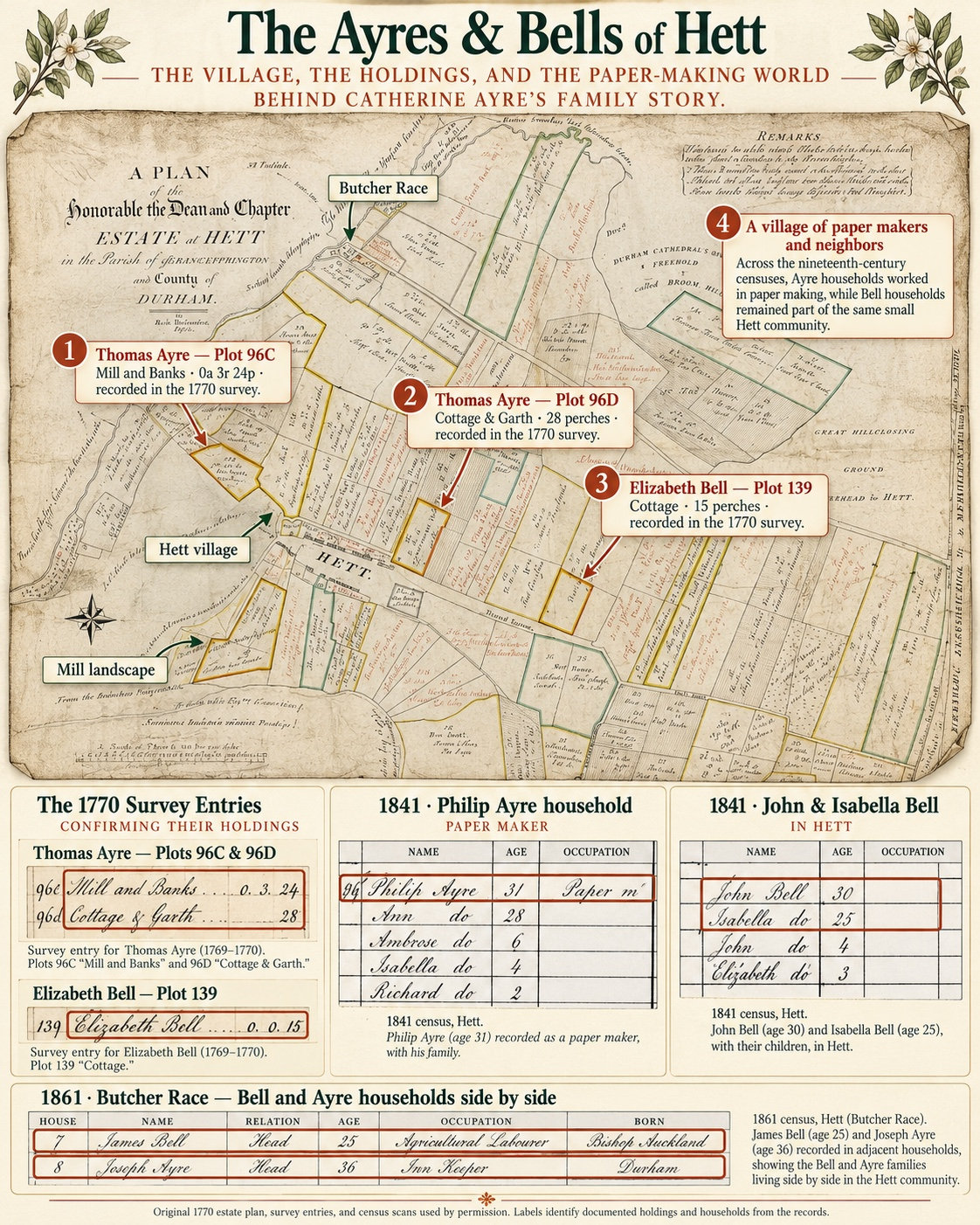
Long before Catherine Ayre was born in Durham, the Ayre and Bell names were already part of the history of Hett, a village to the south of the city. In 1770, an estate survey recorded Thomas Ayre with interests in a mill and a cottage, and Elizabeth Bell with a cottage in the village. We cannot yet connect either person to Catherine through a documented chain of parents and children. But the records open a window onto the place where her likely paternal family had its roots.
Hett and nearby Butcher Race were working communities. Corn and paper mills belonged to their landscape, and local records connect the Ayre name with milling in the eighteenth century. By the nineteenth century, paper-making was still recurring among households named Ayre. The Bells, too, were part of this small village world. Their next appearance in the records would lead us somewhere unexpected.
From Hett to Crossgate
In the 1841 census, John and Isabella Bell were living in Hett with their young children. John was a sawyer. Among the children was Ralph, not yet much more than a baby. Their names were part of the village record, surrounded by the families and trades of the Hett countryside.
Then the trail changes.
By the 1861 census, Isabella is no longer in Hett. We find her instead in Crossgate, Durham—the streets around St Margaret's Church, where Catherine Ayre would be baptized thirty-two years later.
Isabella is now a widow. Her older son John, twenty-three, is a tailor. Her son Ralph, twenty-one, is a paper maker: one of the trades we have been following from Hett. Her daughter Mary Ann is there too.
And then, at the end of Isabella's household, the enumerator writes down another name.
Thomas Ayre.
One year old. A boarder.
A child carrying the Ayre name, living under Isabella Bell's roof. Not a passing mention of two surnames in the same district, but a boy growing up in the very household we have followed out of Hett.
The connection holds. In 1871, the census places Isabella's household at 23 Crossgate. Thomas is still there, now eleven and attending school. Ralph is still a paper maker. Nearby stood St Margaret's, where Catherine's name would enter the parish register in 1893.
Then comes a third census, in 1881. Isabella is still the head of the household. Thomas is twenty-one, listed as a lodger rather than a schoolboy. But it is his occupation that catches the eye. After years of paper makers in Hett and Crossgate, the young man has entered a different trade.
Coal miner.
Thirty-two years later, when Catherine married Levi Hilliard in Ontario in 1913, her marriage record named her father as Thomas Ayre and gave his occupation as miner.
The name appears again, and so does the trade. It is a striking echo across the years and the Atlantic—another reason to take the Crossgate Thomas seriously as Catherine's father, though not yet proof that the two records describe the same man.
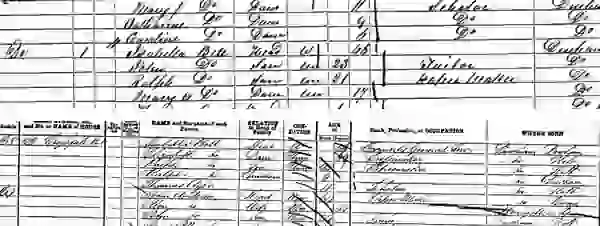
Isabella Bell — widow, head of household
Ralph Bell — son, 21, paper maker
Thomas Ayre — boarder, 1
Isabella Bell — head of household
Ralph Bell — son, paper maker
Thomas Ayre — boarder, 11, scholar
Isabella Bell — head of household
Thomas Ayre — lodger, 21, coal miner
A reading aid for three census returns; the image above reproduces the 1861 and 1871 entries, while the 1881 original is retained in the family archive. Sources: RG 9/3737, p. 40; RG 10/4962, p. 32; RG 11/4954, p. 11.
The child in another household
We cannot know why Thomas came to live with Isabella Bell when he was so young. She may have been a relative or a trusted family connection; the census does not say. Across three returns, the records follow him from infancy to working adulthood in her household, but they leave the most intimate questions unanswered: who his parents were, why he was boarded there, and what he understood about belonging.
That Thomas is our leading candidate for Catherine's father, not a proven identification. Catherine's 1893 birth record names her mother as Isabella Ayre, formerly Crawford, and her baptism names both parents—Thomas and Isabella—at 17 South Street. We have yet to find a record linking the young miner of 1881 directly to the father named in 1893.
Two childhoods, and the silence between them
If the Crossgate Thomas was Catherine's father, both grew up with gaps in their family histories. As a child he was living with the Bells, rather than with parents we can identify. For Catherine, her birth and baptism establish a place and two names, but not what followed. We have not securely identified her father in a later record; his absence from the paper trail does not tell us whether he died, moved away, or remained in her life.
A widowed Isabella Ayre recorded in Durham Union Workhouse in 1901 is our leading, but unconfirmed, candidate for Catherine's mother. If this was her, the entry could point to serious hardship or a need for shelter. It cannot tell us how Isabella felt about her daughter, nor whether she wished or was able to keep the family together.
For now, the trail leads from the mills of Hett to a few streets in Durham, where the lives of the Bells, the Ayres, and Catherine herself may have briefly overlapped. Before we follow Catherine farther, we can see where those traces fell on the map.
Family branches / Census householdsOther Ayres and Bells in the paper-making community
Paper-making appears in several Ayre households beyond the people we can connect to Thomas. These records illuminate the community, not a verified pedigree to Catherine.
Enumerated at the Paper Mill, working in paper manufacture. A particularly strong address-and-occupation anchor; no proven descent from the 1770 millholder.
A continuing paper-making household, with children including Ambrose and Richard in the earlier returns. The sequence is persuasive, though ages and some names differ across years.
A separate paper-maker Thomas, later enumerated in Gateshead with Jane and children. He must not be confused with Thomas the mason or the infant who lived with Isabella Bell.
Another paper-maker household, including daughters in the census. Its exact relationship to the other Ayres remains open.
Approximately twenty-three, a paper maker born in Hett. With Hett-born Joseph Ayre, recorded as a stoker, he gives us a striking bridge from the old mill community to Durham city.
Neighbors at Butcher Race, 1861
James and Ruth Bell lived at Butcher Race with their infant daughter Jane. The following census schedule records Joseph and Eleanor Ayre and their children. Joseph worked as an innkeeper. The households were listed consecutively, but that does not independently prove they shared a property boundary or were relatives.
Joseph's infant son Robert Thomas Ayre cannot be merged with the one-year-old Thomas living in Isabella Bell's Crossgate home: the 1861 census enumerated the two boys separately. Both remain important people in the community's history.
Land & industry / Original recordsThomas Ayre and Elizabeth Bell in the 1770 Hett survey
The survey identifies three documented property interests in Hett. The labels on the illustrated map above help locate the story, but the exact boundaries highlighted in that artwork have not been independently matched to the original plan.
From the original 1770 Hett survey
96CThomas Ayre
Mill and Banks
0a 3r 24p · apparently leasehold
96DThomas Ayre
Cottage & Garth
28 perches · freehold
139Elizabeth Bell
Cottage, east side of Hett
15 perches · apparently freehold
Property holders are documented in the 1770 estate book, not established as ancestors of the later Crossgate household. Original map and survey: Durham Cathedral Archive, DCD/E/AA/20/1–2; the source scans are retained in the family research collection.
Explore the original Hett estate map and survey at Durham University. An 1829 estate plan and the 1839 tithe material offer potential points of comparison; their property-by-property identities have not yet been reconciled.
A proposed eighteenth-century Thomas Ayre–Judith Bell marriage remains an unverified lead. Its inclusion in a collaborative tree does not yet establish an ancestral link between the families in the 1770 estate book and those in Catherine's lifetime.
Trades / Source-by-source notesPaper makers, a bookbinder, and the limits of the records
The working neighborhood included paper-making occupations and other trades, but not everyone named on a nearby census page worked for the same employer.
The neighbors' trades · original census pages
1861Crossgate
Ralph Bell — paper maker; Robert Seed — paper maker on the same census page; Caroline Nichols — an overseer/overlooker in the paper trade (handwriting to be checked further).
187123 Crossgate and nearby returns
Ralph Bell — paper maker; John Anderson — paper maker in another household recorded on the same page.
1881Crossgate
The neighboring enumeration also includes a bookbinder. This is evidence of related skilled work in the area, not proof of employment at the same paper mill.
Primary census references: 1861 RG 9/3737, p. 40; 1871 RG 10/4962, p. 32; 1881 RG 11/4954, p. 11. The occupations and co-residence are evidence; an unproven Ayre–Bell pedigree, a single common employer, and the exact nineteenth-century house footprints remain hypotheses.
Bookbinder is a trade associated with books rather than proof that someone manufactured paper. Ralph's workplace has not been established; the evidence is that he himself was a paper maker and that he lived with young Thomas.
Research notes / Records and interpretationHow we traced the Hett connection
Households: 1841 and 1851 Bell household findings; 1861 Hett/Butcher Race census showing James and Ruth Bell and Joseph and Eleanor Ayre in successive schedules; 1861, 1871 and 1881 Durham census sequence for Thomas in Isabella Bell's household.
Parish and civil evidence: 1893 St Margaret's baptism; Catherine's original civil birth registration naming Isabella formerly Crawford. The Merrington baptism register covering Thomas's probable birth, EP/Mer 6 (1846–1895), is identified as unindexed in the archive finding aid; a negative online search cannot settle his parentage.
Land and historical context: Durham Cathedral estate plans DCD/E/AA/20/1–2 (1770) and DCD/E/AF/12/1–2 (1829); intervening leasehold and valuation series DCD/E/AB/15 and DCD/E/AD/8. The named 1770 property interests are recorded in the original survey; the exact plot outlines on the estate map have not yet been verified.
Open relationships: The proposed Thomas Ayre–Judith Bell eighteenth-century marriage requires parish verification; Joseph Ayre is not identified as the father of the Crossgate Thomas; Isabella Bell's relationship to Thomas is unknown; and the identity of the 1901 workhouse widow remains provisional.
A family in one small neighborhood / 1861–1901
The streets that held Catherine's family.
Imagine walking these Durham streets with Catherine's grandchildren. Before she crossed the Atlantic, her family's story had already passed through this little neighborhood: Thomas Ayre growing from a boy into a working man in Isabella Bell's Crossgate household; Thomas and Isabella, formerly Crawford, giving 17 South Street as their address when their daughter was baptized in 1893; and, perhaps, Isabella's later years within the walls of the Durham Union Workhouse.
We cannot know which doors Catherine remembered or what anyone told her about these places. But the records bring them close enough to picture: the woman who helped raise her likely father, the street where her parents were recorded, the church that entered her name, and a workhouse that may hold a final trace of her mother.
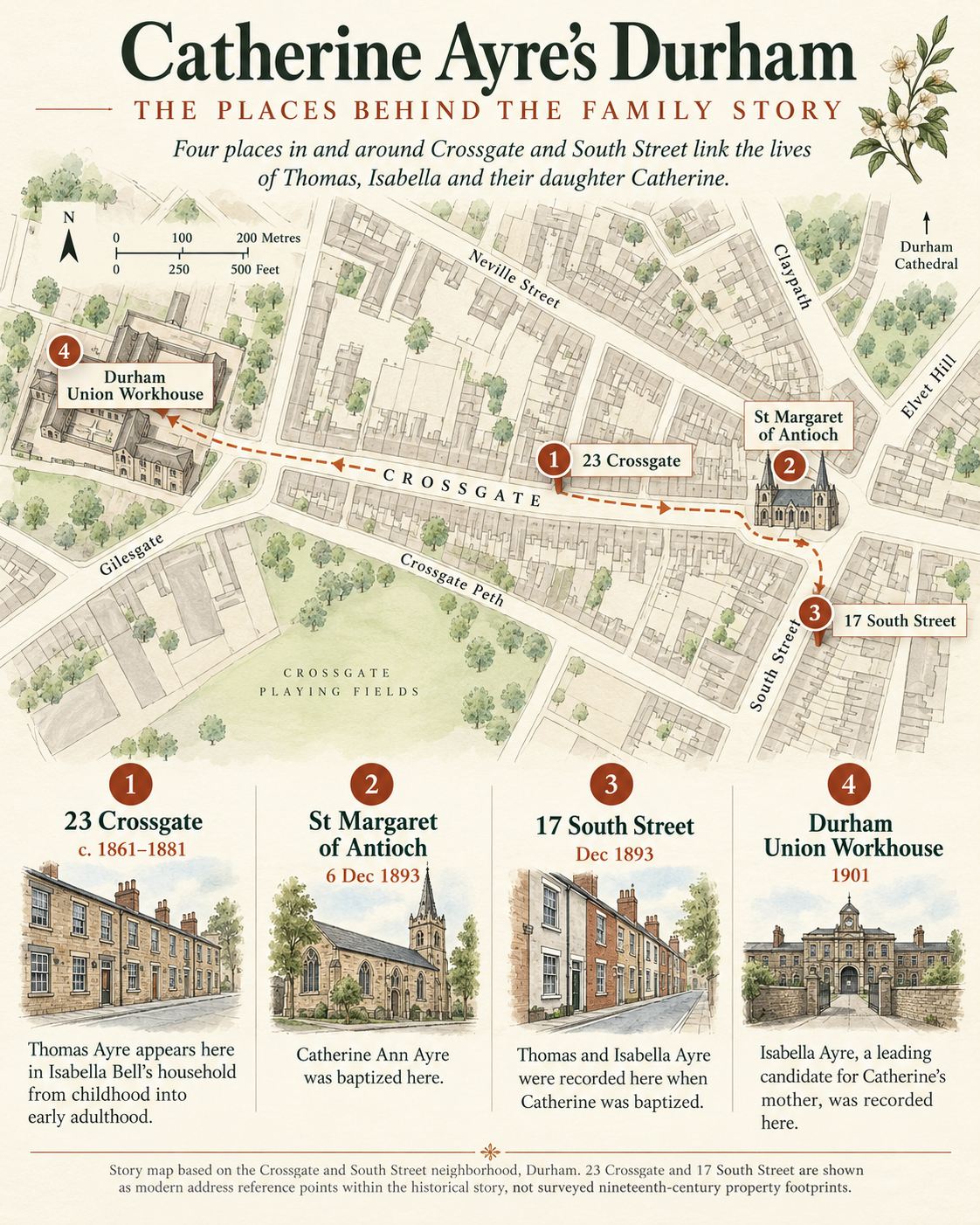
There is an essential difference between the four stories. Thomas's time with Isabella Bell is supported by the census trail; Catherine's parents and 17 South Street appear in her baptism, and her mother's Crawford surname in her civil birth record. The 1901 Isabella Ayre at the workhouse remains a leading identification hypothesis, not a verified account of Catherine's mother. Likewise, the connection between the Crossgate boy and Catherine's father is our preferred reconstruction, not yet a continuous documented identity.
May 1904 / Liverpool to Quebec
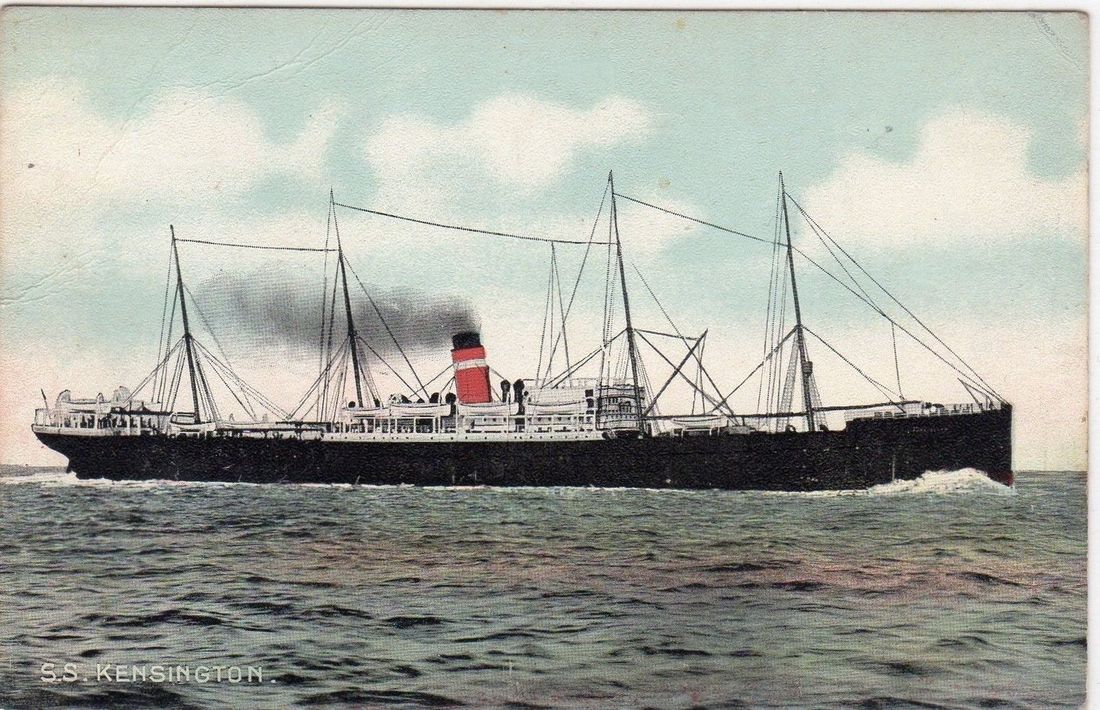
SS Kensington — A Departure Leaves Behind a Clue.
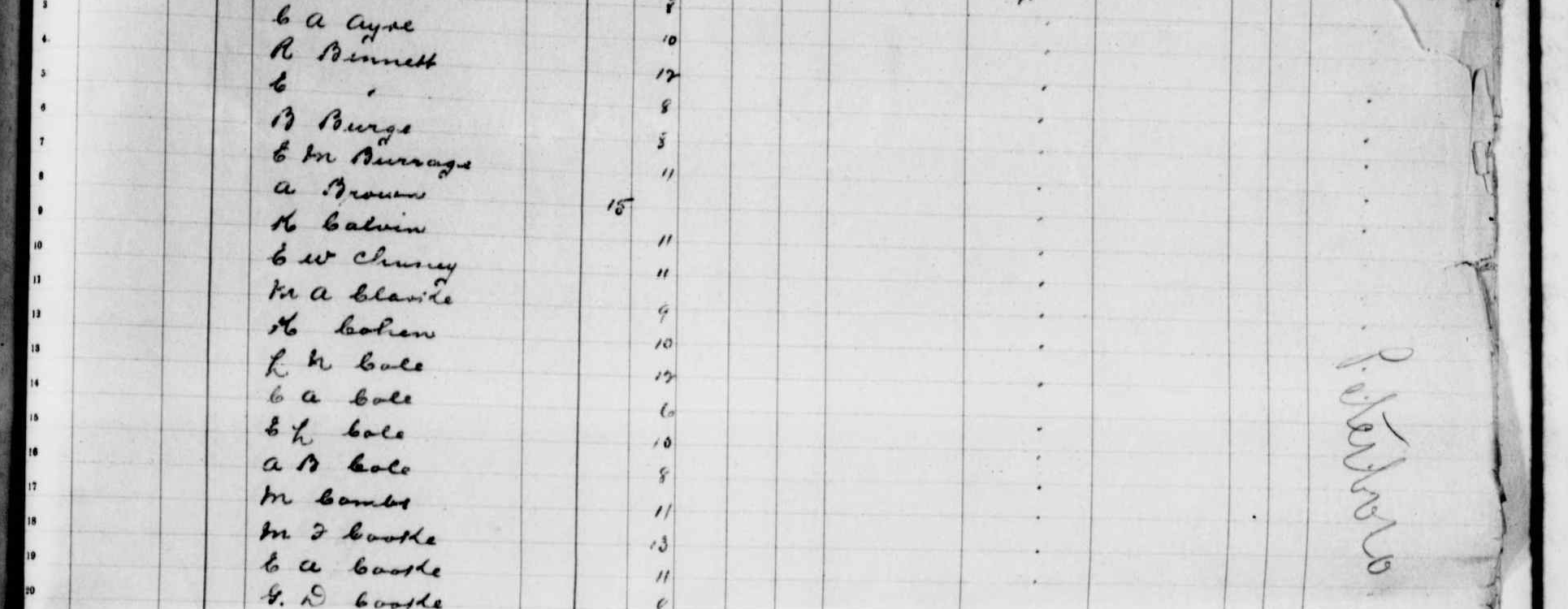
A little more than ten years after her first appearance in the church register, Catherine resurfaces in the passenger manifest of a ship bound for Canada.
It is May 1904. The SS Kensington is crossing the Atlantic from Liverpool to Quebec. Among its passengers is a ten-year-old girl listed as C. A. Ayre.
Thomas and Isabella are nowhere to be found alongside her.
In fact, the pages surrounding her name are filled almost entirely with children.
Page after page. Name after name.
Then, three pages back, we find a single word sprawled across the manifest.
Barnardo.
A name on the passenger list. A word written across the pages nearby.
The name behind the manifest
Barnardo — a child sent abroad.
The word on Catherine's passenger list referred to the children's charity founded by Thomas John Barnardo. Beginning with a school for poor children in London's East End in 1867, it grew into a network of homes, and eventually into an organization sending children across the Atlantic.
Canada was offered as a place of opportunity. It also needed help on farms and in households. Young girls could be placed in domestic service; boys were commonly placed in agricultural work. Children entered the system through very different circumstances, and their experiences in Canada differed just as widely.
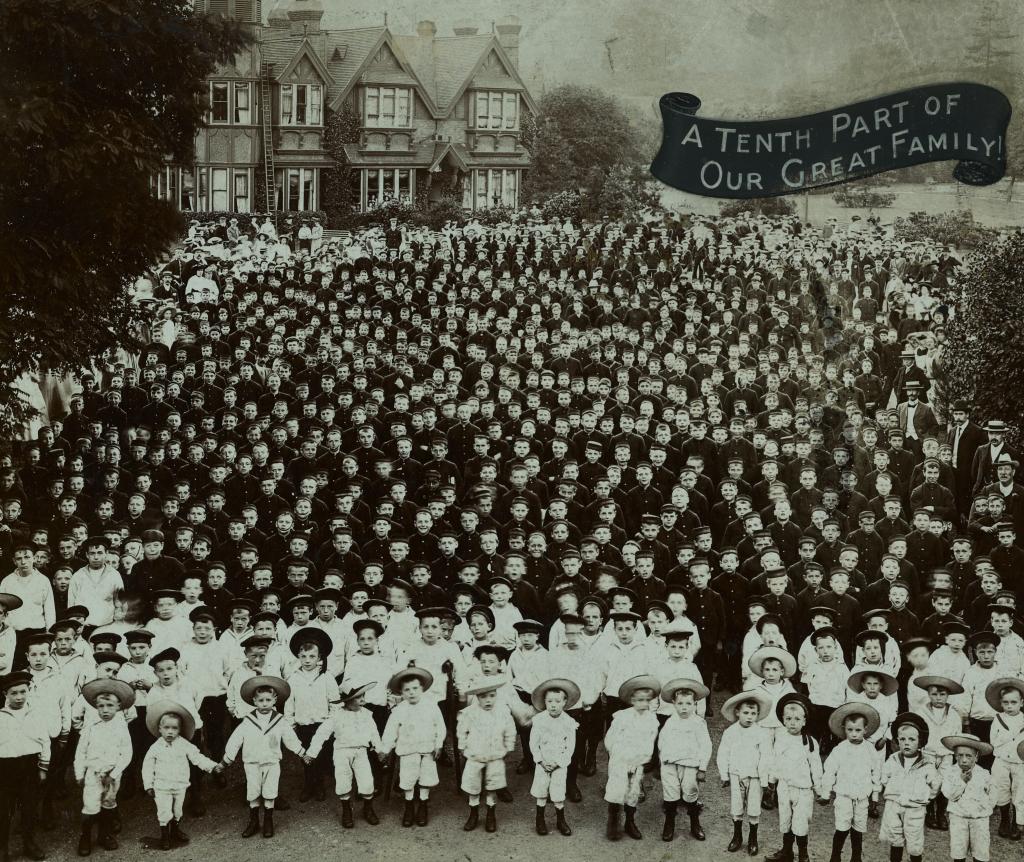
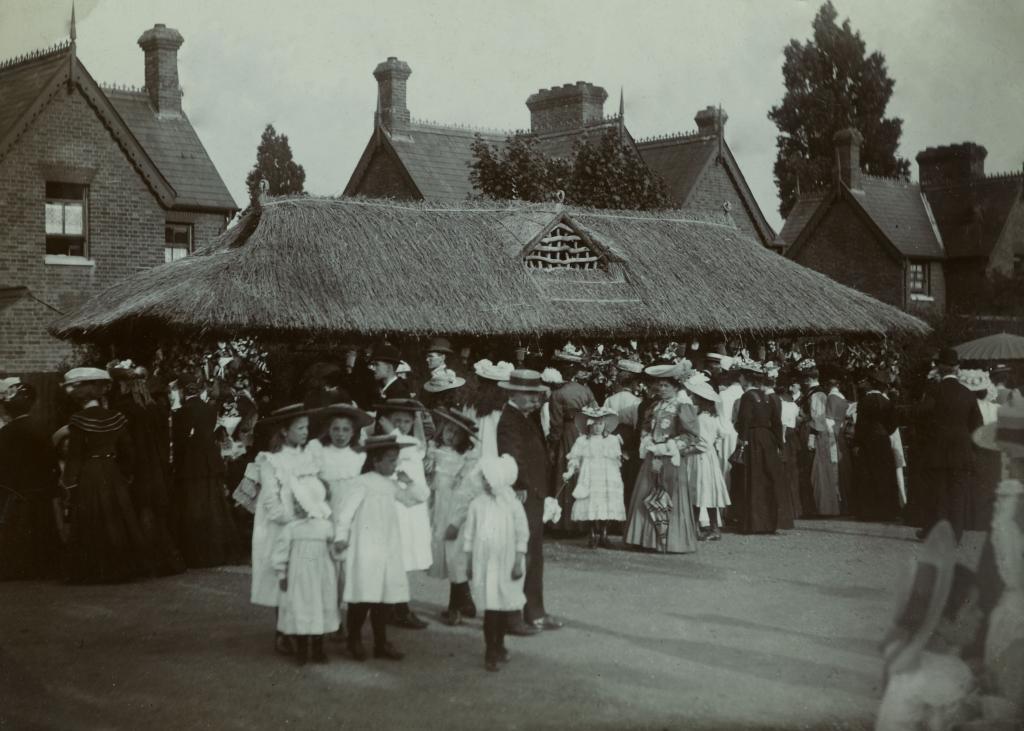
Look at the faces gathered for the photograph. Every one belonged to a life larger than the institution could describe. Many British Home Children were not orphans. Some had living parents struggling with poverty, illness, or other losses. Some children found welcoming homes in Canada; others endured hard work, isolation, neglect, or mistreatment.
Catherine's family remembered her as an orphan. The manifest can tell us that she traveled with a Barnardo-associated group; it cannot tell us whether either parent was dead, who arranged her admission, or what she experienced. What happened to Catherine still matters more than the institution's version of its purpose.
Further reading / The history behind the voyageHow did a charity become a child-migration system?
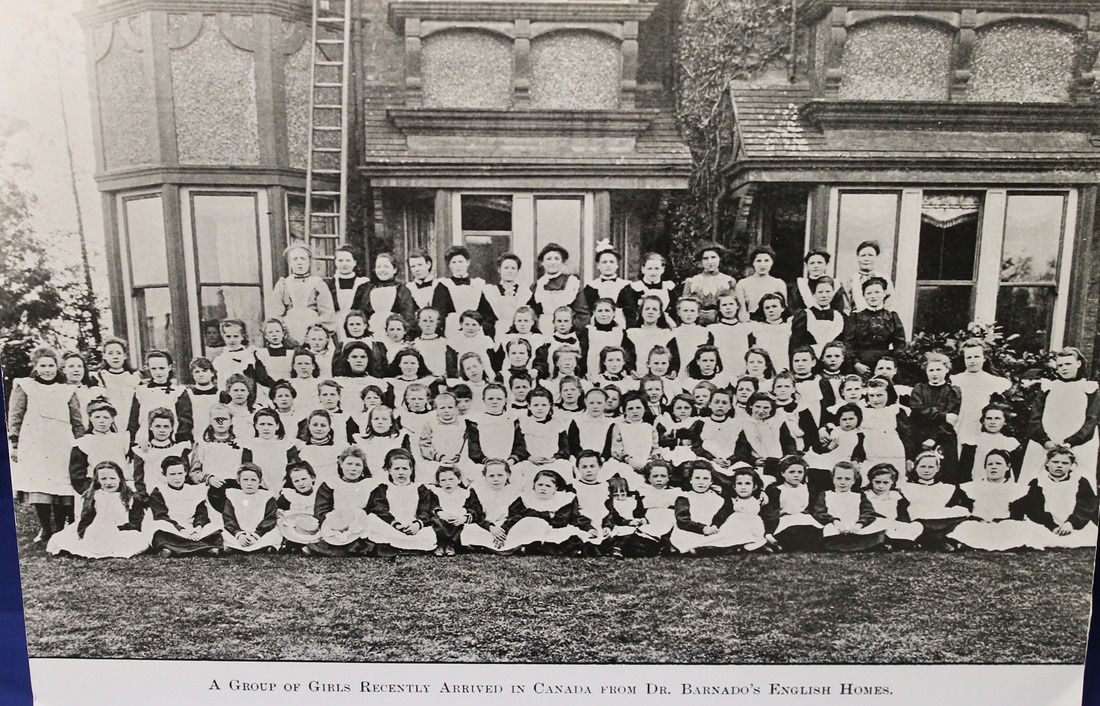
London's slums were overcrowded and disease-ridden. For families struggling to survive, a charity promising shelter and food could mean the difference between getting through the week and losing a child to hunger or illness. Barnardo's early homes expanded into schools, workshops, hospitals, and an entire village for girls at Barkingside, outside London.
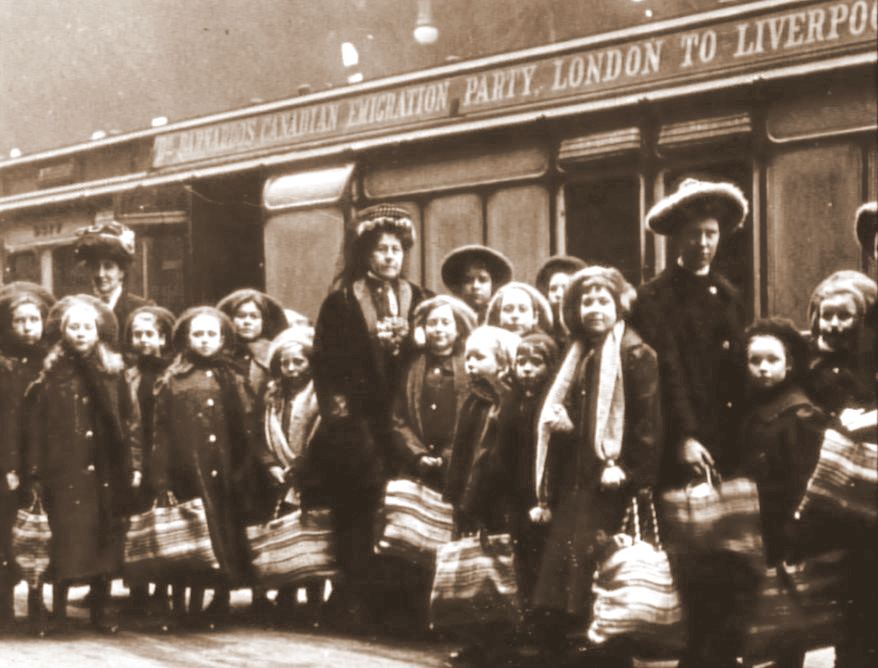
By 1900, Barnardo's girls' village reportedly contained 65 cottages accommodating and training around 1,500 girls. Those large numbers were part of the institution's public story: a vast effort, presented as rescue from destitution. The migration program extended that promise across the Atlantic.
There was a practical economic case as well. Canadian farms and households needed work done; older children could be placed in agricultural and domestic service. Some children were cared for as members of the family. Others were treated primarily as workers. Schooling and supervision varied widely.
Children's paths into care differed. The death of a parent, loss of income, illness, family separation, or an institution's intervention could all play a part. Not every child had been abandoned, and some parents were unaware that their children would be sent abroad.
Sending organizations were supposed to monitor placements, but inspections and safeguards could be inconsistent. The isolation of rural placements could make mistreatment difficult to report. In 2010, the British government apologized for its role in overseas child migration; Barnardo's has since acknowledged the failings of the practice. None of this tells us what happened to Catherine herself, but it changes the meaning of the word in the manifest.
Peterborough, Ontario / 1904
Hazelbrae — the place she arrived.
The next clue was not another name. It was a house: Hazelbrae, the Barnardo receiving home in Peterborough recorded in the Canadian Home Children registry for C. A. Ayre.
Standing on Conger's Hill, the Victorian house received girls who had traveled from Britain. From there, they were sent on to households and placements across Ontario. We can place Catherine within the arrival records, but cannot yet identify the home to which she was sent or the people who met her there.
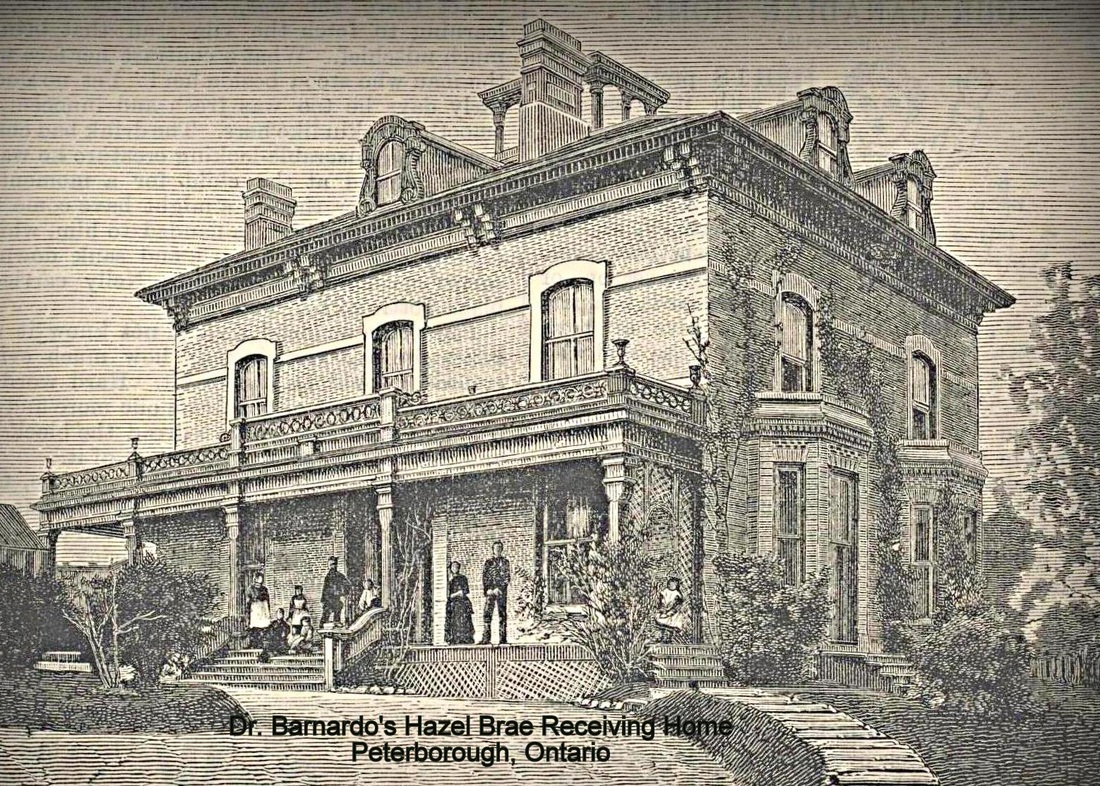
A surviving photograph of Hazelbrae's porch brings this arrival place into view. We cannot identify Catherine among the people in it. Even so, it is a reminder that for each child the journey had to end at an actual doorway, with strangers waiting on the other side.
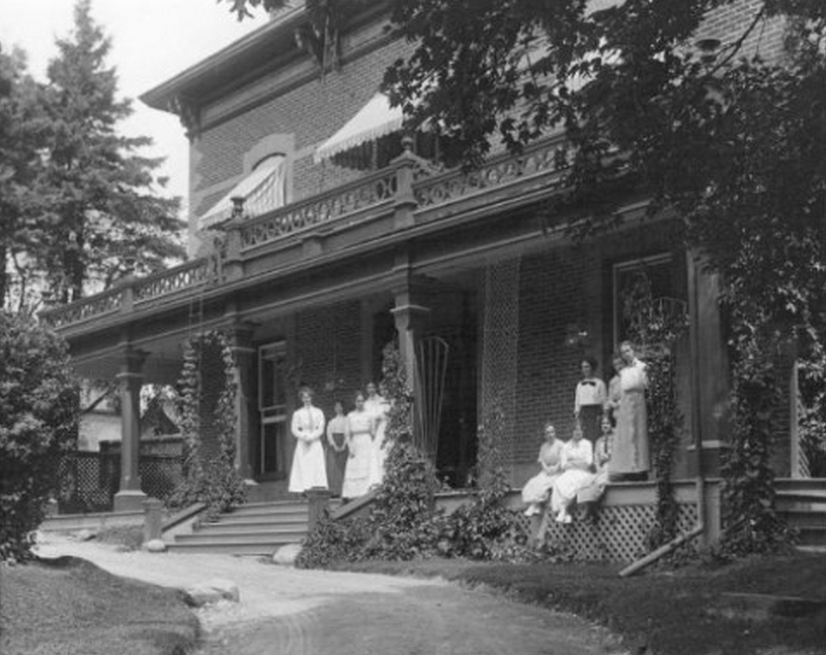
For nearly nine years, Catherine's path through Ontario remains beyond the records we have securely connected to her. Then a marriage record would bring her name back into view.
Photographic archive / Life at HazelbraeInside the home and the departures that followed
These photographs were made at different times and show the institutional setting, not Catherine herself. They offer glimpses of the dormitories and the departures of other girls.
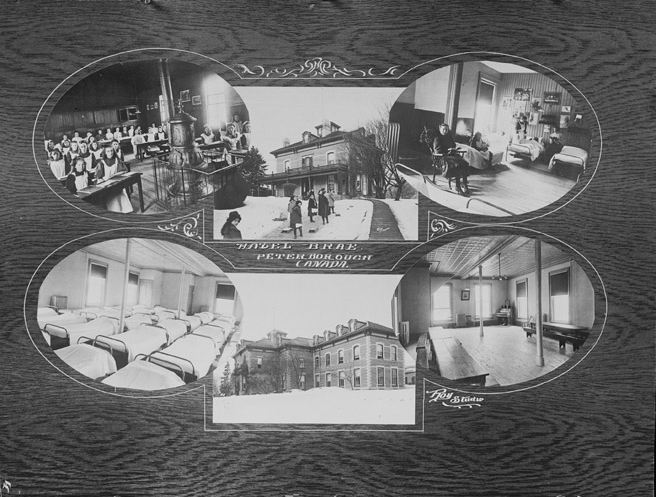
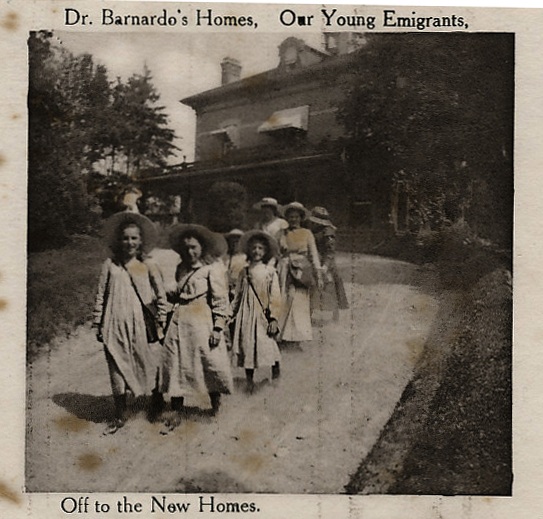
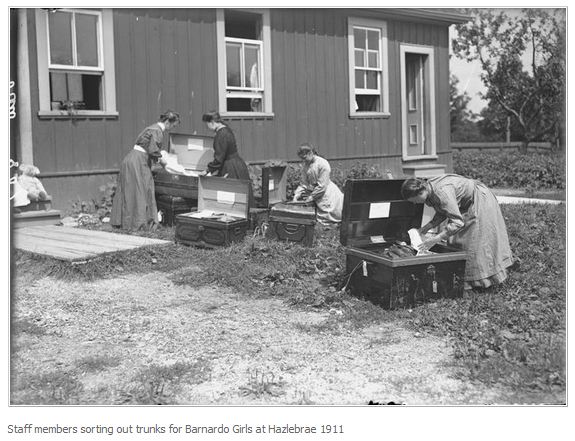
The trunk photograph dates to 1911 and the children shown have not been identified as Catherine or her 1904 party.
King Township, Ontario / April 1913
Two familiar names, an ocean away.
Then, on April 8, 1913, another document brings Catherine into view.
A marriage record from King Township, Ontario.
The bride is Catherine Annie Ayre. The groom is Levi Hilliard.
And there, alongside her name, are two others we have been looking for since Durham.
Thomas and Isabella Ayre.
Twenty years after Catherine's baptism at St Margaret's, their names appear again, this time on the other side of the Atlantic. And beside Thomas's name is an occupation: miner. It recalls the young Thomas Ayre listed as a coal miner in Isabella Bell's Crossgate household in 1881, thirty-two years earlier. The matching name and trade are compelling, even if the identity between the two men is not yet proved.
The affidavit has more to say about the young woman herself. It calls Catherine a domestic worker, reports her residence as King Township and her religion as Methodist, and describes her as twenty and previously unmarried. It describes Levi as a farmer, twenty-three, also Methodist. Their earlier birth records suggest that each was about a year younger than the ages entered here. Isabella is named as Catherine's mother, but no birth surname is recorded for her. The licence and declaration also place the ceremony in King Township on April 8, 1913. We still cannot say where Catherine worked, who employed her, or how she met Levi.
We still don't know what became of them, where Catherine lived in the intervening years, or how she and Levi came to know each other.
But the little girl who crossed an ocean went on to build a life. She married, raised a family, and became part of the lives from which this search began.
Her children would have children. Eventually, those children and grandchildren would become curious about the Scottish orphan in the family story.
She hadn't left them much of an explanation.
But she had left them enough to begin looking.
Research notebook / An evidence-led interpretation
What the records suggest — and what they cannot tell us.
The boy Thomas Ayre who grew up with Isabella Bell is our strongest candidate for Catherine's father, and the 1901 workhouse widow Isabella Ayre is a possible identification of her mother. Neither link is established by a continuous record. The Crawford surname, by contrast, is confirmed in Catherine's civil birth registration. The places, names, and occupations make the reconstruction plausible; they do not reveal what happened within the family before Catherine left England.
Family research / Open questionsFour possible paths through the missing years
A family that could no longer manage.
Perhaps Thomas and Isabella lived together, married or not, while Thomas found work as a labourer or miner. The household might have moved between Durham's industrial districts as employment, rent, or family circumstances changed. By the time Catherine was older, someone may have sought charitable help because the family could not provide for her.
Thomas's recorded occupations fit the region's working economy; Barnardo's received children from families facing economic hardship, including children with living parents.
What is missingNo matched employment, poor-relief or admission record tells us that poverty caused Catherine's departure.
Two parents, but perhaps no marriage.
Thomas and Isabella might have been partners without ever marrying. A baptism could name them both even if Isabella lived elsewhere, retained another surname, or had little support from Thomas. A relationship that later ended could explain why the couple never appears together in a household we can confidently identify.
No marriage entry has yet been securely matched to this couple. Neither the baptism nor Catherine's later Ontario marriage certificate establishes her parents' legal marital status.
What is missingA marriage may exist under different spelling or in another district. We have not proved that they were unmarried, separated, or living apart.
Something happened to one of them.
One parent might have become seriously ill, died, or been unable to work. In a mining district, a workplace injury is one conceivable disruption; other illnesses or family losses could have been just as consequential. A remaining parent or relative might then have struggled to care for Catherine.
Illness, bereavement and interrupted earnings were among the kinds of pressures that brought children into charitable care in this period.
What is missingOur searches have not established a matching death for Thomas or Isabella, any mining accident, or any illness. This is historical possibility, not a family event we can claim occurred.
Catherine may have lived apart from them.
Perhaps her parents moved, formed different households, or relied on relatives and neighbours to care for her. Catherine could have passed between homes before entering Barnardo's system. The empty South Street property in 1901 could simply mean everyone had moved—or that Catherine had long since been living somewhere else.
A single baptism address is not proof of a stable ten-year household. Many Home Children were not orphans, and their routes into care differed.
What is missingWe have not identified a confirmed 1901 household for Catherine, her individual Barnardo intake circumstances, or a relative or guardian responsible for her admission.
Notes from the archive
The records behind the story.
Archival images belong to the historical setting; none identifies Catherine among the photographed children. Family documents remain in the private research collection.
- Durham baptism, 1893. St Margaret's, entry 269, Durham University Library bishops' transcripts DDR/EA/PBT/2/83, p. 34; family archive includes an original page image and transcription.
- South Street censuses, 1891 and 1901. Family's earlier review of Crossgate enumerations; No. 16–17 inhabited by another household in 1891 and listed as uninhabited in 1901. Census scans should be rechecked before claiming precise tenancy or property history.
- 1904 arrival and a later census cross-check. Library and Archives Canada, Home Children item 4905756; female C. A. Ayre, age 10, SS Kensington, Liverpool 19 May–Quebec 30 May, Barnardo girls' party Q04EA, destination Peterborough. The original 1931 King Township census records Roy's mother Catherine Hilliard as England-born and gives 1904 as her year of immigration. The matching year strengthens a probable identification but is not proof that the passenger and the later wife and mother were the same girl.
- Hazelbrae. Home Children Canada registry screenshot and historic Peterborough memorial, both saved in the family archive. They identify Hazelbrae as the distribution home, not Catherine's length of residence or private placement.
- Ontario marriage, 1913. Original Schedule D marriage affidavit/declaration, no. 019836, 8 April 1913, King Township, York County: Levi Hilliard, farmer, twenty-three, bachelor; Catherine Annie Ayre, domestic worker, twenty, spinster; both Methodist; parents named James Hilliard, Sarah Bartlett, Thomas Ayre and Isabella (no mother's maiden surname entered). The provincial licence, no. B 3670, was issued 8 April 1913. The ages differ from their earlier source-based birth chronologies. Both originals were reexamined from high-resolution FamilySearch scans.
- Hett estate survey, 1770. Durham Cathedral Archive, DCD/E/AA/20/1–2. Thomas Ayre is named with plots 96C (Mill and Banks) and 96D (Cottage & Garth); Elizabeth Bell with plot 139 (cottage). Original plan and survey. Exact outlines on the composite illustration are interpretations and not surveyed identifications.
- Ayre and Bell censuses, 1841–1881. Original household images reviewed: 1841 Hett (John and Isabella Bell; Philip Ayre and other paper-making families); 1861 Crossgate, RG 9/3737, p. 40 (Ralph Bell, paper maker; infant Thomas Ayre, boarder); 1871 RG 10/4962, p. 32 (23 Crossgate; Ralph and Thomas); 1881 RG 11/4954, p. 11 (Isabella Bell and Thomas). These documents support the households, not a proved direct descent from the 1770 property holders.
- Historical context. Library and Archives Canada: Home Children; Home Children Canada: Hazelbrae research; and Barnardo's institutional history. Outcomes were varied, and none establishes Catherine's treatment.