Our Family

Zach’s family / Heritage

Many beginnings.
One family.

Before they were our grandparents, their families belonged to different places, languages, and centuries.

There was no single crossing, no single country, no one kind of life that made our family.

Some ancestors lived beside the Rhine and Moselle before their descendants settled in New Jersey. Others built lives in Pennsylvania's farming towns. Some came much later, from Slovak and Galician villages where the borders—and even the names of countries—would change around them.

Eventually, these histories came together in the people we knew as Don, Evelyn, Dale, and Nancy. Four grandparents. Countless lives before theirs.

Follow their four journeys
Rhine & MoselleNew JerseyLehigh ValleyEastern SlovakiaGalicia

Four roads, carried forward

The places behind
the people.

The names on our family tree were once the names of neighbors, farmers, millers, immigrants, tradespeople, and children. Each grandparent inherited a different part of that history. Together, those branches give us a sense of where we came from—and how much life happened along the way.

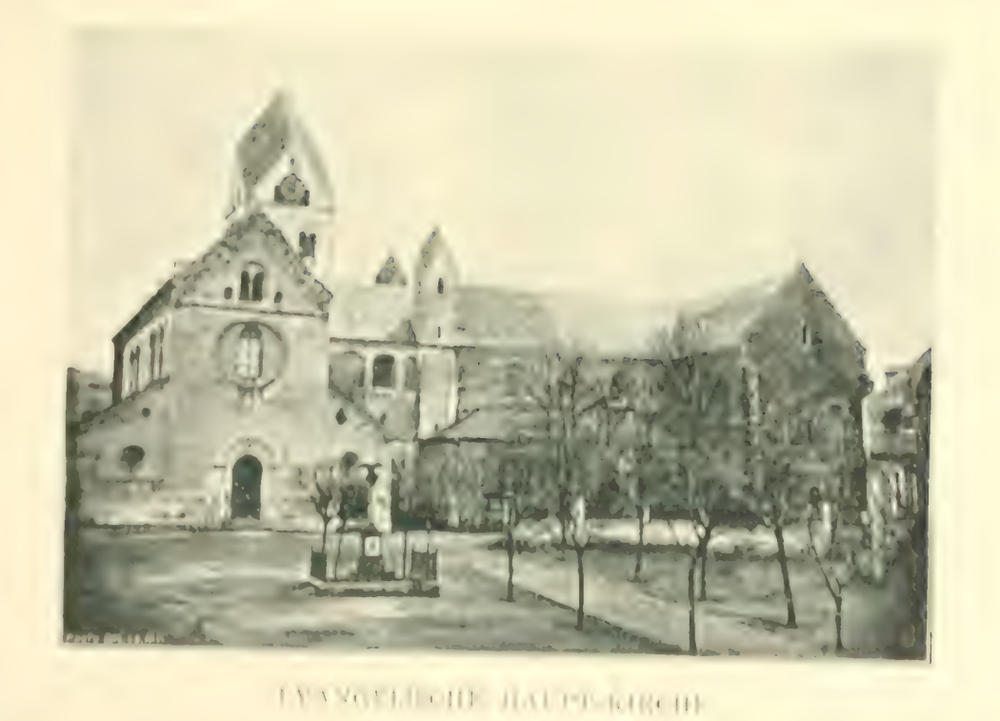
Nineteenth-century illustration of the Bendorf church associated with the Moelich family
Bendorf, on the Rhine · A church illustrated in the 1889 Melick family history

01 / Donald Walter Melick · German-speaking Europe to New Jersey

From the rivers
to Oldwick.

The Melick name began, in one branch of our family, as Moelich in the German-speaking lands near the Rhine and Moselle. Winningen had vineyards above the river; Bendorf was a place of workshops, churches, and trade. Johann Peter Moelich crossed the Atlantic in 1728. His descendants made a life among the farms and mills of New Jersey.

In New Germantown—later called Oldwick—Tunis Melick worked a gristmill that brought neighbors and harvests together. Across generations, the family became part of the countryside. Other lines joined through Dutch-descended New Jersey families, the Craigs, and Don's maternal Beavers ancestors, whose own story reaches to Springdale Farm.

By the time Don was born in 1927, this long history was present in ordinary things: the dairy farm on Homestead Road, the work that had to be done, and a village his family had known for generations.

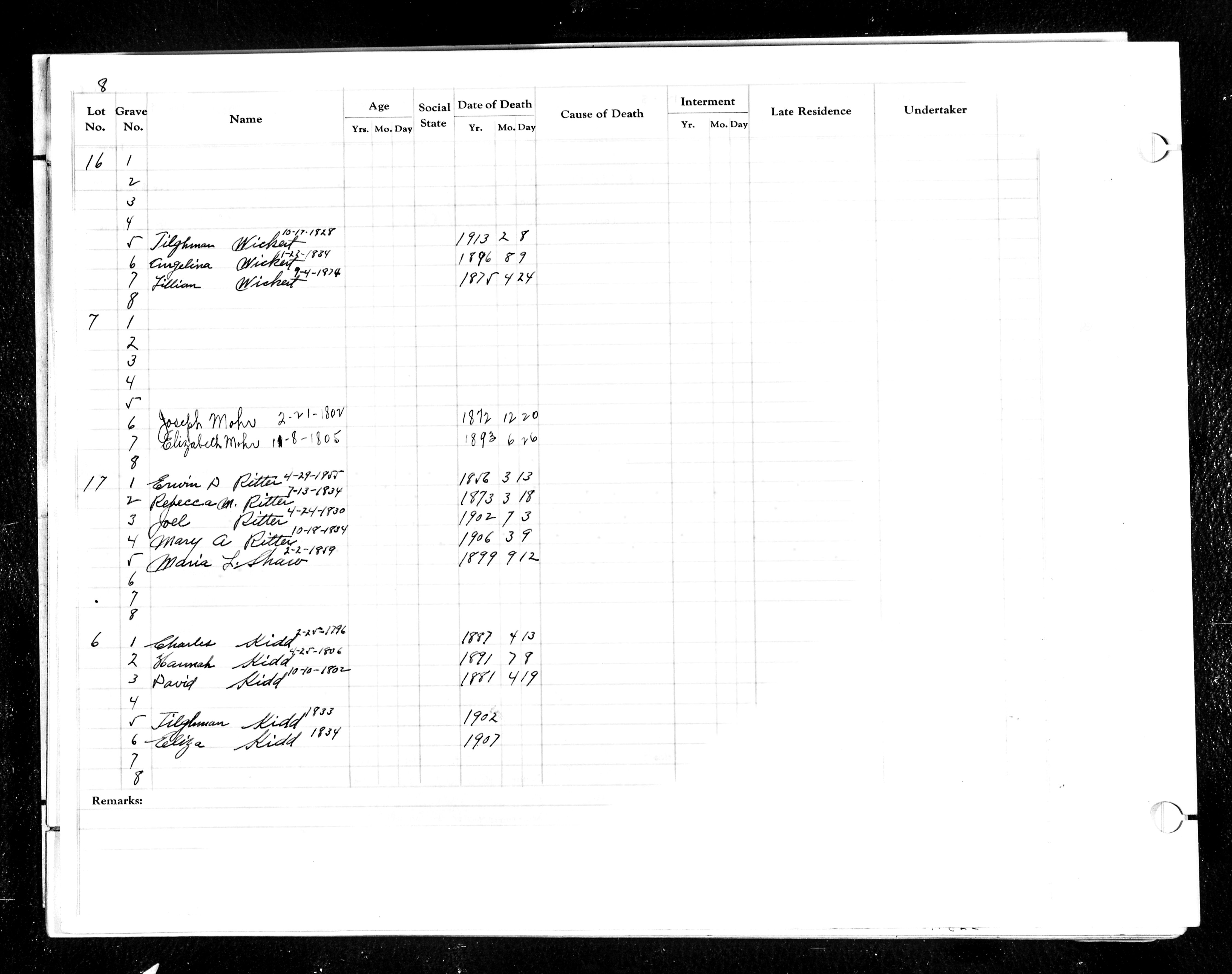
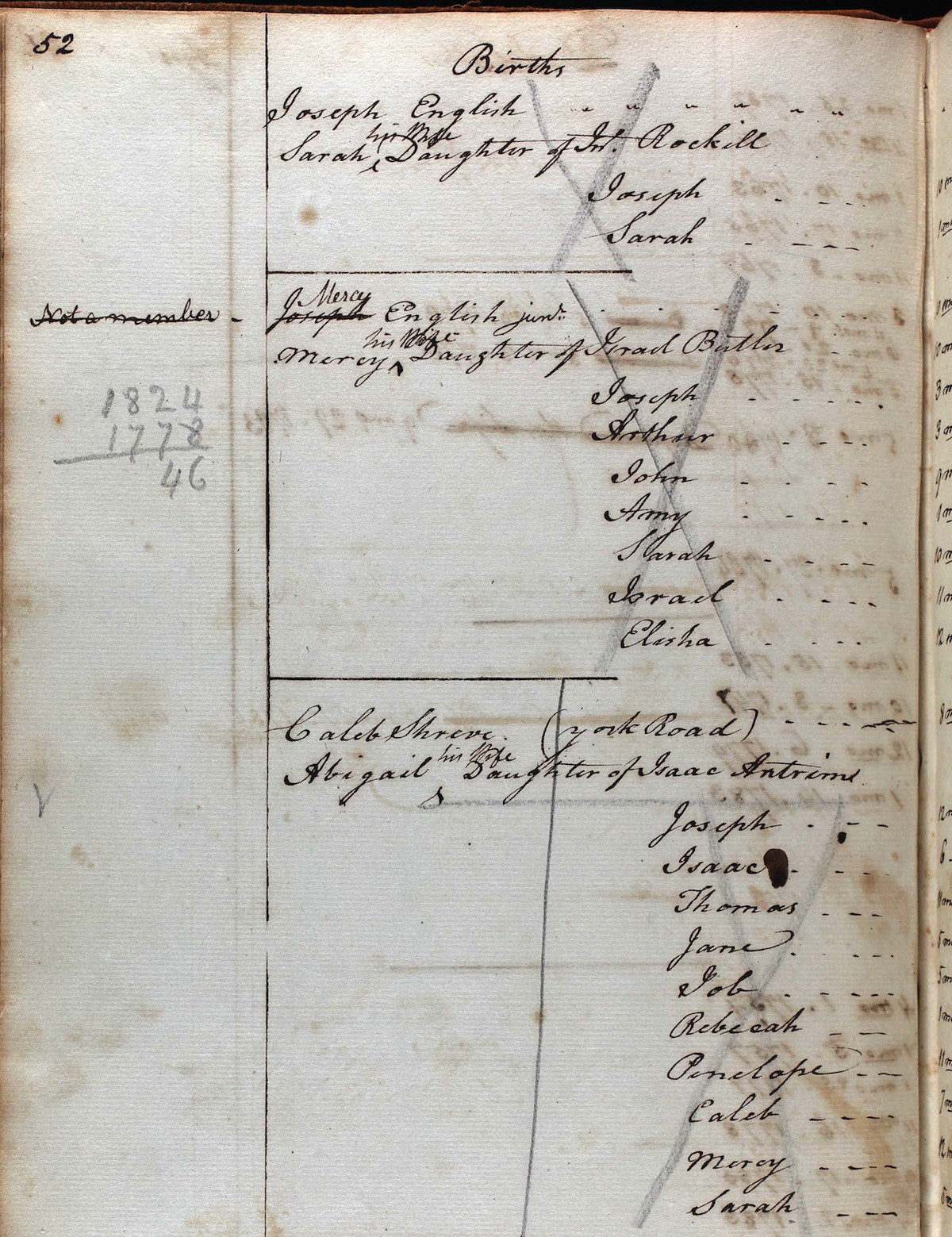
Handwritten register associated with Evelyn's ancestral Shreve family
New Jersey family names · An earlier Shreve register from the family archive

02 / Evelyn Lorraine Kennedy · The older New Jersey countryside

Roots in the
same soil.

When Evelyn Kennedy was a girl, her world was Old York Road in Burlington County, New Jersey. Her father Charles worked as a dairy farmer; her mother Hannah came from the Wainwright family. As with Don, the day began with the rhythms of a working farm, long before the travels and years they would later share.

Behind that childhood lay another New Jersey history. Through the Wainwrights, Evelyn's story runs toward the Carty, Shreve, and Antrim households of early West Jersey, where marriages and family registers kept names alive across centuries. Her relatives were not all farmers or settlers in the same way, but their lives repeatedly met in communities built around land, work, and family.

A small family gesture survives especially vividly: in 1937, William Wainwright's children sent him seventy-five flowers for his seventy-fifth birthday. Ten days later, he died. A century-spanning genealogy becomes, for a moment, simply a family remembering someone they loved.

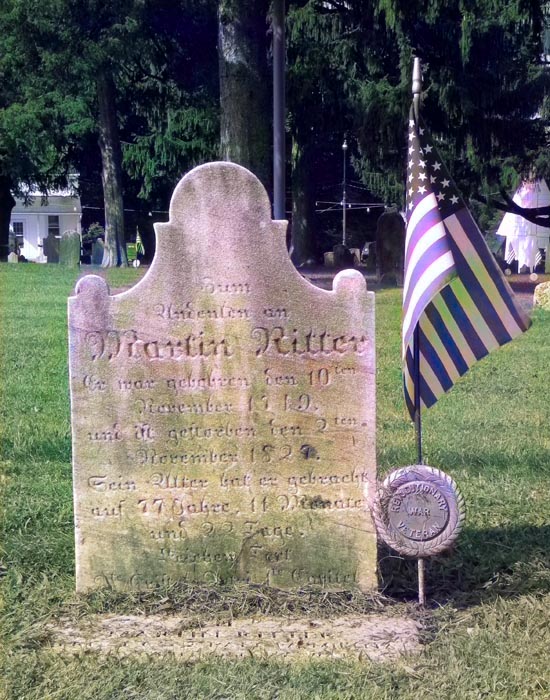
Gravestone of Martin Ritter, whose life spanned colonial and early American Pennsylvania
Pennsylvania, 1749–1827 · A surviving Ritter family marker

03 / Dale C. Ritter · German-speaking villages to Pennsylvania

Across the ocean.
Across generations.

Dale's ancestors carried family names from places such as Zweibrücken and Sigmarswangen, when what we now call Germany was a landscape of smaller states and villages. In Sigmarswangen, an eighteenth-century description counted just thirty-six houses. It is hard to imagine a world more different from the Allentown factories and trucks of Dale's lifetime.

In Pennsylvania, the Ritters, Bilgers, and their neighboring families made homes amid farms, congregations, and small trades. Over time, those lives became part of the larger history of the Lehigh Valley: workshops, railroads, foundries, and manufacturing. The region changed around them, and each generation adapted.

Dale inherited that practical world. He spent decades working at Mack Trucks, knew how to repair almost anything, and found deep pleasure in family, fishing, animals, and the home he and Nancy made on Glen Road. History continued in small acts of care as much as in the great events of the past.

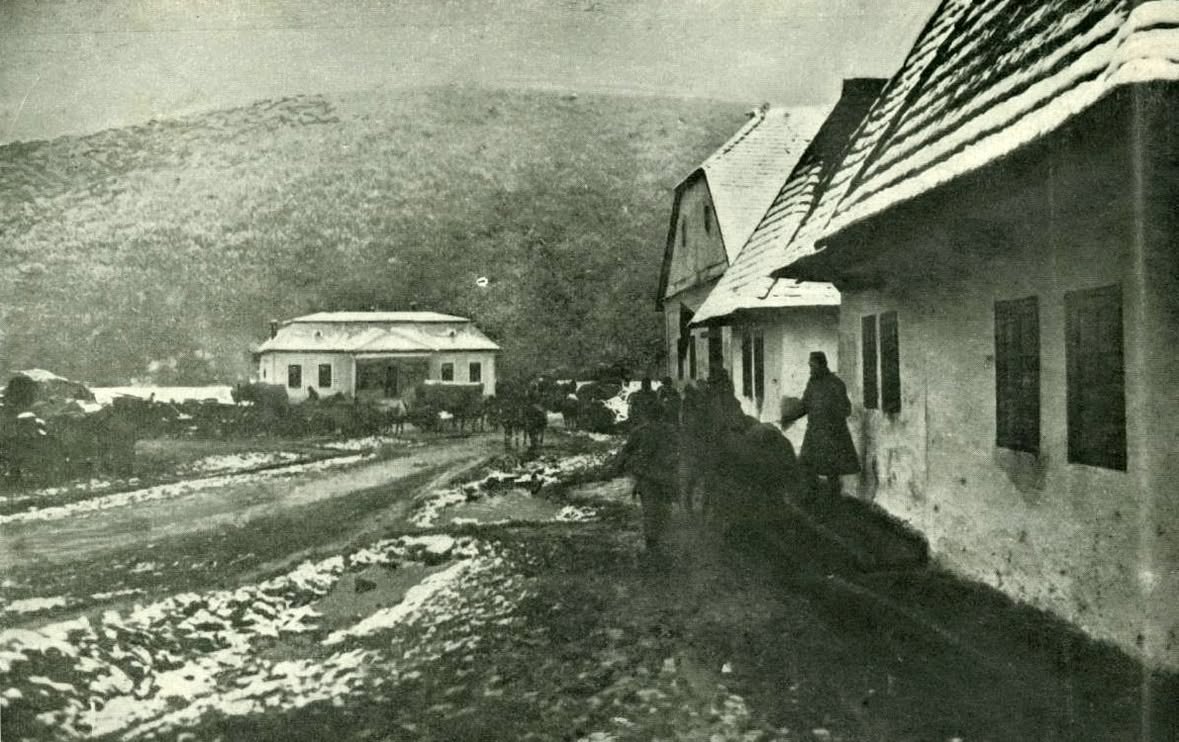
Historic view of Koškovce in present-day eastern Slovakia, one of the villages associated with Nancy's ancestry
Koškovce · A village in eastern Slovakia connected to Nancy's paternal family

04 / Nancy Kovish Ritter · Eastern Slovakia and Galicia to Emmaus

When the borders
kept changing.

Nancy's grandparents and great-grandparents knew a different Europe. The Kovish, Palencar, and Ulicny families had connections to the villages of eastern Slovakia, including Koškovce. The Dwornak and Mruk lines looked toward Skoryki and Juszkowce in historical Galicia, places now in Ukraine. Their homelands belonged to the Habsburg world when they began leaving for America.

They brought languages, faith, work habits, recipes, and family names whose spellings shifted in the new country. In Emmaus and Allentown, ironworks, railroads, churches, and close-knit households became the new geography of their lives. Old country names gradually became American family names.

On July 11, 1936, John Kovish and Anna Dwornak married in Lehigh County. Their wedding joined these two migrations into one family. Nancy was born that October and grew up surrounded by the lives and stories that had made that moment possible.

Where the stories meet

Not one origin.
A shared future.

Don and Evelyn were children of New Jersey farm country. Dale and Nancy grew up with the Lehigh Valley around them, one family rooted in generations of Pennsylvania life and the other shaped by more recent journeys from Eastern Europe.

They would build homes, raise families, work, travel, endure loss, and make memories that never appeared in any history book. The distance between their ancestors' villages and the lives we remember slowly disappeared around family tables, holidays, and ordinary afternoons.

That is the larger story of our heritage: not simply where anyone came from, but how all these lives made room for ours.

Long before usMany places, many households

The Rhine, West Jersey, the Palatinate, the Lehigh Valley, Slovakia, and Galicia.

Across the generationsLives take root

Farms and villages become towns, mills become factories, and unfamiliar places become home.

The grandparents we knewFour histories become ours

Don, Evelyn, Dale, and Nancy carried those earlier worlds into the lives of their children and grandchildren.

These are only some of the roads that brought us here. Each name holds more stories.

Explore the family tree Discover the stories Visit the family archive
For those who want to keep exploringFurther back into Dale's early Pennsylvania ancestryRitter, Bilger, Price, Revolutionary-era history, and linked ancestor profiles

The earlier generations have stories of their own. Follow Dale's families back through European villages, colonial Pennsylvania, and the documents and traditions preserved along the way.

01 / German-speaking Europe

Before there
was Germany.

In the early 1700s, the regions we now call Germany were not one country. Families lived in duchies, principalities and towns within the Holy Roman Empire, each with its own rulers, institutions and traditions.

What would “German” have meant?

The language of everyday life might be a regional German dialect. Identity could be closely tied to a town, ruler, church congregation and landscape rather than to a united nation. The area around Zweibrücken belonged to a Palatine duchy; Sigmarswangen belonged to Württemberg. Those names describe distinct historical territories, even though both places lie in present-day Germany.

Zweibrücken and the Palatinate

The Ritter family's oldest line has been associated with the Zweibrücken region, a landscape west of the Rhine shaped by small states, farming communities and repeatedly disrupted by war. The Palatinate suffered severe destruction during seventeenth-century conflicts and later invasions. For many families across southwestern German-speaking lands, land, taxation, religious life and economic prospects helped shape decisions to leave.

In the early eighteenth century, Pennsylvania became an important destination. Many newcomers were Lutherans or Reformed Protestants, as well as Mennonites, Brethren and other religious communities. The passage across the Atlantic was expensive and difficult; newcomers might arrive with relatives, settle near people who spoke their language, and create new congregations together.

Sigmarswangen: the world of Johann Ludwig Bilger

The Bilger family history names Sigmarswangen as Johann Ludwig Bilger's birthplace around 1730. A regional gazetteer describes this Württemberg village with striking precision: 36 houses in 1730, and 34 of them with a barn beneath the same roof. It was a place where home, livestock and agricultural work existed almost side by side.

The village stood above the Neckar valley near Sulz. It was a small community, governed under Württemberg and connected to parish life, agriculture and neighboring towns. An eighteenth-century Bilger would have recognized the rhythm of the fields and seasons more readily than the later industrial world of Allentown.

Imagine the distance between generations: from a Württemberg house with a barn under its roof to the railroad towns and manufacturing plants where Dale's parents and grandparents worked. The family story spans that entire transformation.

Read more: Sigmarswangen historical gazetteer ↗ NPS · Palatine Germans ↗ Historical Society of Pennsylvania · German migration ↗ Village today ↗

02 / Pennsylvania before independence

A new world,
an older homeland.

When German-speaking settlers entered Pennsylvania in the eighteenth century, they arrived in a place that was already home to Indigenous nations, including the Lenape.

The Lehigh Valley's rivers, trails and fertile land drew settlers, and farms developed alongside mills, churches, workshops and trading towns. German remained widely spoken in homes and congregations; church registers, land records and probate inventories often preserve the names that later became family histories.

Colonial communities were made through families

The Ritter line crossed this period through households associated with Henry, Martin and Daniel Ritter. The Bilger, Price and Bright families joined the larger story through different generations. Marriage connected farms and extended families; occupations connected people to their neighbors and villages.

But the colonial economy also brought dispossession. The Walking Purchase of 1737, engineered by Pennsylvania officials, deprived Lenape communities of extensive eastern Pennsylvania lands. It was not simply a local real-estate transaction: it reshaped the lives of Indigenous people and settlers across the region.

The Lenape are not people of a vanished past. Their communities and sovereign nations continue today, even after forced displacement from large areas of their ancestral homeland. Their history belongs alongside that of the European newcomers who later occupied the same landscape.

Background: Delaware Nation · Lenape history ↗ Penn Museum · Lenape in Pennsylvania ↗

03 / War and independence

The Revolutionary
generation.

The American Revolution came to a Pennsylvania already filled with immigrant families, expanding farms and towns, and competing loyalties.

In 1775 and 1776, volunteers joined local Associator units. In 1777, Pennsylvania introduced compulsory militia service for eligible men. Militia organization was based heavily on county and township, so the records preserve a local map of the war as well as names.

A Ritter name in the militia records

The Pennsylvania State Archives lists Captain Martin Ritter as commander of a Salisbury Township company in the 1783 Northampton County militia organization. It also lists Captain John Ritter in a Moore Township company for 1780 and 1783, and Conrad Reader (Ritter) in Heidelberg Township. These are real entries in the county's surviving military record.

The family genealogy includes a Martin Ritter born in 1749, making the overlap in name and era tantalizing. But the register does not identify the captain's parents or children. We can appreciate that the name appears in the community without assigning his commission automatically to Dale's ancestor.

Militia enrollment was not always the same as marching into combat. Some lists show men subject to service, while actual muster rolls and payment accounts are needed to reconstruct where individuals served and for how long.

The question for the family history: can the Captain Martin Ritter of the 1783 militia list be linked through township, land or probate records to Martin Ritter (1749–1827)? That would turn a fascinating historical parallel into a documented personal story.

Primary record guides: Northampton County militia list ↗ How militia service was recorded ↗ Revolutionary War source guide ↗

04 / A family tradition

The Price family
and a tradition.

One of the most intriguing traditions associated with an early Pennsylvania Price / Preisz family tells of a German immigrant who married a Native American woman near Indian Creek.

The story preserved in an old genealogy

In A Genealogy of the Descendants of Rev. Jacob Price (1926), George F. P. Wanger recorded a tradition about Johannes Preisz (John Price), an immigrant who came to Pennsylvania with his father in 1719. According to the account, Johannes was thought to be frail, and his father encouraged an early marriage. His wife was described in the family story as a Native American woman.

Wanger did more than repeat an anonymous legend. He recorded conversations with Price descendants and earlier local historians, including Abraham H. Price, Abraham H. Cassel and James Y. Heckler. Some regarded the marriage as family fact; others disputed it. The account describes two sons, Daniel and John, and an early family residence in the Indian Creek area.

The newly recovered image of the original printed page 3 supplies a useful genealogical framework: John Price, born in Germany around 1702, reportedly died in 1724 or 1725; his son Daniel was recorded as born December 11, 1723, and marrying Hannah (Johanna) Weicker on May 22, 1746. These details provide documentary leads to follow through church and probate registers. They do not independently verify the earlier marriage to an Indigenous woman.

Read the complete Price tradition and new source page ↗

Who was the woman?

Later online trees sometimes name her Margaret Rebecca, describe her as Unami Lenape, and even identify her father as Netawatwees, a significant Lenape leader. Those specifics do not appear as documented parent-child relationships in the older Price genealogy.

Historian Erin Gotwals revisited the tradition in an essay published by the Johnson-Humrickhouse Museum in 2022. She traced the story through older books, compared it with the known history of Netawatwees, and concluded that the proposed father-daughter relationship has no supporting evidence in the sources she examined. She did not disprove the older family tradition of an Indigenous wife.

The Lenape had long occupied these Pennsylvania homelands, with Munsee and Unami-speaking communities. For Lenape history itself, the most important voices are those of contemporary Lenape nations and their own historical accounts.

How this fits into Dale's family tree

Dale's family tree includes a Price branch through his paternal grandmother, Mamie Price. The early Preisz marriage tradition is worth preserving as an associated surname story. However, the intervening generations connecting this particular eighteenth-century Preisz household to Mamie Price have not yet been documented in the materials available for this edition.

For that reason, we can preserve the remarkable story, read the oldest account, and continue following the Price records without stating that a specific Lenape woman—or Netawatwees—was Dale's proven ancestor.

Two histories can be appreciated side by side: a longstanding Price family tradition, and the independent history of Lenape peoples whose homelands included eastern Pennsylvania. Their possible connection deserves careful family research rather than a claim made solely from an online tree.
Explore: Wanger's 1926 Price genealogy, scanned ↗ Erin Gotwals, “Newcomers,” 2022 ↗ Delaware Nation · History ↗ Delaware Tribe of Indians ↗

05 / Linked family profiles

Meet the
generations.

Every name represents a life. Open a profile to follow family connections, read a shorter biography, and examine the record images that survive.

These profiles bring together Dale's Ritter, Bilger, Bright, Price and Giering lines. Some links have multiple records; others remain names in an older family tree. The page distinguishes those situations in the supporting details, while keeping Dale's biography clear and uninterrupted.

Heinrich (Henry) RitterEarly Pennsylvania · Salisbury Townshipc. 1713–1797

Possible earliest traced Ritter generation

In the eighteenth century, eastern Pennsylvania records place a Henry Ritter among German-speaking households in the area that later became Lehigh County. A 1797 Northampton County probate entry names Martin Ritter as executor of Henry's estate.

Family genealogies identify Martin as Henry's son. Those records connect this household to Dale's paternal line, although the earliest dates and identities require more scrutiny than the later generations.

An immigrant listed as Hendrick Ruyter in 1732 is sometimes merged with Henry Ritter in family trees. The shared or similar names are an interesting clue, but we have not established that the two men were the same person.

Related sourcesPennsylvania estate and probate research ↗Early-line evidence assessment ↗
Continue exploringMartin Ritter →German-speaking Europe →

Working connection

Martin RitterColonial Pennsylvania → Early Republic1749–1827

Paternal ancestral generation

Martin appears in compiled Ritter and Knauss family histories as the son of Henry Ritter and father of Daniel Ritter. The family lived in a part of Pennsylvania where farms, village institutions, and militia companies took shape during the Revolution.

The tavern where the rebellion gathered. On March 7, 1799, opponents of a federal property tax assembled at Martin Ritter's tavern before marching to Bethlehem to release prisoners. Local historical sources identify that building with the later Commix Hotel at West Emmaus Avenue and call Martin both innkeeper and township tax collector. The tavern's role is supported; Martin's personal participation in the protest is not established. Read the full Family Story ↗

The Pennsylvania State Archives also records a Captain Martin Ritter commanding a Salisbury Township militia company in 1783. That is an extraordinary local connection to the family's era, but the captain's identity has not yet been tied conclusively to this Martin Ritter. The historic register is worth reading alongside the family genealogy.

Related sourcesSalisbury Township history · Martin Ritter's tavern, 1799 ↗Commix Hotel · Salisbury Historical Society ↗Northampton County militia officers, 1777–1783 ↗Pennsylvania Revolutionary War records ↗
Continue exploringHeinrich (Henry) Ritter →Daniel Ritter →Fries's Rebellion · 1799 →Revolutionary Pennsylvania →

Tavern and rebellion documented; militia identity and personal involvement unconfirmed

Daniel RitterSalisbury Township · Pennsylvaniac. 1789–1873

Paternal ancestral generation

Born shortly after the Revolution, Daniel belonged to the first generation of the Ritter line growing up in the new United States. He married Lydia Knauss in 1812.

A Knauss genealogy lists Joel Ritter as their son, while federal census material places Daniel and Joel in the same Salisbury Township community. The records connect the eighteenth-century family line to Joel's nineteenth-century world of crafts and Coopersburg village life.

Related sourcesPennsylvania historical records overview ↗
Continue exploringMartin Ritter →Joel Ritter →

Document-supported line

Joel RitterCoopersburg · Farmer and craftsman1830–1902

Dale's paternal ancestor through John Martin

Joel was born to Daniel Ritter and Lydia Knauss in 1830. As the nineteenth century unfolded, he worked in farming, furniture making, cabinetmaking and undertaking. He also held the position of justice of the peace.

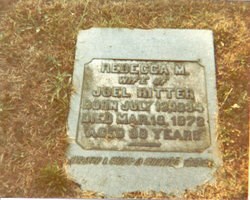
Joel and his first wife, Rebecca Matilda Giering, had nine children, including John Martin Ritter. Rebecca died in 1873. Joel later married Mary Ann Amanda Giering, whose turbulent earlier life included two marriages and the murder of her second husband.

Joel and Mary Ann became involved in the founding years of Coopersburg's Moravian congregation. Meetings in homes, including Joel's, helped give the growing community an institutional home.

Related sourcesCoopersburg Historical Society ↗
Continue exploringDaniel Ritter →Rebecca Matilda Giering →John Martin Ritter →Mary Ann Amanda Giering →

Document-supported line

Rebecca Matilda GieringThe Giering and Ritter familiesd. 1873

Direct ancestor through her son John Martin

Rebecca was Joel Ritter's first wife and the mother of their nine children. One of those children, John Martin, carries Dale's paternal line into the next generation.

Her death in 1873 divided the family story into two chapters: the family Rebecca and Joel raised together, and Joel's later household with Mary Ann Amanda Giering. Both households matter to the history, but Rebecca's role in the direct descent is especially important.

Continue exploringJoel Ritter →John Martin Ritter →Mary Ann Amanda Giering →

Document-supported line

Mary Ann Amanda GieringA Coopersburg family story1834–1906

Joel Ritter's later wife; not the direct ancestral mother

Born in 1834, Mary Ann Amanda's life unfolded through three marriages. Her first husband, James Schumacher, died during the Civil War era; her second husband, David Seem, was killed after a quarrel associated with their wedding.

She married the widower Joel Ritter in 1875, joining the Coopersburg household of a man whose earlier marriage to Rebecca had produced nine children. Their home became connected to the early Moravian congregation, established in 1883.

Mary Ann's story is important in its own right: it is a story of bereavement, rebuilding and community, not simply a link in the ancestry.

Related sourcesCoopersburg Historical Society ↗
Continue exploringJoel Ritter →Rebecca Matilda Giering →

Related family history

John Martin RitterThe next Ritter generation1870–1939

Father of William Henry Ritter

Born to Joel Ritter and Rebecca Matilda Giering, John Martin grew up as the farms and villages of the Lehigh Valley developed into an industrial region.

A 1900 census places a John M. Ritter in Joel's household in Coopersburg. The family line continues through William Henry Ritter, Dale's father.

A discrepancy in one later death record names John's mother as Rebecca Knauss, while other family material identifies Rebecca Giering. The different records can be examined together rather than silently treating one as indisputable.

Continue exploringJoel Ritter →Rebecca Matilda Giering →William Henry Ritter →Mamie Price →

Document-supported line; maternal-name conflict

Mamie PriceA Price surname in Dale's family treeLate nineteenth century

Listed as Dale's paternal grandmother

The site's current family tree identifies Mamie Price as John Martin Ritter's wife and William Henry Ritter's mother. That gives the Price surname a place in Dale's genealogy.

The Price / Preisz family has a particularly memorable early colonial tradition concerning a marriage between a German immigrant and a Native American woman. Whether that early family connects to this Mamie Price through a documented chain of parent-child relationships remains to be established.

The Price story is presented separately rather than assigning an undocumented Lenape ancestor to Dale.

Related sourcesExplore the Price family tradition ↗
Continue exploringJohn Martin Ritter →The Price family tradition →

Lineage and surname require reconciliation

William Henry RitterRailroads → Allentown industry1892–1981

Dale's father

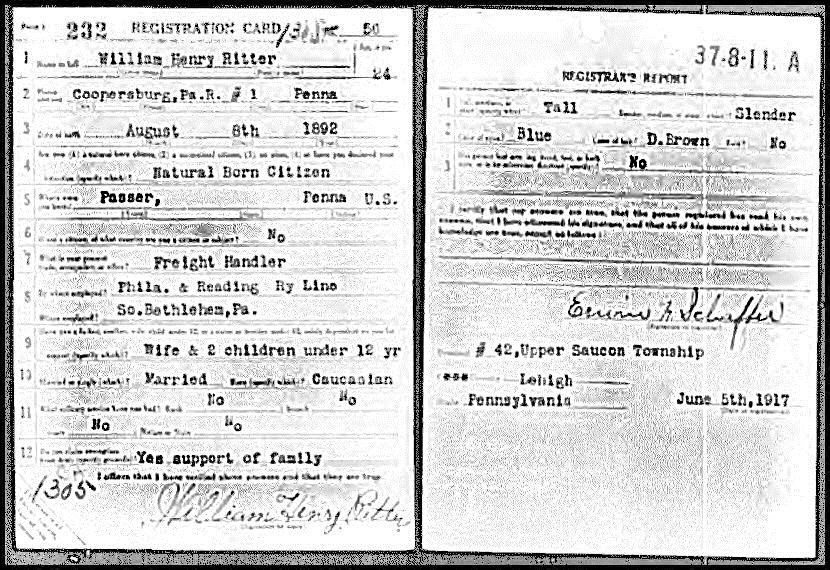
William lived through a dramatic change in the economic life of the Lehigh Valley. In 1917 he reported working as a freight handler for the Philadelphia & Reading Railroad at South Bethlehem.

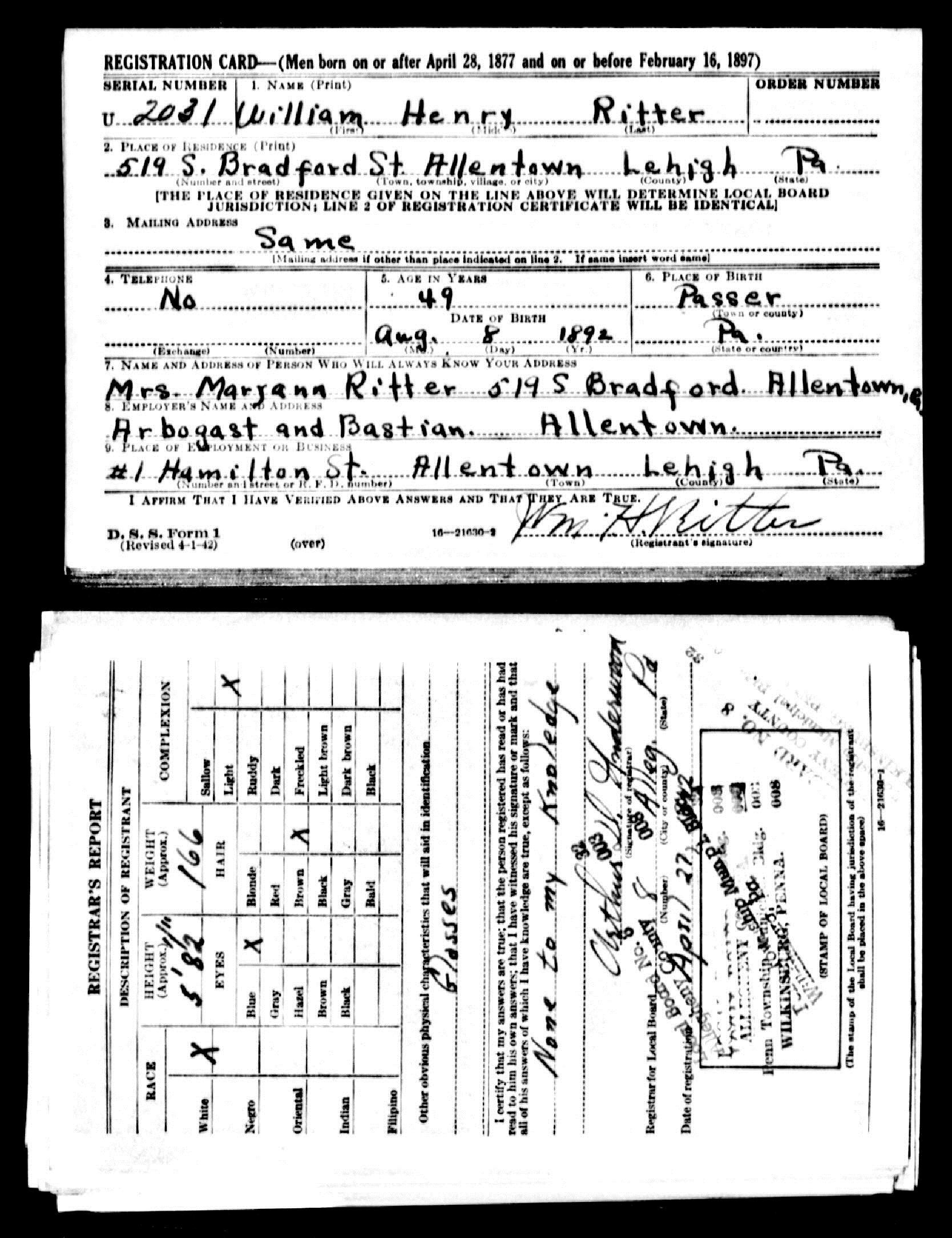
By 1942, when he registered for World War II, he was living in Allentown and working for Arbogast & Bastian, a regional meat-products company. Those two documents place the family inside an increasingly industrial Pennsylvania.

With Mary Ann Bilger he raised ten children, Dale the youngest.

Continue exploringJohn Martin Ritter →Mamie Price →Mary Ann Bilger Ritter →

Primary family documents

Johann Ludwig BilgerSigmarswangen · Württembergc. 1730

Early generation of the Bilger family

The family genealogy places Johann Ludwig Bilger's birth around 1730 in Sigmarswangen, in what is now Baden-Württemberg, Germany.

A Württemberg regional historical gazetteer recorded 36 houses in Sigmarswangen in 1730, with barns under the same roof as the dwelling in 34 of them. That extraordinarily specific detail brings the farming village world of the Bilger family's early story into focus.

Sigmarswangen belonged to the Duchy of Württemberg; it was not yet part of a unified German nation. Village life unfolded under a territorial ruler, parish institutions and an agricultural economy.

Related sourcesLEO-BW historical gazetteer · Sigmarswangen ↗Village today · City of Sulz ↗
Continue exploringJonas Bilger →German-speaking Europe →

Family-tree birthplace; historical setting documented

Jonas BilgerNineteenth-century Pennsylvania1831–1909

Bilger family branch

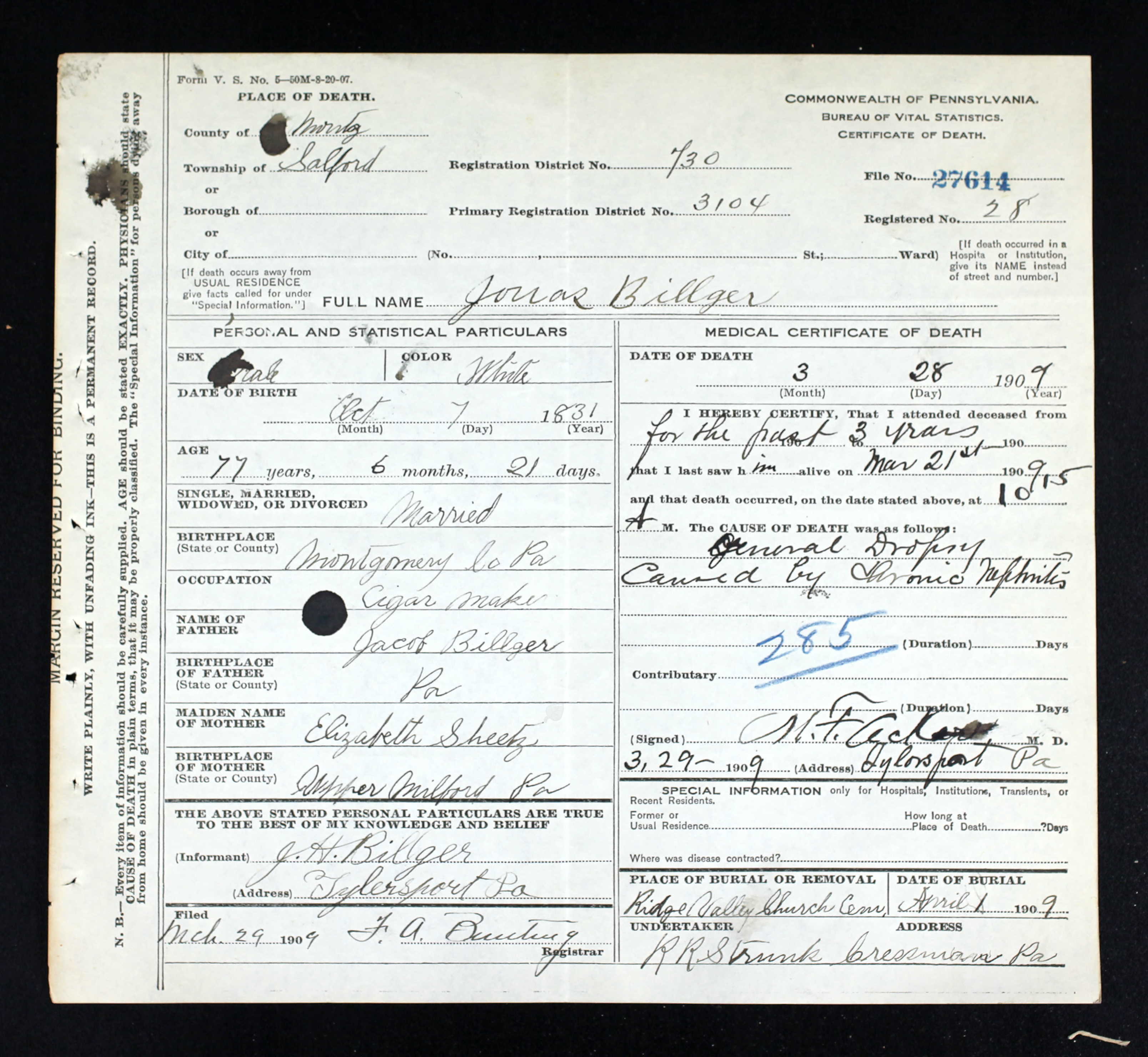
Jonas Bilger's death certificate places him in Pennsylvania's nineteenth-century world of skilled and small-scale trades. His work was recorded as cigar maker, one of the occupations that flourished alongside farms and mills.

His name also appears in the family's records of the Bilger generations that eventually led to Dale's mother, Mary Ann Bilger.

Continue exploringJohann Ludwig Bilger →Hiram Bilger →

Family document

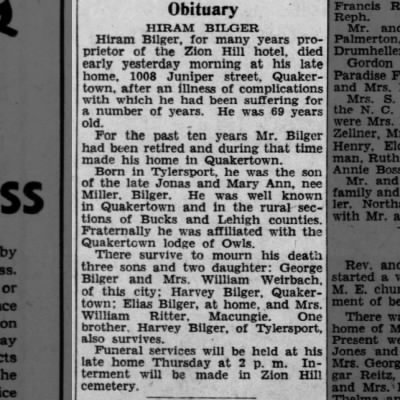
Hiram BilgerLehigh Valley familyDied 1934

Dale's maternal grandfather

Hiram Bilger and Hannah Bright connect the maternal branches that joined the Ritter family through their daughter Mary Ann Bilger.

An obituary preserved in the family archive provides a direct way into Hiram's life rather than treating him simply as a name at the top of a family tree.

Continue exploringJonas Bilger →Hannah Bright →Mary Ann Bilger Ritter →

Family document

Hannah BrightBright → BilgerMaternal family generation

Dale's maternal grandmother

Hannah Bright married Hiram Bilger. Their daughter Mary Ann Bilger became Dale's mother, bringing the Bright family into the Ritter story.

The Bright line deserves its own deeper investigation. The existing published archive establishes Hannah's place in the family tree but does not yet offer the same range of records as the Ritter and Bilger branches.

Continue exploringHiram Bilger →Mary Ann Bilger Ritter →

Family-tree relationship

Mary Ann Bilger RitterThe mother of ten children1890s–twentieth century

Dale's mother

Mary Ann Bilger married William Henry Ritter. They raised a family of ten children between 1914 and 1936, with Dale the youngest.

Through Mary Ann, Dale inherited the Bilger and Bright lines. Through William, he inherited the Ritter and Price lines. Their household joined histories that had developed over generations in eastern Pennsylvania.

The date of Mary Ann's death is inconsistent across existing family summaries and should be reconciled against the grave or death record before a definitive year is assigned here.

Continue exploringHiram Bilger →Hannah Bright →William Henry Ritter →

Immediate family; date reconciliation pending

More family branches and individual source documents can be added here as the original RootsMagic export and supporting scans are incorporated.

Behind every surname is a household, a landscape, and a world of its own.