At ten o'clock on the morning of March 7, 1799, people began assembling at a tavern on the road between Emmaus and Mountainville. Some arrived as members of mounted volunteer companies. They were there to decide what to do about men being held by federal authorities in Bethlehem. Before the day was over, a company had set out to secure their release.
This was not a meeting in an anonymous public house. The building was known as Martin Ritter's tavern. Martin, born in 1749, stands in the direct ancestral line leading to Dale Ritter. The meeting placed a family-connected property at the center of one of the early United States' most consequential disputes over taxation and federal authority.
A new nation, an unfamiliar tax
Only a little more than two decades had passed since the Declaration of Independence. George Washington had left office; John Adams was president. The United States was engaged in an undeclared naval conflict with France, and Congress had authorized a direct tax on houses, land and enslaved people to support national defense.
In this Pennsylvania German region, the levy became especially visible when assessors arrived to measure and count the windows of houses. It was a new kind of federal presence at the door of an ordinary household. Farmers who had spent years improving their properties feared that the system would penalize them compared with owners of unimproved land. Resistance spread through villages and agricultural townships around the Lehigh Valley.
The confrontation was not simply a disagreement over a bill. It raised questions that the new republic had barely begun to answer: How far could a national government reach into local communities? What did resistance mean after independence had been won? And when did a protest against a tax become defiance of the law?
The meeting at Ritter's
In early March, U.S. Marshal William Nichols detained men who had resisted the tax's enforcement and held prisoners in Bethlehem. Their arrest galvanized opponents of the levy. A meeting was called at Ritter's tavern for 10 a.m. on March 7. Among those who assembled was a mounted company commanded by Captain Henry Jarrett, a prominent participant in the protests.
According to W. W. H. Davis's 1899 history, those gathered decided to proceed to Bethlehem. Once underway, the group selected Andrew Shiffert as its commander. A few attendees questioned the action, but the others were determined to continue. Other protesters, including men under John Fries, were already mobilizing from nearby communities.
The crowd succeeded in securing the prisoners' release. But the episode would not end at the tavern door. President Adams issued a proclamation against the armed resistance, and federal troops were sent into Pennsylvania to enforce the law and arrest participants.
The owner and the tax collector
The most unexpected detail in the family connection is that Martin Ritter was himself described as a tax collector in Salisbury Township. The same man whose name identified the meeting place held a local office concerned with collecting taxes. That makes the tavern more interesting—and Martin's own position less straightforward—than a simple tale of an ancestor leading an uprising.
Local histories identify Martin as the tavern's proprietor and date him 1749–1827, matching the man in the Ritter family genealogy. They document the gathering at his establishment, but do not establish that he summoned the crowd, spoke at the meeting, marched on Bethlehem, or supported its aims. An April 7, 1799 list of detained or summoned participants does not include Martin; the list is limited and cannot establish that he was absent. His personal role remains unknown.
What can be said is powerful enough: a tavern belonging to a direct family ancestor became a place where local people decided to challenge the authority of the federal government.
The building remembered as the Commix Hotel
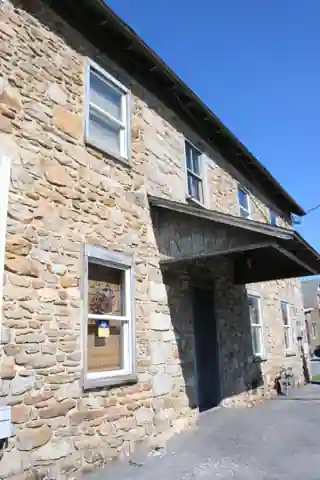
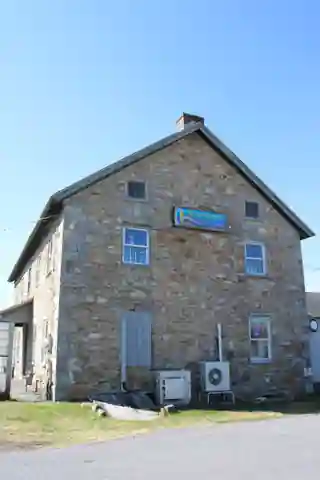
The building was constructed in the later eighteenth century, with stone walls and the Germanic architectural character typical of the area. Much later it became known as the Commix Hotel, at 3245 West Emmaus Avenue in Salisbury Township, near Allentown. The Salisbury Township Historical Society identifies the surviving structure with Martin's former tavern and the 1799 gathering.
Among the surviving family media are two photographs dated March 27, 2021, in the family tree. One shows the long fieldstone side of the building and its entrance canopy. The other shows its gabled end beneath a sign reading “COMMIX.” These are modern photographs of a historic site, not eighteenth-century views. The older stonework is a remarkable physical connection, even as the windows, signage and fittings reflect later uses.
Two centuries after the gathering
Original photographs dated March 27, 2021, in the RootsMagic collection. These are photographs of the real stone building, not reconstructions of the meeting in 1799. Select either image for its archive record and link to the full-resolution original.
From protest to treason trial
John Fries, a Pennsylvania auctioneer and Revolutionary War veteran, became the rebellion's most familiar name. He was prosecuted for treason, convicted and sentenced to death. After legal proceedings that included a new trial, President John Adams pardoned him. In May 1800, Adams also issued a broader proclamation of pardon to participants in the uprising.
The events became known as Fries's Rebellion, sometimes the Hot Water Rebellion. For contemporaries, the struggle was about more than the amount of a tax. Federal judges treated armed resistance as a challenge to the survival of the republic's institutions. Protesters viewed the government's methods as an intrusion upon liberties they believed independence should have protected.
Back in Salisbury, the tavern continued to stand. A township history mentions Ritter's tavern in 1812–1813 road records and includes Martin Ritter on an 1818 list of tavern licenses. Those later traces give his establishment a history beyond the gathering. Its role in the rebellion was eventually incorporated into local historical tours.
Why Martin belongs in the family story
Martin's family is linked through his son Daniel Ritter, grandson Joel Ritter, great-grandson John Martin Ritter, and the later generations that lead to Dale. The house where people gathered in 1799 belongs to that long chain of Pennsylvania lives.
A gravestone gives us Martin's name and years. A family genealogy places him among Dale's ancestors. A township history adds an occupation, a building, a date, and a gathering that put the property into the national story. The documents do not tell us what Martin himself thought as those people assembled. They do something just as valuable: they put one of the family's ancestors in a real place at a remarkable moment in American history.
Sources & original records
The relationship to Dale is based on the family tree. The tavern's historic role and identification as the Commix Hotel are corroborated by township and local historical sources. Those sources do not identify Martin as a participant in the march. An 1899 history recounts the tavern meeting but says its author could not establish the tavern's precise location; later local histories identify it with the Commix property.
- William L. F. Schmehl, Salisbury: Born the Year the Liberty Bell Was Hung and Rung, 1753, section “The Fries Insurrection,” pp. 54–55, and “Taverns,” pp. 38–39. Identifies Martin Ritter (1749–1827), local tax collector, tavern owner and March 7 meeting.
- Salisbury Township Historical Society, Historic Sites of Salisbury Township. Describes the surviving Germanic stone tavern, Martin's ownership and its role in the rebellion.
- W. W. H. Davis, The Fries Rebellion, 1798–99 (1899), pp. 54–56. Early historical account of the gathering at Ritter's tavern and the subsequent march; notes uncertainty over its precise location.
- April 7, 1799 list of insurgents, Papers of the War Department, George Mason University. A list of people detained or bound to appear, not a complete list of marchers; Martin Ritter is not named.
- Federal Judicial Center, Case of Fries (1799). Trial, treason-law context, second proceedings and pardon.
- President John Adams, pardon proclamation, May 21, 1800. Text preserved by the University of Virginia Miller Center.
- Discover Lehigh Valley / Lower Macungie Township Historical Society, Fries Rebellion historic sites guide. Identifies the Commix Hotel and contemporary site address.
- Melick Tree v3 and original family photographs IMG_6003 Commix Hotel and IMG_6004 Commix Hotel, dated March 27, 2021 in the tree. The website displays reduced-resolution previews; the archive records link to the full-resolution originals.