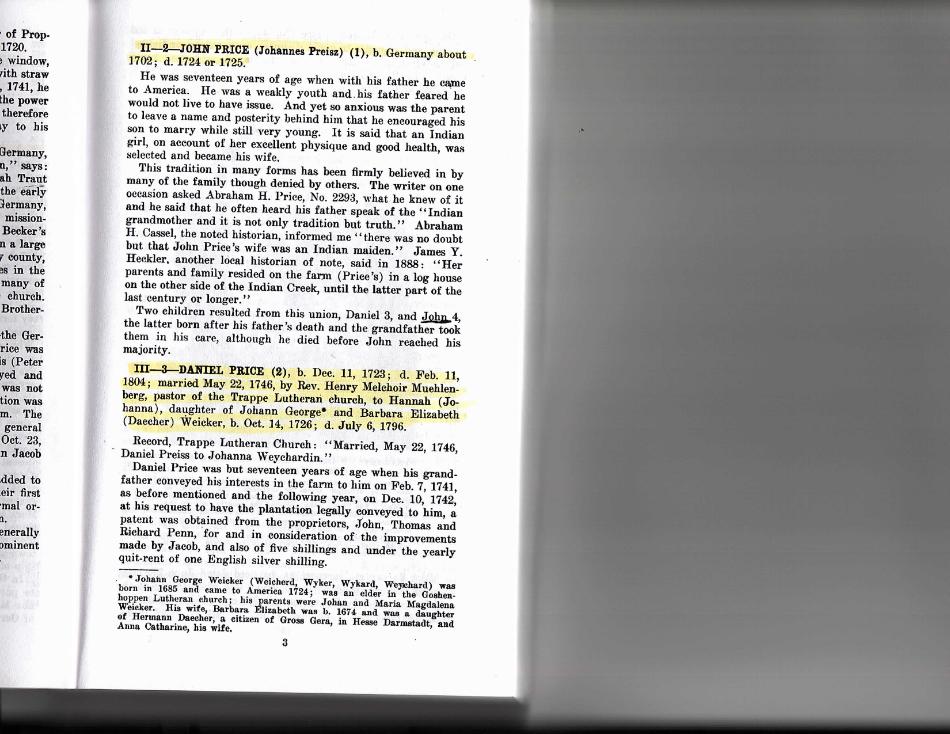
For generations, members of the Price family passed down a story about Johannes Preisz, a young man who had crossed the Atlantic from Germany. The tradition said he married an Indigenous woman in colonial Pennsylvania. The earliest account we have reviewed tells us just as much about the family remembering this marriage as about the marriage itself.
The young immigrant
On page 3 of A Genealogy of the Descendants of Rev. Jacob Price (1926), George F. P. Wanger identifies John Price (Johannes Preisz) as born in Germany around 1702 and dying in 1724 or 1725. The account says that Johannes had arrived in America with his father at seventeen and was in fragile health, so his father wanted him to marry young and leave descendants.
Wanger then reproduces a family story that a young Indigenous woman, remembered for her health and physical strength, became his wife. The language of the 1926 account reflects how its author and sources spoke about Native people; it is not evidence of the woman's own name, community or identity.
Believed by some. Denied by others.
The writer did not present the tradition as uncontested. He reported asking Abraham H. Price, a descendant, and hearing that it was a story his father often told. The historian Abraham H. Cassel believed that John Price's wife was Indigenous, while James Y. Heckler, writing in 1888, placed her family near the Price farm and Indian Creek.
“This tradition in many forms has been firmly believed in by many of the family though denied by others.”— The 1926 genealogy, printed p. 3
These are named memories and historians' reports, preserved in a book published long after Johannes's death. They demonstrate that the story was circulating within and around the family. They do not by themselves supply a contemporaneous marriage register, a documented name for the woman, or evidence for a particular tribal affiliation.
Two sons named in the account
The genealogy says the couple had Daniel and John, the younger boy reportedly born after his father's death. Their grandfather took an interest in raising them, according to the story.
Daniel is assigned a marriage on May 22, 1746, to Hannah (Johanna) Weicker, performed by Rev. Henry Melchior Muhlenberg of Trappe Lutheran Church. These are detailed genealogical assertions with potential baptism, church and property records to examine.
Daniel's later entry offers a much firmer starting point for tracing the Price generations. It still does not independently establish his mother's identity or prove the disputed aspect of the earlier marriage story.
What the Lenape claim does—and does not—say
Later online trees have attached names such as Margaret Rebecca, an Unami Lenape identification and even a proposed father, Netawatwees, an important Lenape leader. Those details are not supplied by the 1926 genealogical passage.
Historian Erin Gotwals reassessed the proposed Netawatwees relationship in a 2022 Johnson-Humrickhouse Museum essay and found no documentary support for it among the sources she studied. That does not categorically disprove the older marriage tradition; it means the specific identification should not be adopted as fact.
Lenape peoples were and remain nations with histories distinct from the Price family's recollections. Their history should not be reduced to an unverified ancestry story, and a general term used in the 1926 source should not be rewritten into a confident tribal identification.
Where this story meets Dale
Our family tree includes Mamie B. Price Ritter, a grandmother in Dale Ritter's paternal line. The intervening father-to-child chain connecting her specifically to this Johannes Preisz household has not been demonstrated in the sources reviewed here. The story therefore belongs to the family's Price research and oral traditions, not yet to a proven line of Indigenous ancestry.
That may sound less conclusive. But it is also more faithful to the surviving source: a book in which relatives themselves disagreed, and a historical claim we can still investigate without pretending the questions are solved.
Sources and limits
- George F. P. Wanger, A Genealogy of the Descendants of Rev. Jacob Price (1926), printed p. 3, entries II-2 (John Price) and III-3 (Daniel Price). The user supplied a scan of the original printed page; the older extract supplied earlier reproduces the same passage. Open the full scanned genealogy ↗
- The source image above is a resized reproduction of the original printed page 3 supplied by the family. The underlying manuscript/master scan remains in the research collection, and the entire volume is available through the full-book link.
- The printed genealogy reports named Price-family reminiscences and local historians' accounts of an Indigenous marriage, and supplies dates for Johannes and Daniel and Daniel's later marriage. It contains no documentary name, tribal identity, or verified ancestry for the unnamed woman.
- Erin Gotwals, “Newcomers,” Johnson-Humrickhouse Museum (2022), historical reassessment ↗. For Lenape history independent of the Price tradition see the Delaware Nation's own history ↗.
- The user's existing GEDCOM documents Mamie Price Ritter in Dale's line. A verified generation-by-generation connection between Mamie and Johannes Preisz is not included in the examined records.