In the margin of an old burial register, a clerk wrote the number 17. Beside it are five numbered grave spaces and a series of names. The page was made to account for burials. Read beside the family tree, it becomes a record of marriage, death, remarriage and memory.
Some source records come with full sentences. This one uses ruled columns for a name, a date, an age, and a place of interment. Many columns were left blank. The handwriting can be difficult to decipher, but three entries are especially clear: Rebecca M. Ritter, Joel Ritter, and Mary A. Ritter.
The wife who came first
Joel Ritter, born in 1830, was a farmer and cabinetmaker in the Coopersburg area. His first wife was Rebecca Matilda Giering. They had children, including John Martin Ritter, through whom Dale's direct line continued.
Rebecca died in 1873. In the lot register, her name is followed by the death date March 18, 1873. It gives a formal shape to a loss that must also have altered the practical life of a home with children still growing up. The document establishes a date and a burial entry; it cannot tell us what was said or felt in the house afterward.
A surviving photograph of Rebecca's grave marker is also part of the family archive. The stone and the register are different witnesses: one commemorates a person in a physical place; the other records how the cemetery accounted for her burial.
The household changed
Joel later married Mary Ann Amanda Giering, a woman whose life had already included more than one devastating loss. She had been widowed before; one of her husbands, David Seem, was killed following a dispute remembered in local accounts. Dale's biography gives Mary Ann a section of her own, because her experiences deserve more than a footnote in Joel's life.
There is an important genealogical distinction here. Rebecca was the mother of Dale's direct ancestor, John Martin Ritter. Mary Ann Amanda was Joel's later wife and part of the household's history, but she was not John Martin's mother. Both relationships belong to the family story, even though they are not the same kind of ancestral connection.
One page, different generations
In the register, Joel's own name carries the death date July 3, 1902. Mary A. Ritter appears with March 9, 1906. Those dates correspond to the genealogical accounts for Joel and Mary Ann Amanda. Nearby are other names and dates that may offer further connections, but the handwriting and their relationship to the family should be checked before assigning them to new ancestor profiles.
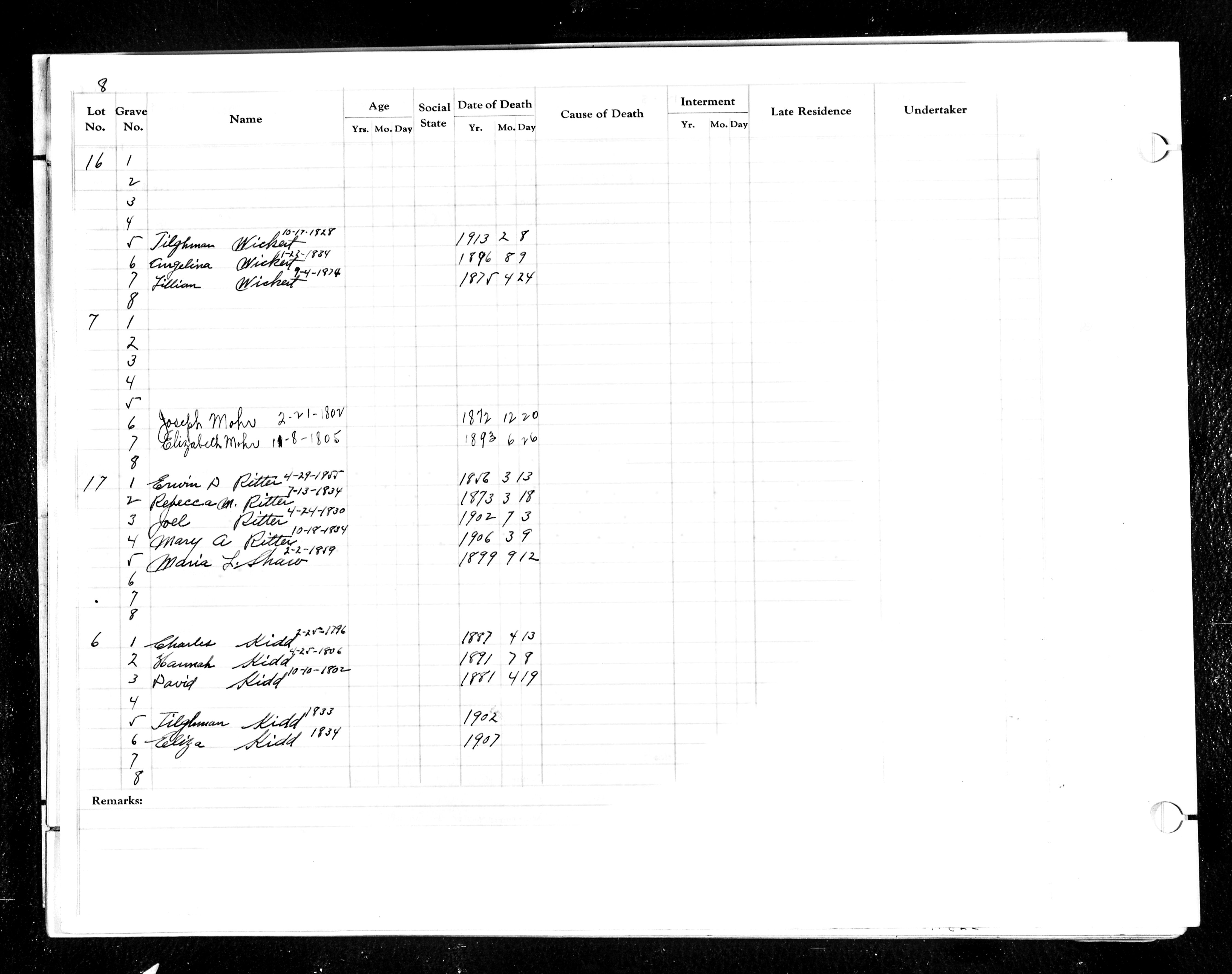
Registers were not written to tell a satisfying story. Their purpose was to mark burials accurately and manage spaces. That is precisely why they are valuable: they preserve details a later family history might simplify, overlook or arrange too neatly.
A conventional family tree can place Joel at the center and Rebecca and Mary Ann on either side. This document does something else. It preserves the people together in the same small section of a cemetery ledger, while keeping each name and date distinct. It reminds us that a family was never just a line of descent. It was also a sequence of households, changing relationships, and people who shared a place in the community.
The paper and the lives
The register doesn't tell us what kind of husband Joel was, how Rebecca's death affected their children, or how Mary Ann found her place in the Ritter home. Other sources can take us further: church and burial records, census pages, local histories, and stories passed down in the community.
But lot seventeen gives us a beginning for that work. It asks us to look at the names together and still see them as individuals. It gives Rebecca her own date; Joel his; and Mary Ann hers. Even a ledger made for keeping track of cemetery plots can restore complexity to a family story.
Sources & original records
The burial register directly establishes what is written on this page, including the lot grouping and dates. Identifying the wives and explaining their relationships requires the separate family tree and biographical evidence. The unnamed cemetery must not be inferred from the image alone.
- Ritter family cemetery lot register, page 8, lot 17. Entries visible for Rebecca M. Ritter (1873), Joel Ritter (1902), Mary A. Ritter (1906), and others requiring further identification.
- Rebecca Giering Ritter gravestone photograph.
- Dale's documented Ritter family generations and Mary Ann Amanda's chapter for the relationship history and context.
- Family origins and evidence pages for additional Ritter source context.