
A life across two countries / c. 1868–1943
Before he crossed an ocean, Walter Mitchell knew a smaller world.
He was born in eastern Berkshire, where the countryside around Fifield and Bray lay only a few miles from Windsor. There were old parish churches, hedged fields and villages whose rhythms followed the agricultural year. But the country was changing. Railways connected communities to growing towns, and the demand for building materials turned the clay beneath Berkshire's fields into a valuable commodity.
The young Walter would become a brickmaker, then a soldier. His regiment would carry him across the Mediterranean and the Atlantic, to islands he had never known and finally to a Canadian harbour. In Ontario, the journey would give way to a marriage, children, work and the long, ordinary years of a family life.
Decades later, he would wear a uniform once more. Yet the greater part of his life would unfold far from the army, in the place he chose to call home.
I / The brickmaker's country
The Brickmaker's Country.
Walter's parents were William Mitchell and Mary Ann Smith. In the spring of 1871, the census found a two-year-old Walter in their household at Bray. His early years passed during the long Victorian expansion, when Britain's cities were growing and families in the surrounding countryside increasingly depended on the trades that supplied them.
Brickmaking was one of those trades. Around Warfield and Bracknell, clay pits and brickyards provided employment to men whose work transformed raw earth into the materials of a changing country. Clay was dug, shaped, dried and fired. Kilns required tending, and newly made bricks had to be moved and stacked. Much of the work was repetitive, physical and seasonal, carried out in conditions far removed from the grand buildings the finished bricks might eventually become.
Walter would later describe himself as both a labourer and a brickmaker. He came of age in a district where such work was familiar and where a young man's prospects were often measured by the employment available close to home.
By the time he reached adulthood, however, Walter was looking beyond Berkshire.
The British Army offered something the brickyards could not: regular military employment, a place within a regiment, and the possibility of seeing parts of the world that most people in his home parish would know only by name.
In September 1887, at about nineteen years old, he joined the 3rd Royal Berkshire Militia. His attestation placed his birth at Fifield, his residence at Warfield, and his occupation among the labouring trades.
Two years later, he made the more consequential commitment. On 25 June 1889, Walter Mitchell enlisted in the regular Royal Berkshire Regiment at Reading.
He was assigned the number 2727.
The brickmaker from Berkshire had become a soldier.
II / The regiment
The Regiment.
The British Army Walter entered was an institution built around discipline, tradition and movement.
For much of the nineteenth century, British infantry regiments had served not only at home but across a vast network of overseas stations. Garrisons occupied fortified harbours, guarded strategic routes and maintained Britain's military presence in territories separated by thousands of miles. The Royal Berkshire Regiment belonged to that world.
Its soldiers were drawn from towns and villages, farms and workshops. Some came for steady pay, others for opportunity or the promise of adventure. Whatever brought them to the recruiting office, the regiment imposed a common routine. Men learned to march together, maintain their equipment, follow orders and live within the closely regulated society of a military barracks.
There was little privacy. Daily life revolved around inspections, drill, cleaning, meals, guard duties and the authority of officers and sergeants. Uniforms had to be kept presentable, weapons maintained and equipment ready. The regiment became an organizing fact of life, determining not only what a man did but where he lived and when he moved.
Walter spent his first years in the regular army in Britain. Then, in March 1891, his service took him away from home.
He was bound for Malta.
The journey marked the beginning of nearly five and a half years spent at overseas military stations. Walter had entered the army from an inland county in southern England. By the time he returned to civilian life, his regiment would have carried him across the Mediterranean, the Atlantic, and eventually to the shores of Canada.
III–IV / Malta, 1891–1893 · Bermuda, 1893–1895
Islands of Stone, Seas Apart.
Malta: An Island of Stone
Malta must have been a dramatic change from Berkshire.
In the late nineteenth century, the island was one of Britain's most important Mediterranean strongholds. Valletta rose above its harbours in walls and terraces of pale limestone, its streets laid out within the fortified city built centuries earlier by the Knights of St John. Churches, palaces, military buildings and crowded residential quarters stood inside an extraordinary system of bastions and defensive works.
Beyond the city stretched a different landscape from the green fields of southern England: rocky ground, terraced agriculture, low stone walls and villages built from the same honey-coloured limestone.
The harbour was a world of its own. Naval vessels, merchant ships, coal supplies and military transports connected Malta to ports throughout the Mediterranean. British sailors and soldiers mixed with dockworkers, traders and the island's Maltese population. English could be heard alongside Maltese and Italian. Catholic churches and religious festivals were prominent features of public life in a colony where the British military was powerful but remained only one part of a much older society.
Walter arrived in March 1891 and remained until March 1893. His days would have been shaped by the familiar routines of infantry service, but the setting had changed almost completely. The heat of summer, the exposed stone buildings, the crowded harbour and the different languages of the streets belonged to a world far from home.
The regiment's life extended beyond parade grounds. A surviving photograph from 1892 shows the football team of H Company, 1st Royal Berkshire Regiment, during the battalion's time in Malta. The men assembled for the camera in a place far from Berkshire, but their recreation was unmistakably familiar. Football, regimental friendships and organized leisure offered relief from the repetition of military duties.
Malta was not a battlefield in Walter's surviving service history. It was a place where he lived and worked for nearly two years of his early adulthood. And then the regiment moved again.
Bermuda: The Atlantic Years
Bermuda had long held an important place in Britain's Atlantic military network. Its islands stood along the ocean routes connecting Britain, North America and the Caribbean. Around the great naval dockyard on Ireland Island, the British had constructed fortifications, workshops, stores and military facilities intended to protect shipping and support the Royal Navy.
By the 1890s, the colony was both a naval station and a settled island society. Whitewashed buildings, narrow roads, subtropical vegetation and sheltered waters surrounded communities whose lives were deeply connected to the British presence.
Walter's regiment arrived in March 1893. He would remain in Bermuda for more than two and a half years—longer than he had spent in Malta.
Military duty continued much as before. Guarding installations, maintaining equipment, drilling and attending inspections remained part of infantry life. But overseas garrison service also had periods of relative routine in which soldiers formed friendships, played sports and found ways to occupy their hours away from duty.
Photographs preserved by the regimental museum offer glimpses of the battalion's Bermuda years. Images from 1895 show members of the Royal Berkshires on Boaz Island and record a park associated with their recreation. Officers and families appear in the collection, reminders that an overseas garrison could become a community in its own right.
For Walter, these years occupied much of his mid-twenties. Back in Berkshire, the brickyards continued their work and the towns continued to grow. The fields and villages of his childhood remained an ocean away. His own life had become one of changing stations, regimental routines and long separations from the place where he had grown up.
Then came the movement that would alter the course of his family history. In December 1895, the Royal Berkshires departed Bermuda for Halifax, Nova Scotia.
Walter was sailing to Canada.

The long way to Ontario
From a Berkshire parish to the Mediterranean and across the Atlantic, the five places that shaped Walter's journey.
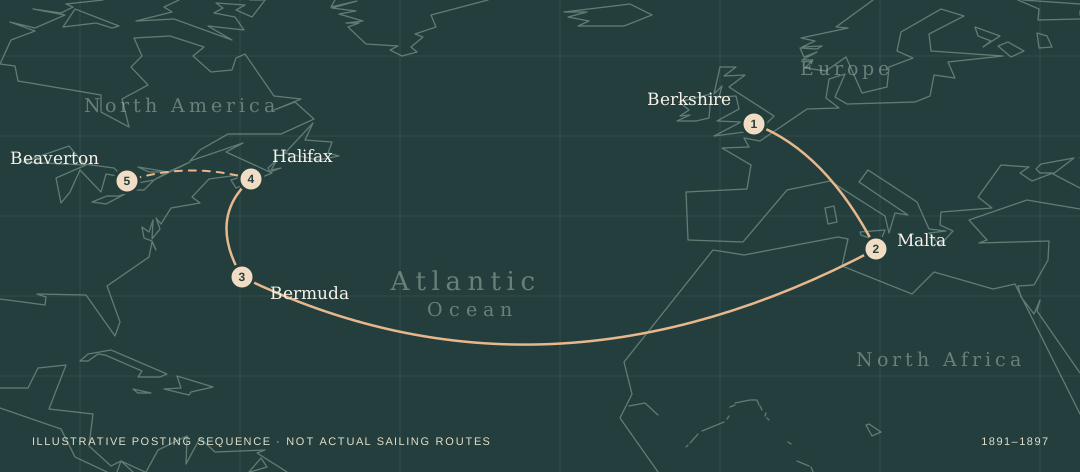
- 1BerkshireTo 1891 · Home and enlistment
- 2Malta1891–1893 · Royal Berkshire garrison
- 3Bermuda1893–1895 · Royal Berkshire garrison
- 4Halifax1895–1896 · Final active-service station
- 5BeavertonBy 1897 · Ontario marriage and family
The Royal Berkshire battalion in photographs
V / Halifax · December 1895–July 1896
The Last Garrison.
Halifax was among the most important military ports in British North America.
The city had grown around its harbour, one of the great natural anchorages of the Atlantic coast. By the late nineteenth century, it possessed busy wharves, commercial streets, rail connections and substantial military installations. Above the waterfront stood the Citadel, the massive hilltop fortress that had guarded the city through successive generations.
British soldiers had been a familiar presence in Halifax for more than a century. The arrival of the Royal Berkshires in December 1895 placed Walter within that long military tradition. His battalion was quartered among the city's garrison facilities, including Wellington and Glacis Barracks.
A photograph preserved by the regimental museum shows a Royal Berkshire sentry at the Halifax Citadel in 1896. It is an evocative surviving image from Walter's time in the city. The soldier stands in the setting of a British fortress overlooking a Canadian port. Around him lay the defensive works, streets and harbour of the last overseas station in Walter's regular military career.
Walter remained in Halifax until July 1896. Then his military status changed.
After seven years of regular service, he transferred to the Army Reserve. He was still obligated to the British Army, and that commitment would not formally end until 1901, but he was no longer serving continuously with the battalion.
It was a decisive transition. The young man who had left Berkshire in uniform could now build a civilian life. After years spent moving wherever the regiment was ordered, he had an opportunity to choose where he would work and live.
Canada became that place.
Within a year, Walter would be married in Ontario. His future no longer belonged to the regiment alone.

VI / Woodville and Beaverton · From 1897
Emily.
Woodville was a long way from Malta.
The Ontario village lay within the agricultural country of Victoria County, surrounded by the farms, small communities and market towns that had grown across the province during the nineteenth century. Nearby Beaverton, on the shores of Lake Simcoe, served the surrounding countryside through local businesses, churches, roads and lake transportation.
It was in this part of Ontario that Walter Mitchell began a new life.
On 5 March 1897, he married Emily Louisa Mitchell in Woodville.
The marriage register described Walter as a brickmaker living in Beaverton. Emily was a young woman connected to the nearby Laxton district, where her family had established its own roots.
For Walter, the marriage marked a departure of a different kind. The previous decade had been defined by military service: enlistment, distant stations, barracks and the authority of the regiment. His life with Emily would be built around work, home and children.
The 1901 census places Walter and a wife recorded as Emma in Thorah Township, already raising a young family. Later documents use Emily and Emily Louisa, the names by which she appears in the family's subsequent history.
Walter's work as a brickmaker and labourer belonged to a practical world of physical employment. In rural Ontario, households depended on work that followed the rhythms of the local economy and the changing seasons. Beaverton was growing, but it remained a relatively small community, where businesses, churches and neighbours formed much of the social fabric.
In the years after Walter's arrival, the region's connections to the wider province expanded. The Canadian Northern Railway reached Beaverton in 1906, bringing the sound and movement of trains into the community's daily life. Farms remained central to the district, but travel, trade and communication increasingly connected its residents to larger towns and cities.
For Walter and Emily, the passing years brought the responsibilities of raising children and sustaining a household.
The distance Walter had travelled was considerable. He had crossed seas, spent years in military stations, and made the passage from the old country to Canada.
Yet the most enduring part of his life would unfold within a far smaller geography.
It was here, in and around Beaverton, that he and Emily made their home.
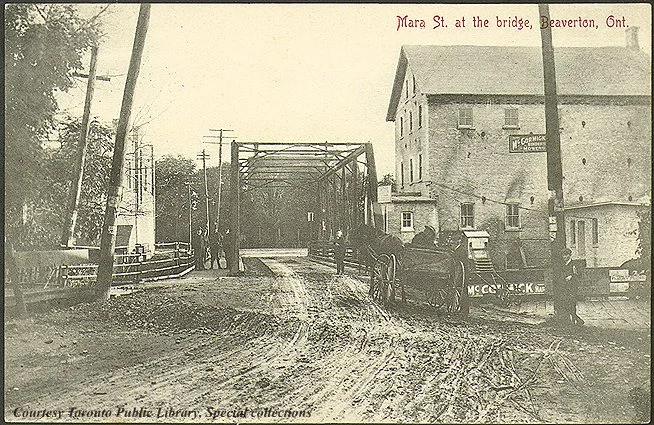
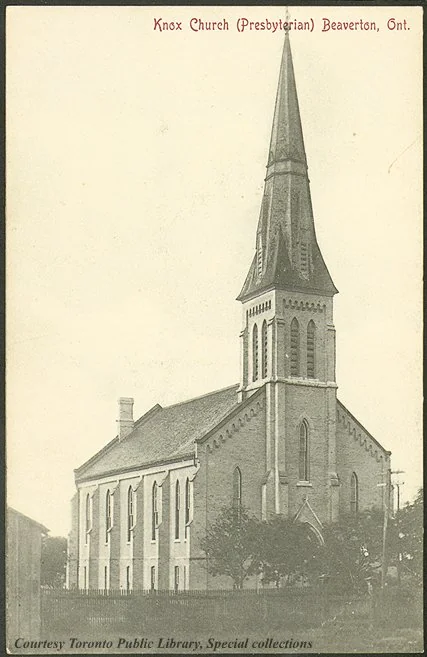
Read also: Emily Louisa Mitchell's biography ↗.
VIII / The Years at Home · 1917–1943
The Years at Home.
The later decades of Walter's life were quieter in the surviving record.
There were no further overseas stations to list, no new military numbers and no journeys across the Mediterranean or Atlantic documented in his papers.
Instead, his name appeared in the records of a household.
Walter and Emily remained in the Beaverton area as their family grew. Their children came of age in a world very different from the Victorian Berkshire countryside Walter had known.
In 1925, their daughter Mary was born.
By then Walter was in his fifties. His days in Malta and Bermuda were more than thirty years behind him, and even his Canadian military service had ended eight years earlier.
Mary would know the father who belonged to this later period of his life: the working man at home in Ontario, rather than the young private who had sailed away from Britain.
The 1931 census offers a small but revealing glimpse of the Mitchell household. Mary, then five, appears with her family in a home recorded as having seven rooms and a radio.
The radio was one of the new technologies transforming domestic life during the period. Across Canada, families could now listen to music, news and entertainment transmitted from places well beyond their own communities. Sound travelled into homes in ways that would have seemed extraordinary during Walter's boyhood.
It was another reminder of how much the world had changed during his lifetime.
Walter's occupations changed, too. Earlier records called him a brickmaker or labourer. By the time of his death, his occupation was given as greenkeeper, work associated with maintaining grass and grounds.
It was a settled occupation, a long way from the barracks and overseas garrisons of his youth.
Walter died on 25 October 1943, during another world war.
He had lived through the late Victorian period, the height of Britain's overseas military presence, the transformation of Canada in the early twentieth century, and two global conflicts.
Emily survived him by a little more than two years, dying in January 1946.
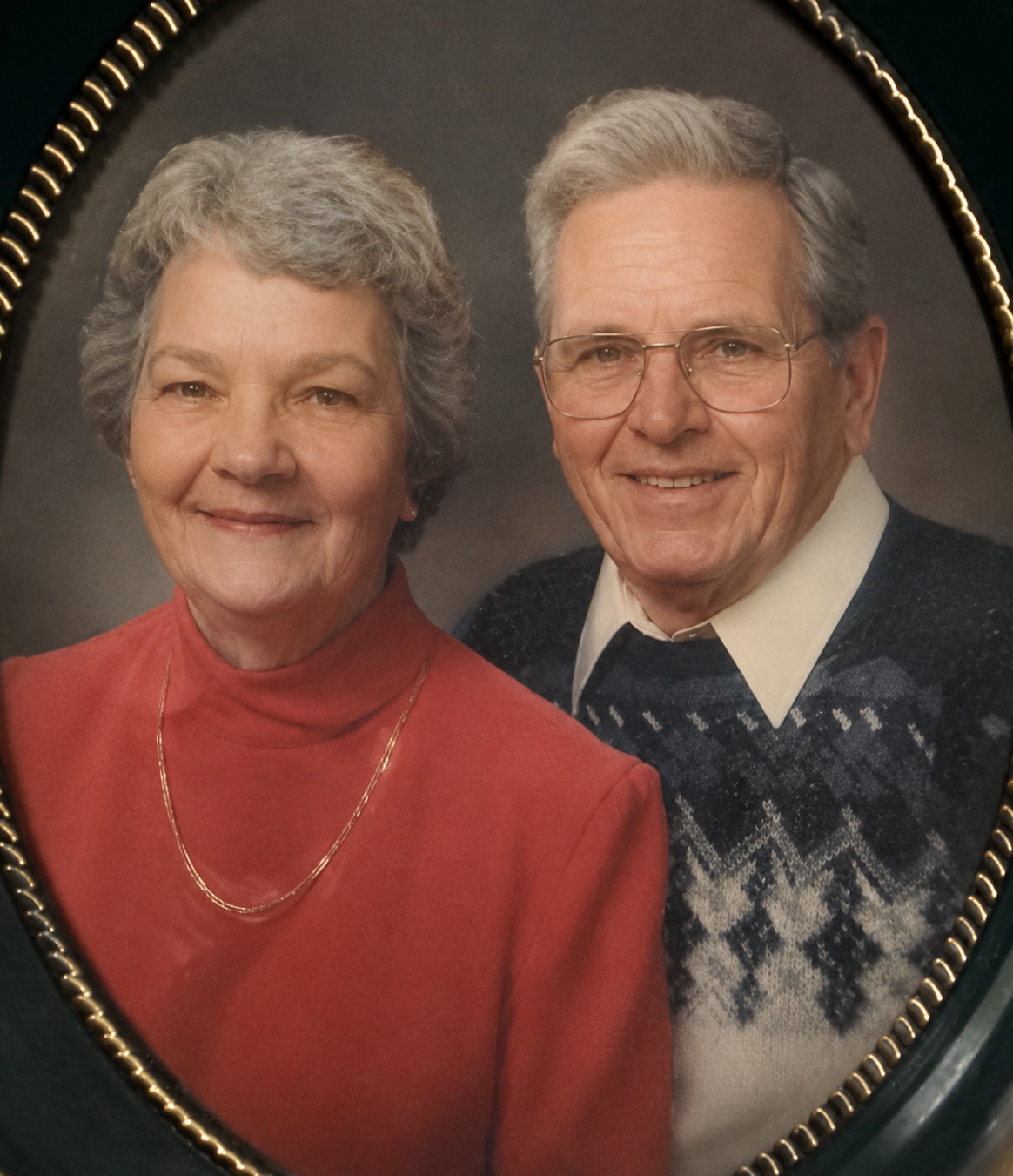
Mary would go on to marry Roy Hilliard. Through their family, the story of the young man from Berkshire would pass into another generation.
The route that had begun among the fields and brickworks near Windsor had ended in Ontario, where Walter had spent most of his adult life.
IX / The Man Behind the Records
The Man Behind the Records.
More than a century after Walter first enlisted in the Royal Berkshire Regiment, his family began piecing together the years before he came to Ontario.
His British service had survived as a statement in his Canadian papers. The regiment and the length of service were remembered, but the places were missing.
Then the original British military documents were found.
They traced a young Walter Mitchell from Berkshire to Malta, Bermuda and Halifax. They named his father, recorded the years of his service and preserved an unexpected entry about his marriage to Emily in Woodville.
And there, among the physical descriptions written by military clerks decades apart, was the dancing-girl tattoo.
It was a small detail, almost incidental to the officials who recorded it. But it had survived the long passage of time between two enlistments, two countries and two very different stages of Walter's life.
The records now belonged together.
They also restored something more meaningful than a missing military chronology.
They revealed how a young working man from Berkshire became a soldier overseas, how his final garrison brought him to Canada, and how the years of his adulthood came to be spent with Emily and their children in Ontario.
There is no need to make Walter into a heroic adventurer or assign him experiences that the surviving history does not contain.
His life was remarkable enough.
He left the country of his birth, lived for years on distant shores, exchanged military service for the responsibilities of family life, and later returned to uniform when Canada was at war.
The armies preserved his movements.
His descendants preserved his place in the family.
Together, they have given Walter Mitchell a life that reaches far beyond the dates on his gravestone.
Page through his original Canadian military file and read the British service notes ↗
Evidence / Behind the story
The records that brought him back.
This narrative draws on original British and Canadian service papers, Berkshire census and birth-index material, the 1897 Ontario marriage registration, Ontario family censuses and later civil registrations. The historical setting is informed by the Royal Berkshire Archives, regimental museum collections and Halifax garrison histories.
- British Royal Berkshire Regiment. The National Archives, WO 97/5522/130, soldier no. 2727. Attestation and military history sheet record father William Mitchell, enlistment at Reading, Malta/Bermuda/Halifax postings, reserve transfer and marriage to Emily L. Mitchell at Woodville in 1897. The supplied five-page compilation includes an unrelated East Lancashire drummer's document (image 2), excluded from Walter's biography.
- Berkshire militia. The National Archives, WO 96, 3rd Royal Berkshire Militia attestation, 9 September 1887. This names Fifield as his birthplace, Warfield as residence and his civilian occupation.
- Parentage and birth. 1871 Bray census, RG10/1291 folio 18 p. 4, household William/Mary/Walter; GRO index, Cookham district, December quarter 1868, volume 2C p. 396, mother's maiden name Smith. Mary Ann Smith is the adopted identification; the full birth certificate has not been inspected and exact date remains unsettled.
- Walter and Emily's marriage. Ontario registration 014420, Woodville, 5 March 1897, manuscript first page ↗ and second page ↗. A later child birth registration reports 7 April 1896 instead; the contemporaneous marriage entry is preferred.
- Canadian Expeditionary Force. Library and Archives Canada RG 150, accession 1992–93/166, box 6264, file 33, no. 868214 (1916–1917). Identifies Emily as wife, prior Royal Berkshire service, personal markings, promotions and Oshawa discharge. Sailing history: Library and Archives Canada, guide to the 182nd Battalion ↗.
- Ontario household and vital records. Original Thorah census 1901, North Ontario district 97 p. 2 family 15; 1921 and 1931 Thorah/Beaverton family censuses; Harold Mason Mitchell birth registration 039837, 9 February 1917; Walter death registration 039155, 25 October 1943; Emily Louisa death registration 003550, 4 January 1946.
- Photographs of his actual battalion. Rifles Berkshire and Wiltshire Museum at The Wardrobe, SBYRW 5383 (H Company football, Malta 1892) and 24987–24989 (Halifax Citadel, Boaz Island Bermuda and off-duty park, 1895–1896). Linked, not reproduced; no person shown is asserted to be Walter.
- Local and visual historical context. Royal Berkshire Archives, brickmaking in Bracknell and Warfield; Halifax Military Heritage Preservation Society, garrison barracks. Reading street image by Henry Taunt (Reading Borough Libraries; public domain); Valletta/Floriana panorama (Victoria and Albert Museum via Commons; public domain); Halifax from the Citadel, 1901 (Wm. Notman & Son, McCord Stewart Museum VIEW-3384, via Commons; public domain); Beaverton Mary Street postcard (Toronto Public Library, PC-ON 144; public domain). Context images do not imply personal presence.
The original GEDCOM and subsequent research revisions are preserved separately. The adopted family identification is Walter Mitchell, born approximately 1868 near Fifield/Bray, father William Mitchell and mother Mary Ann Smith. Variants including the Canadian 1869 birthday, another reported father forename and differing tattoo arm positions remain documented in the private research files rather than silently discarded.
The verified British and Canadian original sheets are now available to view in Walter’s public source room ↗. Detailed identity crosswalks and excluded records remain preserved in the private research archive.