When John Vroom Melick married Margaretta Welsh Craig, the household they made joined two intertwined histories of the same New Jersey countryside. The Melicks had operated mills nearby; the Craigs and Welshes had worked the land around New Germantown.
The earlier crossing from Germany
The family began its American chapter well before Jacob Welsh arrived in Tewksbury. His grandfather, Johannes Wilhelm Welsch, is identified in family research as a native of the Baumholder district in the German Palatinate. Richard Welch's compiled account describes his passage aboard the Marlborough, arriving in Philadelphia in September 1741. It carefully distinguishes him from a similarly named Welsch who appeared on a 1737 passenger list.
By 1743, Johannes Wilhelm was buying land in German Valley, later called Long Valley, in Morris County. The study cites a 258-acre purchase for £122, completed by deed in 1750, and a 1784 agreement in which he joined neighbors supporting a church shared by German Reformed and Lutheran families. His son William Welsch, born in New Jersey according to the family pedigree, belonged to the next generation. William's son was Jacob.
That distinction may explain why Snell's 1881 history remembers a “William Welsh” from Germany while the GEDCOM identifies a New Jersey-born Captain William. The older immigrant and the younger William are two different men. The names and dates are plausible, but the reported 1741 ship identity and father–son connections still merit comparison against the original passenger and deed records.
A Welsh family arrives in Tewksbury
William Welsh was remembered in the 1881 county history as a settler at Round Valley. His son Jacob came to Tewksbury in 1797, making his home about a mile northwest of New Germantown. The account describes land given by his father with provisions for Jacob's wife and children. He married Catharine Crater, and together they raised a family whose children married into other nearby households.
One of those children was Dorothy Welsh, who married John Craig. By the time their daughter Margaretta was born in 1839, both surnames were well established in the region. The county history preserves the marriage of Dorothy and John as part of its account of the Welsh settlement.
There were two Williams in the account: a German immigrant grandfather and a New Jersey-born descendant. That makes the apparent disagreement less mysterious, even while leaving room for further documentary verification. Jacob's move to Tewksbury and Dorothy's marriage remain the direct link to the Craig farm.
A blacksmith on the other side of the family
Jacob's mother, Dorothea Scharfenstein, connected him to yet another settlement story. Her father, Johann Moritz Scharfenstein (1714–1781), was remembered as a blacksmith. The compiled research reports his naturalization in 1750, a 361-acre purchase in Upper German Valley in 1767, and a will written and proved in 1781, providing for sons, daughters and grandchildren.
That makes the Welsh–Craig inheritance more than a single farming line. Behind Margaretta were landowning and working families that made their living through skilled metalwork, farming and the movement of goods. The family pedigree also links Johann Moritz's wife Catharina to the Welsch family, although her reported birth location and timing need verification before presenting the two lines as a proven cousin marriage.
Another branch of Jacob's maternal ancestry leads through the Craters to the Wintermutes—whose descendants were remembered as taking opposing sides in the American Revolution. Their divided family story ↗
The farm that came through Margaretta
John Craig farmed at New Germantown, where the young John Vroom Melick worked for him. When John Vroom married Craig's daughter Margaretta, the marriage joined two local families already connected by generations of neighbors and marriages.
John Craig died in 1869, and the King Street property passed into the household of his daughter and son-in-law. Although it later became known as a Melick farm, its route into the family matters. It came through Margaretta's Craig inheritance, not through an unbroken succession of fathers named Melick.
That same family landscape held other Craig homesteads and branches. An 1881 biographical sketch tells how an earlier Moses Craig purchased another Tewksbury homestead in 1757 and conveyed it to his son Robert. It also preserves a later portrait of Robert Craig, born in 1815. That portrayed farmer belonged to the extended Craig family, not the direct line from John and Dorothy to Margaretta.
More than one name on a piece of land
The King Street property is a reminder that farms did not carry a single surname forever. Land could move through daughters and marriages; its history was shaped by mothers' families as well as fathers'. In Margaretta's case, the Welsh, Crater and Craig names are as essential as Melick to understanding how her household came together.
Her son Walter Cameron Melick grew up in the agricultural world those families helped create. Later generations developed orchards and dairy operations nearby. But the story of the King Street farm begins, in part, with a Welsh family making a home close to New Germantown in 1797.
Historical sources
- James P. Snell, ed., History of Hunterdon and Somerset Counties, New Jersey (Philadelphia, 1881), Tewksbury chapter, printed p. 474 (PDF p. 564), names Jacob Welsh, Catharine Crater, Dorothy Welsh and John Craig; printed pp. 484–485 (PDF pp. 576 and 581), documents the separate Robert Craig homestead and family.
- The Melick family narrative and cemetery materials support the Craig–Melick marriage, 1869 inheritance and later King Street history; see Don's biography. The 1881 history abbreviates the family's earlier generations, so the identity of its immigrant William is treated as a probable distinction, not proved from that passage alone.
- Richard Welch, “Biography/History of Johannes Wilhelm Welsch,” reproduced in Melick Family Research, PDF pp. 12–13: the reported 1741 Marlborough crossing, 1743 land purchase, 1784 church association and the possibility of confusion with an earlier namesake.
- Research compilation on Johann Moritz Scharfenstein, Melick Family Research, PDF p. 34: blacksmith occupation, 1750 naturalization, 1767 property and 1781 probate. These are compiled citations to earlier records, not independently examined deeds or wills.
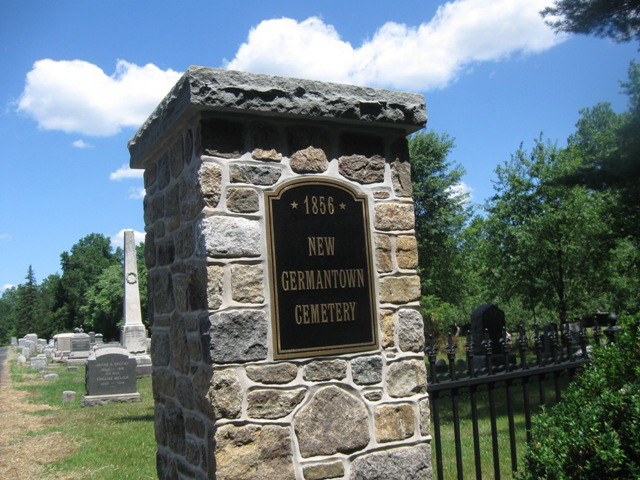
- The cemetery-gateway photograph supplies place context; it does not depict the Craig farm or the 1797 settlement.