On April 16, 1910, a census enumerator recorded seven members of the Wurst family in Philadelphia’s Nineteenth Ward. The first name was William, a twenty-four-year-old working at a gas works. Directly beneath his name was Barbara, his mother, who was forty-six and widowed.
Then came Annie, Tillie, John, Mamie, and Emma. The relationships were entered in reference to William: sisters and a brother. In an official register organized around the person designated head of household, Barbara’s position was recorded as mother, although she was the older generation around whom these six young lives had formed.
By the time the census was taken, four of the children were listed with occupations. The two youngest, thirteen-year-old Mamie and eleven-year-old Emma, were not.
What survives is not a complete account of the family’s days, finances, or relationships. It is a unusually clear view of several working lives under the same roof.
Seven entries
The census describes William as unmarried and the household head. Barbara is recorded as widowed. In the columns asking mothers about children, the enumerator wrote that she had borne six children and that six were living. The household enumerates exactly six younger Wursts, including William.
- William 24 · head
- Gas works
- Barbara 46 · mother, widowed
- No occupation recorded
- Annie 19 · sister
- Cutter · lace-curtain mill
- Tillie 17 · sister
- Folder · hosiery mill
- John 16 · brother
- Trunk maker · trunk factory
- Mamie 13 · sister
- No occupation recorded
- Emma 11 · sister
- No occupation recorded
The designation head is a census relationship category, not a deed or an explanation of who made household decisions. William’s entry does not tell us whether the family rented or owned its home. Barbara’s widowhood does not tell us when her husband died or how the family coped with his death.
Even so, the list is striking in its variety. The occupations did not all belong to a single factory or even to a single branch of industry.
Four kinds of work
Annie, nineteen, was a cutter in a lace-curtain mill. The occupation joined a familiar domestic object—a curtain hanging in a window—to Philadelphia’s machinery, materials, and specialized textile labor. The record names the kind of work, not the building or business where she performed it.
Tillie, seventeen, was a folder in a hosiery mill. Hosiery was among Philadelphia’s major manufacturing specialties. By 1900, the city was a national leader in hosiery and knit goods; thousands of workers were employed across a sector that included large mills and smaller manufacturers.
The two sisters were therefore in related but distinct trades. Annie’s work concerned lace curtains; Tillie’s concerned hosiery. Their entries do not identify a shared employer, a particular machine, or the amount either was paid.
John, sixteen, was a trunk maker in a trunk factory. His occupation belonged to another material world: the manufacture of objects made for carrying and protecting belongings in transit. The census does not say whether he cut material, fitted hardware, assembled cases, or undertook some other part of that work.
William’s employment at a gas works connected the household to the systems that powered and lit the expanding city. His specific task is not securely resolved from our transcription, and the document does not identify a company.
Each occupation is narrow on the page. Taken together, they show how one family’s working life extended across several different parts of industrial Philadelphia.
An industrial city
Philadelphia’s textile economy was especially varied. At the beginning of the twentieth century its factories and workshops produced woven cloth, carpets, knit goods, hosiery, lace, and many other materials. Kensington, farther northeast, was among the city’s principal textile districts. A historical survey estimates that in 1910 roughly four hundred textile firms employed thirty thousand workers there.
That scale helps explain the larger economy around Annie and Tillie, but it does not locate the Wurst household in Kensington or place either sister in one of its particular mills. The family’s address has not yet been confidently extracted from the census street heading.
Philadelphia’s industrial history also included conflict. In 1903 textile workers and children marched with labor organizer Mother Jones to publicize working conditions. In the winter of 1909–10, thousands of the city’s shirtwaist workers struck for better terms of employment. The Wurst household’s census was taken in the same spring as the latter action.
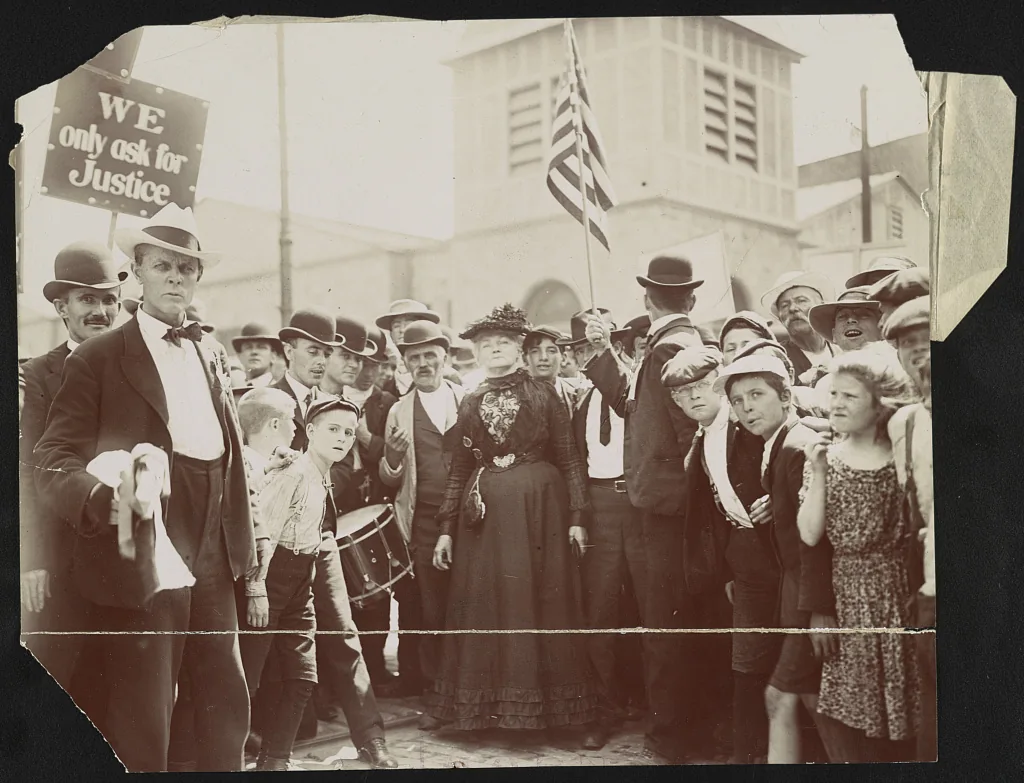
These movements are part of the setting, not incidents we can attribute to Barbara or her children. No surviving family record connects them to a particular protest, union, strike, or workplace dispute. Nor should the broad history of difficult factory conditions be substituted for evidence about their own hours, wages, or treatment.
Barbara and the younger children
Barbara’s entry occupies one line. It records her age, her widowhood, her relationship to William, and her history as a mother. It does not name an occupation.
That absence cannot tell us what Barbara did during a day. The census’s categories were not designed to describe the labor of maintaining a home, caring for children, or managing daily arrangements. Nor can they establish that she lacked other income or assistance.
Mamie, thirteen, and Emma, eleven, appear below their working siblings without occupations. In April 1910 they were still children in a household where four older members were already connected to city industries. We know they lived together; we do not know their routines at school, at home, or in the neighborhood.
Mamie would later enter the Conlin family. A 1919 Philadelphia church marriage record joins Mamie Wurst with Francis, also recorded as Frank, Conlin. A later death certificate for Emma Patrick names her parents as William Wurst and Barbara Sperle, reinforcing the connection between the Wurst children and the earlier parental generation.
Those later records widen the story without replacing the significance of 1910. The same individuals who appear together in one enumerator’s sequence would eventually be recorded in marriages, new households, and death records of their own.
What the census can tell us
It is tempting to turn a row of occupational entries into a complete account of how the Wurst household supported itself. Four listed occupations do not reveal four pay packets, what each person brought home, the household’s rent, or how money was shared. None of that appears on the page.
What the document does preserve is more specific than a general portrait of poverty or factory life: William at the gas works; Annie cutting lace curtains; Tillie folding hosiery; John making trunks; Barbara recorded as a widowed mother; Mamie and Emma still without listed occupations.
They belong together in the 1910 census but should not lose their individuality within it. Each had a different place in the household, and several already had a different relationship to Philadelphia’s industrial economy.
The seven entries occupy only a few lines. They are nevertheless an unusually useful record of one family at one moment, before later documents carried its members into separate histories.
Records and further reading
Primary family record. 1910 United States census, Philadelphia, Pennsylvania, Ward 19, enumeration district 311, sheet 3A, lines 11–17, enumerated April 16, 1910. William Wurst is recorded as the unmarried twenty-four-year-old head; Barbara, forty-six, as his widowed mother; Annie, Tillie, John, Mamie, and Emma as his siblings. The original image was reinspected for this article and is retained in the private family research collection.
Other family evidence. Philadelphia church marriage register, 1919, for Mamie Wurst and Francis/Frank Conlin; Pennsylvania death certificate, 1946, for Emma Patrick, naming William Wurst and Barbara Sperle as her parents. Those records remain separate from the historic-context photographs.
Historical context.
- Jack McCarthy, “Textile Manufacturing and Textile Workers”, Encyclopedia of Greater Philadelphia. Philadelphia’s diverse mills, hosiery industry, industrial geography, and labor disputes.
- Christina Larocco, “Garment Work and Workers”, Encyclopedia of Greater Philadelphia. The organization of work and the limits of industrial employment records.
- United States Census Bureau, Twelfth Census of the United States: Manufactures, documenting the significance of hosiery manufacture in Philadelphia around 1900.
- Library of Congress, Mother Jones with Philadelphia textile workers, 1903. Archival photograph; the catalog reports no known restrictions on publication.
Editorial note. The family member identities and occupations are transcribed from the Wurst census. The geographic industry figures and textile-labor history describe Philadelphia more generally. No census-address photograph, actual Wurst employer, participation in a strike, individual wages, family finances, or unverified earlier German pedigree is inferred from this context.