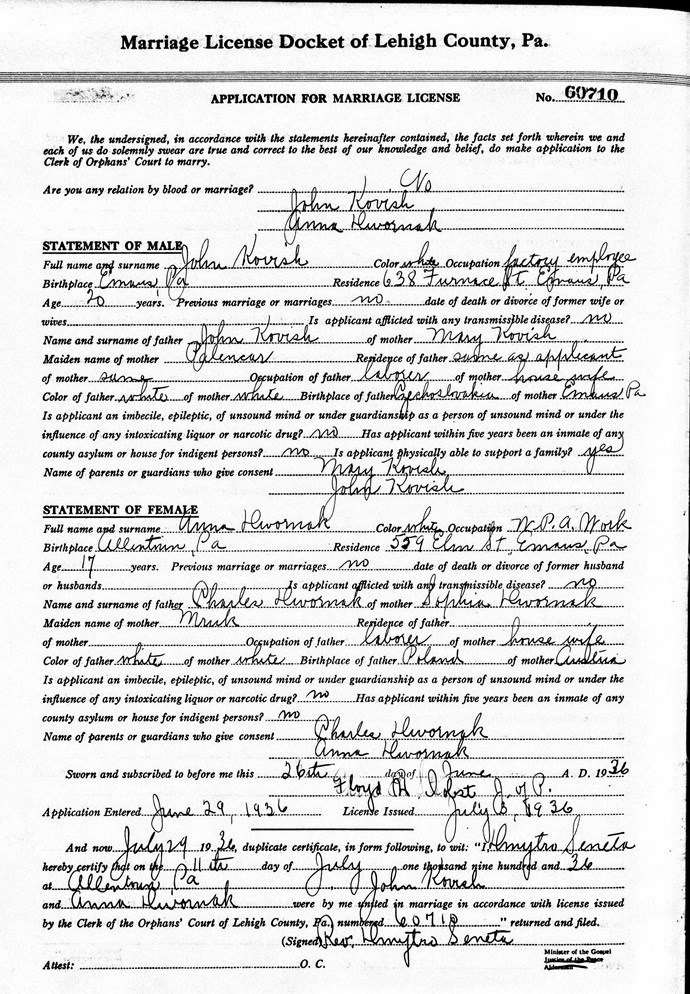
On a form issued by the Commonwealth of Pennsylvania, two names sit one above the other: John Kovish and Anna Dwornak. The clerk needed their ages, their parents' names, their birthplaces, and enough information to decide whether the marriage could take place. For their descendants, those short answers preserve something much larger.
John was twenty. Anna was seventeen. They were not immigrants arriving together on a ship, or members of a single European village who had always known one another. They belonged to the generation born after—or during—the journeys that brought their parents and grandparents from eastern Slovakia and Galicia to the industrial towns of Pennsylvania.
Two family histories on one page
The groom's section names his father, John Kovish, and his mother, Mary Palencar. John Sr. had come from Koškovce, in the Slovak lands; Mary had grown up in Emmaus as the daughter of Stephen Palencar and Maria Ulicny. Foundries, factories, church communities and Furnace Street households formed the world from which their son emerged.
The bride's section belongs to a different journey. It names Anna's father as Charles Dwornak—the American name also used by Basil or Wasyl Dwornik—and her mother as Sophie Mruk. Anna was born in Allentown. Her parents came from the Galician lands now in Ukraine, carrying into Pennsylvania a different language, set of village connections and religious traditions.
The record is valuable partly because it makes these connections ordinary. An official asked for the names of their mothers and fathers; the answers are the very surnames that would otherwise appear in separate branches of a family tree.
From application to marriage
The docket records the application entering the county office on June 29, 1936, the license being issued on July 6, and the wedding taking place on July 11. A duplicate certificate was recorded on July 29. The distinction matters: the latest date appearing on a marriage record is not necessarily the day the couple married. Here the form preserves the separate stages.
Other entries place the couple in the working life of the Lehigh Valley. The groom is described as a factory employee, and both are linked to Emmaus. The marriage united families that had not traveled the same route to America but had found a common home within a few miles of one another.
The household that followed
Later that year John and Anna became the parents of Nancy. Her childhood in Emmaus belonged to a Pennsylvania world of schools, neighbors, factory work, churches and extended family. Yet the names written on this earlier paper still connected her directly to Koškovce and to the villages of Galicia.
That is what gives the marriage record its meaning. It did not mark the beginning of either family's story. It marked the place where those stories met. The people who crossed borders were one generation; the people who formed a new household in 1936 were the next. Nancy would know their blended history not as an abstract map of Europe, but as her own family.
Decades later, John's and Anna's obituaries added the closing chapters of their lives. The marriage docket, by contrast, leaves them at the beginning: two names in a clerk's handwriting, with almost everything still ahead of them.
Sources & original records
The dates and parent names above come from the original Lehigh County license docket; broader migration and working-life context comes from the family tree and Nancy's biographical research. An application records what the applicants supplied—it is not independent proof of every birthplace or relationship.
- John Kovish and Anna Dwornak, Lehigh County, Pennsylvania marriage-license docket, no. 60710 (1936). The visible record gives ages, parents, application entry date, license date and marriage certification.
- The Kovish household, 1940 census, as preserved in the family archive.
- John Kovish obituary and Anna Dwornak Kovish obituary.
- Nancy's eastern Slovak family history and Galician family history for the earlier generations.