At 559 Elm Street in Emmaus, Pennsylvania, a family had a fixed address. It appears in Basil Dwornak's obituary and again on his death certificate. But the names belonging to that address began much farther away, in the eastern borderlands of Europe.
He was born Wasyl Dwornik in Skoryki; she was born Zosia Mruk in Juszkowce. Their home villages were in Galicia, then a province of Austria-Hungary. Modern maps place them in Ukraine. The labels changed as empires fell and borders moved. The people would also have their names written in different forms: Wasyl as Basil or Charles; Zosia as Sophie or Sophia; Dwornik as Dwornak.
The journey and the beginning
Both crossed the Atlantic into a Pennsylvania already transformed by industry. The family research records Wasyl's departure from Galicia, while a later obituary places his arrival in 1916 and says he first settled in Coaldale. Those accounts disagree about the exact year; what is certain from the surviving family history is that he established a life in the Lehigh Valley and that Sophia, too, made the region her home.
Coaldale and Emmaus were distinct places in an industrial landscape. The first was associated with Pennsylvania's anthracite coal country; Emmaus lay among the manufacturing and railroad communities surrounding Allentown and Bethlehem. Basil's later work would tie his household to the transportation system linking places like these.
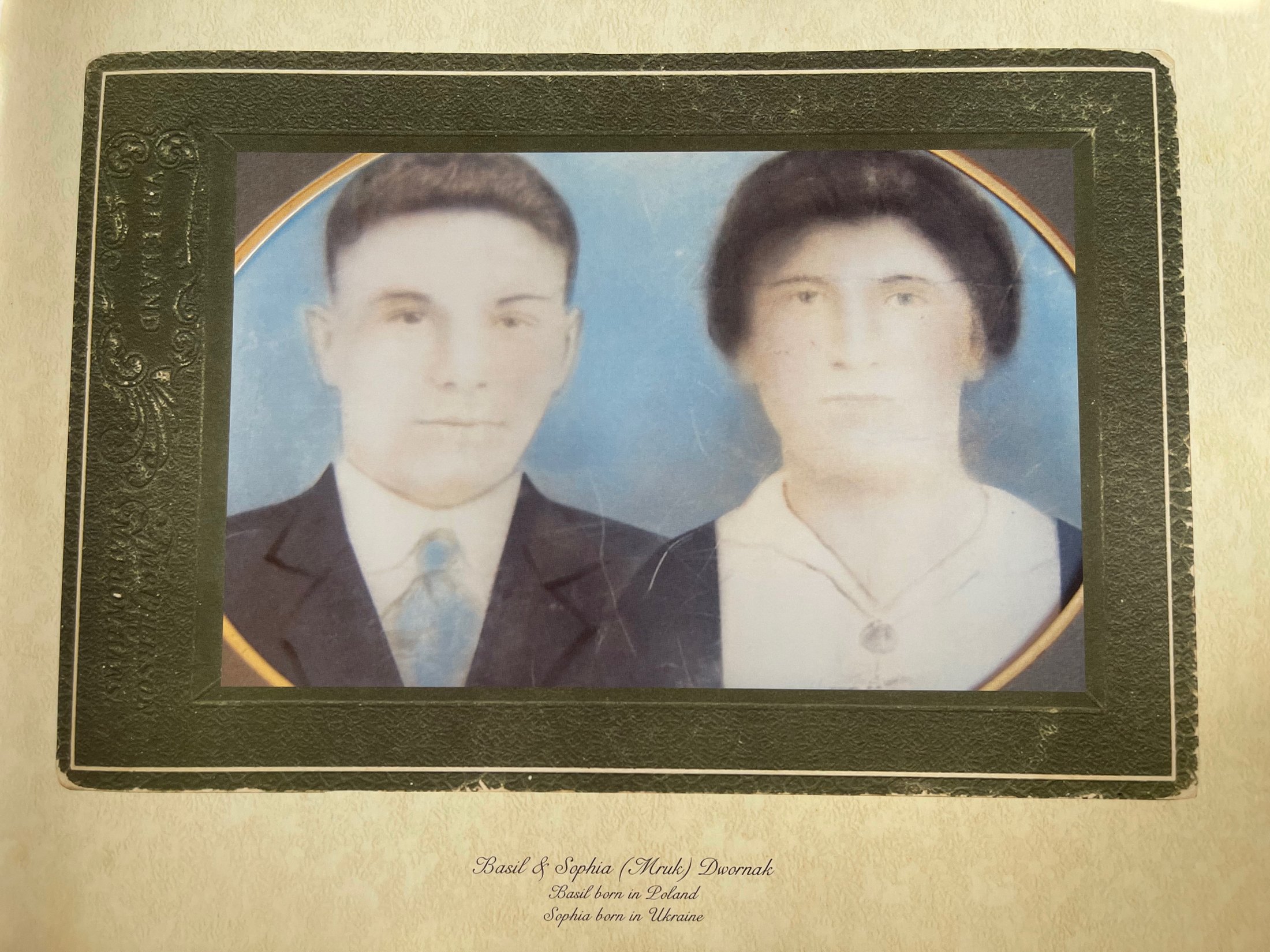
The photograph in the family collection brings the couple into view. A man in a dark jacket and tie appears beside a woman with carefully arranged hair and a pale collar. The mount identifies them as Basil and Sophia, but it gives no reliable date or photographer. We can look at their faces without pretending to know what they were thinking or exactly when they sat for the portraits.
Work that connected the valley
Basil worked for the Lehigh Valley Railroad, retiring in 1960 according to his obituary. The death certificate also identifies the railroad as his retired occupation. These later accounts do not say precisely what his railroad duties were, so the story cannot place him at a particular engine, station or workshop.
Earlier censuses preserve a more varied series of job descriptions. In 1930, recorded as Charles Dwornak, he was a lineman in electric light. In 1940, as Basil, he was a stationary engineer for a power-and-light company. And in 1950, his occupation was recorded as trucker at a filling station. Those entries reflect the work reported at three particular moments. They do not explain how these positions fit with his railroad employment or prove a continuous sequence of job changes. Read the original-census timeline ↗
Seen together, the occupations touch several parts of the Lehigh Valley's industrial world: electric power, trucking and rail transport. Railroads were essential to the movement of people, coal and manufactured goods through this part of Pennsylvania. These are contexts for the work recorded on Basil's documents, not proof of the particular tasks he performed on any given day. His daughter Anna would marry into a family with its own history of work in Emmaus factories and iron foundries.
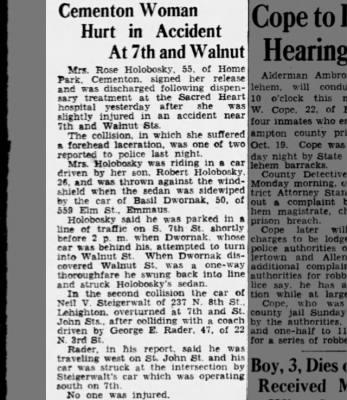
One surviving newspaper clipping captures a more ordinary incident between those milestones. In November 1944, The Morning Call named Basil Dwornak among the motorists involved in collisions at Seventh and Walnut Streets in Allentown. The paper reported no injuries to occupants of his vehicle. The report cannot tell us who was responsible or what the episode meant to his household, but it places him in the everyday traffic of the same industrial city where he worked and raised a family.
A household that joined other households
Basil and Sophia raised children whose names appear in the family's later records. Their daughter Anna married John Stephen Kovish in July 1936. The wedding record brought together the Dwornak and Mruk ancestry of Galicia with the Kovish and Palencar ancestry of eastern Slovakia. Their daughter Nancy was born later that year.
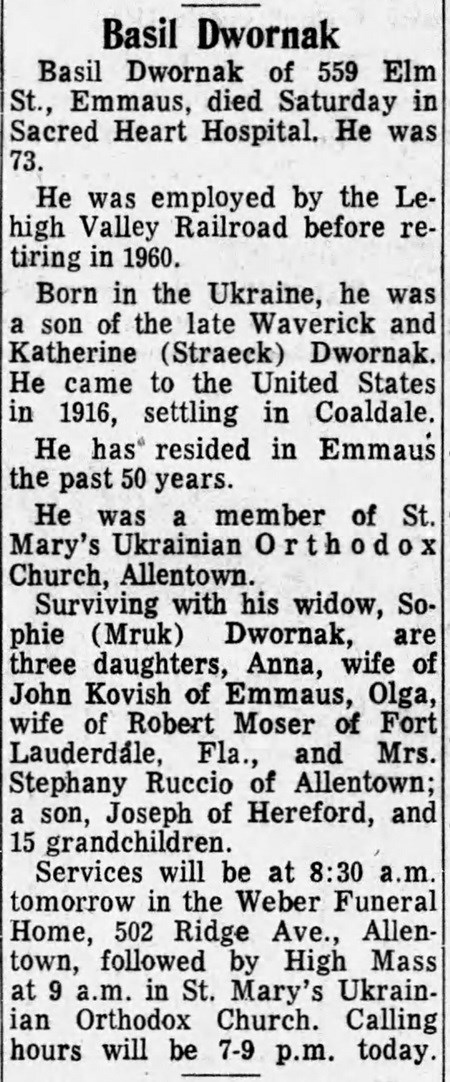
Church life provided another form of continuity. Basil's obituary identifies him as a member of St. Mary's Ukrainian Orthodox Church in Allentown. In Pennsylvania, the institutions a family attended could preserve language, religious practice, and community ties that had crossed the ocean with its earliest immigrant members.
What the records leave behind
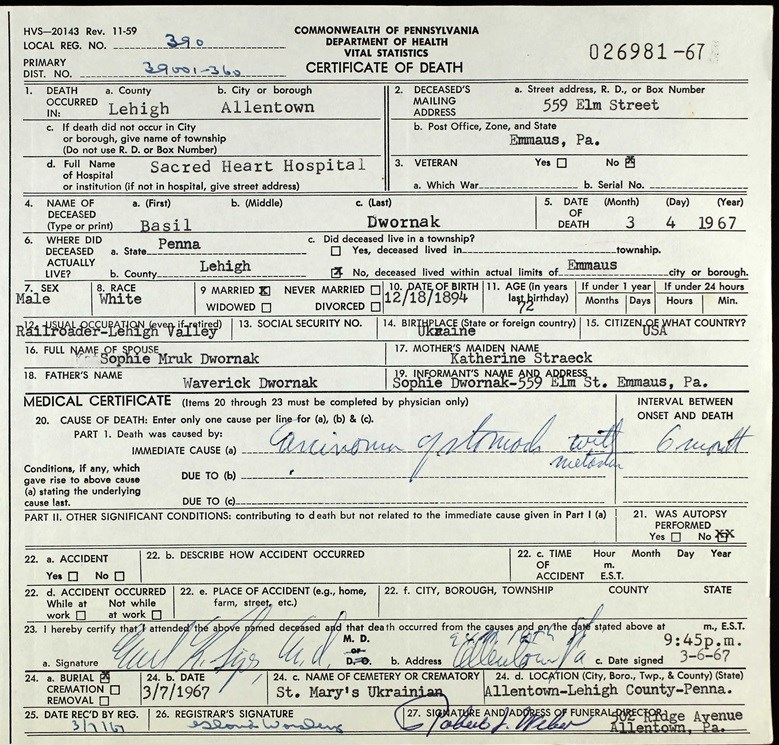
Basil died on March 4, 1967, at Sacred Heart Hospital in Allentown. His obituary described 559 Elm Street as his home and gave the names of his wife, children, and grandchildren. The death certificate, a more formal document, repeated the address and identified Sophie as his spouse and informant.
The contrast between the two kinds of evidence is revealing. The state form preserves the date and place of death, a reported birth date, an occupation, and names to connect the person to official records. The obituary records a community: his work, his church, the family that survived him, and the place where his funeral would be held.
Neither document can tell us what the first years of marriage felt like, or how often memories of Skoryki and Juszkowce came up around the table. They do show that the journeys which began in Galicia did not remain isolated immigrant stories. They became an Emmaus household, daughters and a son, a local church, the varied work recorded over the years—and eventually Nancy's family.
Sources & original records
The details in this article are drawn from specific family documents. The photograph is undated; the obituary and death certificate provide different kinds of evidence and disagree on some dates.
- Basil and Sophia (Mruk) Dwornak, family portrait. Original identification on the archival image; photographer and date not established.
- The Morning Call, November 15, 1944, page 4. Mentions Basil Dwornak in an automobile collision at Seventh and Walnut in Allentown; does not establish fault.
- Basil Dwornak obituary (1967). Newspaper notice recording Lehigh Valley Railroad employment, St. Mary's church, Coaldale and Emmaus, and family members.
- Commonwealth of Pennsylvania, certificate of death no. 026981-67, 4 March 1967. Medical record details are not reproduced in this public story.
- Original-image-reviewed 1930, 1940 and 1950 United States census entries for Basil/Charles Dwornak, preserving the differing reported occupations and names; these are separate census snapshots, not proof of continuous employment by any one employer.
- Marriage license of John Kovish and Anna Dwornak (1936), connecting the next generation.
- Nancy's Galician family history, including the earlier migration research that requires reconciliation with Basil's obituary.