In 1900, a Philadelphia census enumerator recorded a girl named Lizzie Curran, born in June 1894, in the household of Samuel and Maggie Curran. Her sisters Margaret and Mary appeared nearby. She was one of three daughters in a household described by a few columns of handwriting.
Ten years later, another census recorded Elizabeth Curran with Samuel and Margaret and four younger household members: Margaret, Mary, Samuel, and Catherine. Elizabeth was about sixteen. The form also recorded an occupation.
These two words place Elizabeth in one of the industries that helped define working life for young women in the city. They do not identify her employer or describe her circumstances at work. The wider history of that industry, however, gives the entry meaning.
The garment
A shirtwaist was a blouse, often made of cotton or linen and cut in a style resembling a man’s shirt. It could be plain enough for daily wear or finished with lace, pleats, and decorative stitching. Worn with a long skirt, it became a familiar part of women’s clothing around the turn of the twentieth century.
As demand increased, the blouse became an industrial product. Cloth was cut, sewn, trimmed, pressed, and packed by different workers. Some manufacturers employed workers directly; others sent work to contractors operating smaller shops.
The word operator commonly referred to a person who operated a sewing machine. Instead of producing a complete garment, a worker might be responsible for a particular seam or part, repeated across many pieces. The skill involved was real, even as the production system made individual labor less visible.
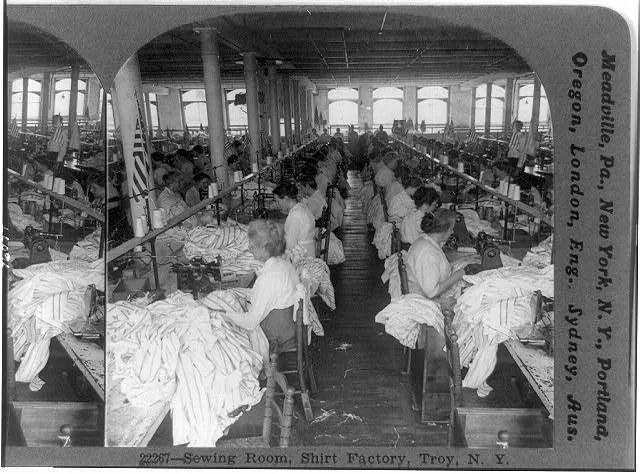
Philadelphia and New York were leading centers of shirtwaist production. The work offered young women wages and a place in an expanding industrial economy. It also exposed many workers to long hours, uncertain pay, and conditions over which they had little control.
Work and the household
The garment trade relied heavily on women’s labor. In some Philadelphia workshops, operators were paid for the work they completed rather than a fixed weekly wage. Contractors could determine rates, and workers sometimes paid for supplies they needed to do their jobs. Those practices became central complaints in the city’s shirtwaist labor disputes.
Elizabeth’s occupation tells us that she earned her living in this trade, or was at least recorded as working in it when the census was taken. It does not tell us her weekly earnings, her hours, whether she worked in a large factory or a small shop, or how her wages were used at home.
Her presence in the Curran household matters nonetheless. Census entries often preserve the different roles of parents, daughters, and sons at a moment when work and family life were closely connected. In Elizabeth’s case, the occupation column provides a brief but significant record of her activity outside the household.
Philadelphia’s shirtwaist strike
On December 20, 1909, more than 7,000 of Philadelphia’s approximately 12,000 shirtwaist workers walked off their jobs. The action followed a large strike in New York and continued into February 1910.
Many of the Philadelphia strikers were young Jewish women and girls from Russia. They sought higher piecework rates, dependable payment, shorter hours, sanitary workplaces, protection against arbitrary dismissal, and an end to charges for work materials. They also asked employers to recognize their union.
The strike did not take place only inside factories. Workers organized picket lines; some were arrested. The Women’s Trade Union League, other labor organizations, and sympathetic Philadelphians helped sustain the walkout. The dispute became part of a broader argument about women’s work and employers’ authority.
When the strike ended on February 6, 1910, workers had secured changes to hours, the negotiation of piecework rates, and charges for materials, although employers resisted union recognition. It was a substantial episode in Philadelphia labor history, occurring in the very year Elizabeth's occupation was recorded.
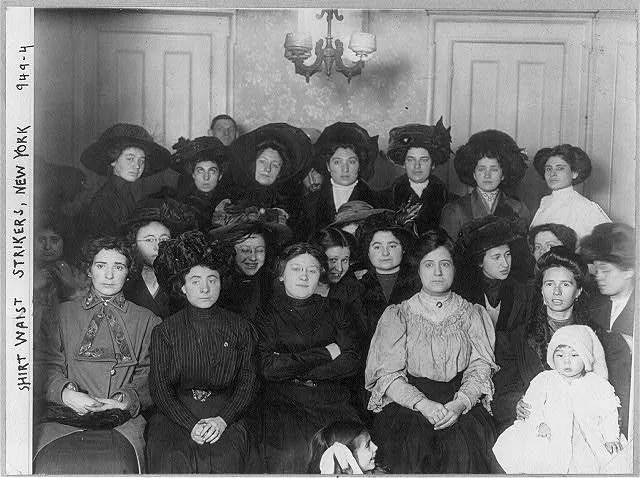
No document yet places Elizabeth on a picket line, in a union, or at any named shirtwaist factory. Her relationship to the strike is therefore one of historical setting rather than proven participation. To say otherwise would turn the experiences of other workers into details of her own life.
What the records preserve
In 1900 the census called her Lizzie and placed her among the Curran children. In 1910 it recorded Elizabeth as a young wage earner. The names and ages are consistent with the same daughter, although the surviving entries must be read together rather than treated as an uninterrupted biography.
We do not have a workplace photograph of Elizabeth, a pay record, or a first-hand account of what she thought about her job. Neither of the two census entries alone tells us precisely when she began working or how long she remained in the trade.
There is, nevertheless, something important in those two occupations columns. A woman’s working life often disappeared from later family accounts when the record turned toward marriage, children, or another household. Here, at least, Elizabeth’s industrial work is visible in its own right.
Her work belonged to a trade that helped clothe a generation and to a city where young women were demanding a larger say in the terms of that work. That is the history the record can support. But Elizabeth's life did not end with a line in the occupation column.
From Lizzie's house to Elizabeth's family
A later family compilation places Elizabeth's marriage to Samuel A. McDermott in Philadelphia in 1917, citing a marriage index. The index entry and license number have not yet been independently recovered, so the year is a guide rather than a certified wedding date. The family itself is unmistakable by the next census.
On 28 February 1920, Samuel and Elizabeth were enumerated together in Philadelphia with two small children, Robert and Agnes. Samuel worked as a pipe fitter in a shipyard. The household also included Elizabeth's father, Samuel Curran, working as a newspaper delivery clerk, and her younger brother—also Samuel Curran—working as a messenger for a steam railroad.
For Elizabeth, marriage did not mean leaving the Currans behind. The names recorded under one roof show the continuity of family life between her years as a daughter in the garment trade and the years in which she was raising her own children. We do not know why they lived together or how their wages were shared. We do know that Elizabeth's father and younger brother were there, part of the same Philadelphia household before Regina was born.
By 1930 the McDermotts had made a home at 221 East Willard Street. Regina's childhood belonged to that next chapter. Continue to Regina's family home ↗
Records and further reading
Family documents. The primary family evidence is the 1900 United States census (Philadelphia, Ward 6, ED 108, sheet 4B, lines 96–100; original 4115180_00460.jpg, recording Lizzie's June 1894 birth month), the 1910 census (Ward 34, ED 849, sheet 17A, lines 34–40; 4449968_00542.jpg, recording operator in the shirtwaist industry), and the 1920 census (Ward 34, ED 1201, enumerated 28 February, lines 80–85; 4385040_00069.jpg, documenting Elizabeth's married household, children, father and brother). Copies are maintained in the private family research archive, not published as unrestricted scans.
Marriage-year lead. A compiled family genealogy reports a 1917 Philadelphia marriage of Samuel A. McDermott and Elizabeth C. Curran, citing a marriage index without an independently examined license number. Other family dates in that compilation conflict with census evidence and are not adopted here. The Philadelphia Marriage Indexes, 1885–1951 collection describes the original index and how licenses are located.
Historical context.
- Julianne Kornacki, “Shirtwaist Strike (1909–10)”, Encyclopedia of Greater Philadelphia.
- “Garment Work and Workers”, Encyclopedia of Greater Philadelphia.
- Library of Congress, 1907 shirt factory sewing-room photograph and January 1910 New York shirtwaist strikers photograph. The catalog records report no known restrictions on publication.
Editorial distinction. The census documents Elizabeth’s household and recorded occupation. The photographs and labor history illustrate contemporaneous garment work and organizing elsewhere; neither photograph identifies Elizabeth, her employer, or her participation in a strike. Her exact 1900 and 1910 street addresses have not yet been established from the research transcripts.