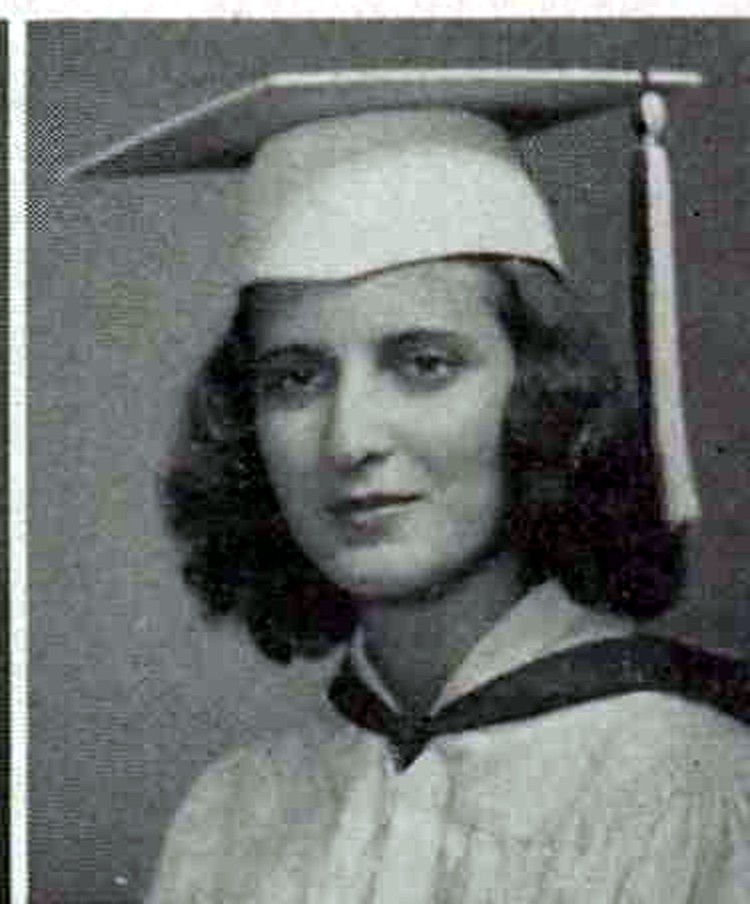
A GIRL FROM PHILADELPHIA.
Before there was a school portrait, a marriage, or a career in Allentown, there was a little girl in Samuel and Elizabeth McDermott's Philadelphia household.
Regina Delores McDermott was born on November 18, 1924. She grew up in a city of close-set neighborhoods, where home, school, shops and parish life could all exist within a few city blocks. Philadelphia was already old, industrial and crowded with the lives of families who had made it their own.
In 1930, when Regina was five, the census counted her with Samuel and Elizabeth. It called her Jean—a name the family has since connected to Regina herself. It is a reminder of how much a person's life exceeds any single name written on a government form. [1]
By the early 1940s, the McDermotts were associated with 221 East Willard Street in Upper Kensington. Beyond their own block stood the rowhouses, parish buildings, shops and elevated railway of northeastern Philadelphia. Her city had endured the Depression and was living through the upheaval of another world war. For Regina, approaching adulthood, those events formed the backdrop to a more personal passage out of childhood. [11]
The names Samuel and Elizabeth on Regina’s census entry lead us backward, toward two very different kinds of work in an industrial city. The story of the woman in the yearbook had begun long before she was born.

The neighborhood beyond Willard Street
McPherson Square stood among Kensington's closely spaced rowhouses and public spaces. The elevated railway had been running along Kensington Avenue since 1922; by Regina's school years it was part of the neighborhood's streetscape. The archive preserves the nearby world more precisely than a generic photograph of Philadelphia could.
A GIRL CALLED LIZZIE.
Before she was Regina's mother, Elizabeth Curran was a Philadelphia daughter earning wages in the shirtwaist trade.
Long before Regina was born, the family already had roots in Philadelphia. In 1880, an Irish-born widow named Catherine Curley, fifty-eight, shared a household with her daughter Mary Funk, twenty-seven, and nine-year-old granddaughter Maggie Funk. Decades later, Margaret Curran's death certificate named her parents as Henry Funk and Mary Curley and recorded a November 1870 birth. Together, those details make the young Maggie a strong match for the woman who became Regina's maternal grandmother. Through her, Catherine Curley appears to be Regina's great-great-grandmother. [9]
Maggie married Samuel Curran around 1892 or 1893, according to the marriage durations recorded in two censuses. Their daughter Lizzie, born in June 1894 according to the 1900 census, grew up alongside Margaret and Mary. The family later included younger Samuel and Catherine. By 1910, Margaret had borne six children, of whom five were living—a small but poignant detail the enumerator recorded without naming the child who had died. [9]
In 1910 Elizabeth was about sixteen and working as an operator in the shirtwaist industry. Shirtwaists—blouses worn with long skirts—were made in workrooms where women cut, sewed and finished garment after garment. She belonged to the same Philadelphia trade that had recently experienced a major labor strike; nothing identifies her as a participant. [9]
Within the next decade, Elizabeth had married Samuel McDermott and begun raising Robert and Agnes. A secondary family compilation suggests a wedding in 1917, but an original marriage license has not been verified. By 1920, Elizabeth's father, Samuel Curran, and her seventeen-year-old brother, also Samuel, shared the McDermott household. Her husband fitted pipe in a shipyard; her father delivered newspapers; her brother carried messages for the railroad. Elizabeth had a family of her own without leaving her father and brother behind. [13]
Explore Elizabeth’s work and the shirtwaist labor movement
Philadelphia's garment industry depended heavily on young women's labor. Some workers earned by the piece rather than the week; factories and contracting shops offered wages but also exposed workers to insecure pay and demanding conditions. Elizabeth belonged to that working world, before her daughter Regina's own school years began.
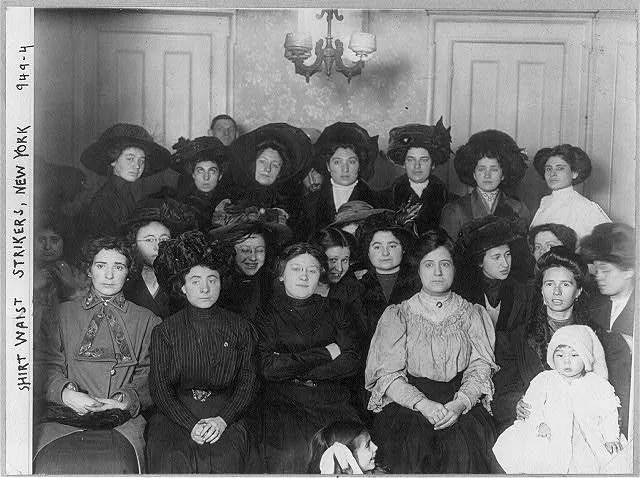
The timing brings a particular piece of city history into focus. In December 1909, thousands of Philadelphia shirtwaist workers struck for better wages, hours and workplace conditions. The strike continued into February 1910—the very year Elizabeth's occupation entered the census. Her record does not place her among the strikers; it places her in the trade whose conditions they sought to change. [9]
It is easy to remember a parent only as the person a child knew. But Elizabeth had already lived a young working woman's life. The blouse industry, the city household and the tumult of 1910 belonged to the world she carried into Regina's childhood.
Read the deeper history / Her motherElizabeth Curran and the shirtwaist trade ↗A closer look at the 1900 and 1910 censuses, the work itself and Philadelphia's 1909–10 strike.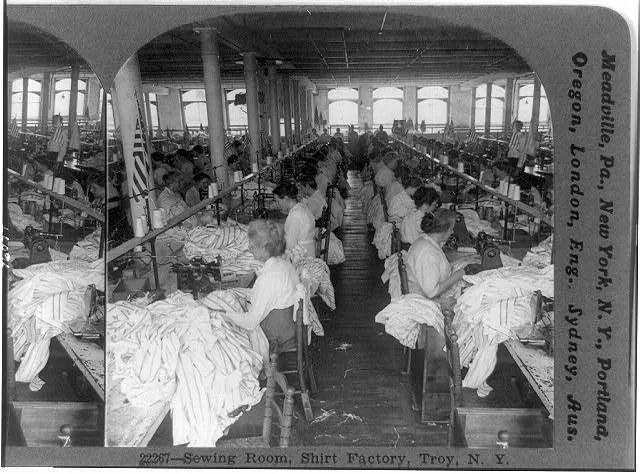
See the 1910 shirtwaist strike photograph
AT THE PHILADELPHIA MINT.
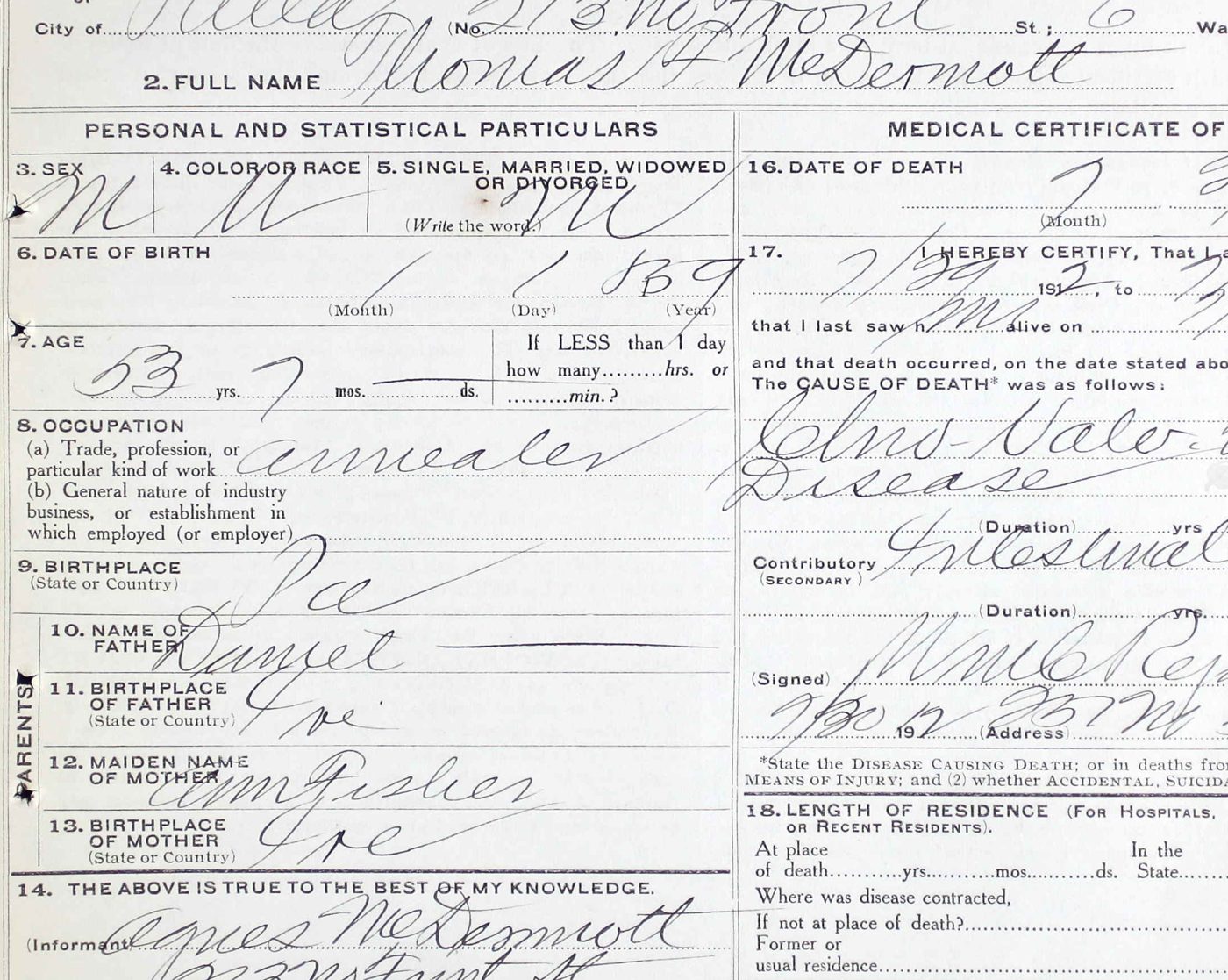
Regina's grandfather Thomas McDermott worked at the United States Mint in Philadelphia, doing the skilled metalwork that helped turn metal into the nation's coins.
In 1900, a Philadelphia household headed by Thomas and Agnes McDermott included children named Sallie, Frances, Samuel and Josephine. Regina's father Samuel was born in Philadelphia on 27 December 1889. His indexed city birth record names his parents as Thos. and Agnes McDermott, an independent link to the household that later included the Mint worker. It was a working city household at the turn of a century, much like the Currans across Philadelphia. [10]
The 1900 census names Thomas F. McDermott as an annealer at the United States Mint. His work was neither an unnamed factory job nor an incidental detail on the census page. The Mint had stood at the center of Philadelphia's public life since the nation's earliest years, and annealing was one of the precise industrial processes that made finished coinage possible. Metal had to withstand repeated shaping without cracking; heating and cooling helped keep it workable. [10]
In 1901, Philadelphia's third Mint opened at Seventeenth and Spring Garden Streets. The imposing new building replaced the older Chestnut Street Mint and introduced electrical power throughout its production equipment. A decade after the first McDermott census, the family's records return us to this institution: the 1910 census lists John McDermott, roller, U.S. Mint, with wife Agnes and children Samuel and Josephine. A roller helped prepare strips of metal to the thickness required for coinage, work just as exacting as annealing. [14]
That second record calls the father John, while the 1900 census and a 1912 death certificate call him Thomas. The same wife, the same two younger children, a marriage length advancing from twenty-four years to thirty-four, and two related jobs at the Mint make this very likely the same household. The reason for the name difference remains unknown. What emerges clearly is a family whose working life was entwined with the making of American money—before Regina's father Samuel found his own skilled trade in the shipyards. [10]
The children's later records bring another kind of certainty. The son Thomas, sixteen in the 1900 census and born in February 1884, appears to be the Thomas F. McDermott who died in 1964. His death certificate records a birth date of February 27, 1884, names his wife Mary Cantwell, and identifies his parents as Thomas McDermott and Agnes Stewart. A separate 1924 death certificate for his sister Sallie A. McDermott Martin names the same parents. Two children independently preserved their mother's maiden surname. The younger Thomas was not his father—the Thomas who died in 1912. [10]
By 1920, Regina’s father Samuel was working as a pipe fitter in a shipyard. In the home he shared with Elizabeth, their two small children and two Curran relatives, work now connected three different trades: shipbuilding, newspaper distribution and railroad service. The census names these occupations, not the employers or the daily routines of the people who held them. [13]
Explore the McDermott records and earlier Irish generations
Thomas's 1912 death certificate reported his parents as Daniel McDermott and Ann Fisher, both born in Ireland. His age differs from the older censuses, so those parent names remain an important lead rather than a separately proven connection to Samuel. The 1900 and 1910 household evidence firmly connects a family and its work at the Mint, while the two different names for the father remain as written on the records.
A glimpse of a metalworker and two names from Ireland may seem distant from Regina's 1943 portrait. Yet the distance is the point. One generation worked in industrial Philadelphia, another raised the people who would become her parents, and the city kept changing around them.
Step inside / Philadelphia c. 1901–1910See the Mint where the family worked ↗Two contemporary views from the Free Library of Philadelphia, with the people and trades behind them.Philadelphia · A family workplace · 1900–1910
WHERE THE COINS WERE MADE.
Thomas's annealing work and John's recorded rolling work belonged to the many skilled hands behind the coins Americans used every day. These period views preserve the building and its machinery at the time of the McDermott records.
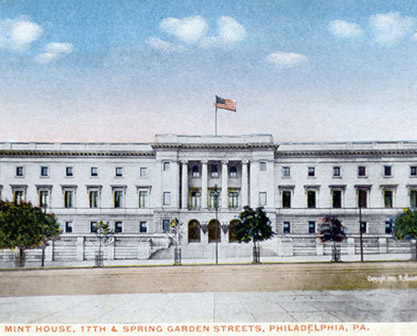

The coins could leave Philadelphia in every direction. The census preserves the names of two of the trades that helped make them.
See Thomas McDermott’s original 1912 record
Curran and McDermott households Samuel & Elizabeth Regina, 1924
A simplified narrative guide, not a substitute for the source-qualified family tree.ONE FACE. ONE STREET.
The address beside Regina's school photograph was more than a point on a map. For decades, 221 East Willard Street held the household that raised her—and the family was part of Philadelphia's working life on both sides of its front door.
By 1930, Samuel and Elizabeth McDermott lived at house number 221 with six children: Robert, Agnes, James, Jean, John and baby Mary. Their names run across two consecutive census pages, the last four appearing on the continuation. Samuel, once a pipe fitter in a shipyard, had become a street railway conductor. The five-year-old daughter listed as Jean is a strong match for the Regina named alongside the same parents and siblings in 1940. [1]
The 1940 census lets us enter the house ten years later. Samuel and Elizabeth were there with Robert, a daughter recorded as Anne, James, fourteen-year-old Regina, John and Mary. An older uncle, John Lyons, was also under the roof. There were several generations and several kinds of work: Samuel's occupation was trolley conductor, Robert was a photographer for an electrical company, and the older daughter was a file clerk for the city. The household had reported living in the same house in 1935. [15]
Samuel's 1942 draft registration gave his employer as P.T.C., the Philadelphia Transportation Company. Its streetcars belonged to the everyday movement of the city, taking people to work, shops and schools. The line from his father's Mint work to Samuel's shipyard and trolley jobs is one of skilled labor threaded through the life of Philadelphia. [15]
In 1924, Samuel's sister Sallie A. Martin was recorded as having lived at 217 East Willard Street, and her husband James gave that address to the registrar. Samuel's family occupied 221 in the 1930 census. Just four house numbers apart, those addresses connect the extended family to a very small stretch of Philadelphia, although the records—six years apart—do not establish that the siblings lived there at the same time. [15]
Another generation's life can be traced to this address. In March 1944, Margaret Curran—the grandmother who had once appeared as Maggie Funk—died in Philadelphia. Her certificate recorded 221 East Willard Street as her usual residence and named her deceased husband Samuel Curran. The record brings Elizabeth's mother into the same family geography as Regina's childhood; it does not tell us how long Margaret lived there. [15]
By 1950, Samuel and Elizabeth still lived at house number 221 with their daughter Mary, then employed in an insurance office. Samuel continued to be enumerated as a trolley car conductor. Regina had begun another chapter of her life in a household with Frank Conlin on Souder Street, while the Willard Street address remained part of her family's history. [15]
And in the middle of those years, the 1943 edition of The Garland captured Regina as a student at Little Flower Catholic High School for Girls. The portrait preserved her face; the address printed alongside it has now brought a whole household into view.
The school had opened only four years earlier, in 1939, at 10th and Lycoming Streets. Regina belonged to one of its early generations of students. A Catholic girls' school in wartime Philadelphia was a place where young women prepared for whatever might come after graduation, while a world at war pressed beyond the classroom. [2]
Beside Regina's portrait are the details that make a familiar face part of a larger family geography: 221 East Willard Street and St. Hugh. St. Hugh of Cluny parish had been established in 1922, just two years before Regina's birth, at Howard and Tioga Streets. The parish entry connects her to another institution of the neighborhood, one that had its own life long before this photograph was rediscovered. [3]
These are places a descendant can still find on a map. A house number, a school, a parish: the geography of a young woman's life, written almost casually on a page meant for her classmates.
Willard Street, Little Flower and St. Hugh tell three parts of the same Philadelphia story. The Conlin–McDermott family history follows the addresses and earlier households in greater depth.

TWO LIVES. ONE FUTURE.
Across Philadelphia, another young person's name was appearing on the papers of wartime.
Frank Conlin's 1942 draft registration placed him at 250 East Cambria Street—also in Upper Kensington—employed by Link-Belt, with his mother Mame named as the person who would always know where to reach him. He entered the Army that December, served overseas and returned from military service in 1945. [4]
Regina's school portrait and Frank's registration belong to two separate lives in the same part of Philadelphia. Then the records begin to tell a shared story. In April 1950, the census placed Frank and Regina together at 6713 Souder Street, in the area now known as Oxford Circle in Northeast Philadelphia—not Kensington. [11] Frank was recorded as a production supervisor. Regina's name appeared immediately below his. [5]
It is one of those small moments in family research that changes how the past looks: two different addresses, two different young people, and then one household. The years that followed would belong to their family together, without making either person's earlier life—or Regina's working years—any less her own.


A different Philadelphia · Oxford Circle, 1950
Another address. Another part of the city.
By the time Frank and Regina shared their Souder Street home, their address lay northeast of the Kensington blocks where their earlier records had placed them. This photograph shows the newly built Bushrod Library on Castor Avenue around the same year: a local landmark in the wider Oxford Circle area, not their house or a building they are known to have used.
An interlude / Two cities that shaped a family
FROM PHILADELPHIA TO ALLENTOWN.
One family story, written into the streets of two Pennsylvania cities.
Philadelphia.
In Kensington, Elizabeth Curran was a young garment worker; Thomas McDermott's death record preserved an industrial trade and an earlier Irish generation. Samuel and Elizabeth raised Regina in this city. In the 1940s her home was associated with East Willard Street, while Frank's wartime registration named nearby East Cambria Street.
By 1950, Frank and Regina were sharing a household on Souder Street in Oxford Circle. Kensington and Northeast Philadelphia were different neighborhoods, but both belonged to the city that held their family's earlier lives.
Return to Kensington's historic photographs
Allentown.
In the Lehigh Valley, Muhlenberg College became the setting for thirty-one years of Regina's professional life. Beginning in the Registrar's Office and later working in support of a dean, she was part of the institution as generations of students came and went.
Allentown's streets, neighborhoods and civic life had their own history apart from the college. The downtown storefronts in this 1958 photograph belonged to the wider city during those same decades, just as the Kensington photographs belong to the Philadelphia of her youth. [12]
Continue to Regina's working lifePhiladelphia gives the story its earlier generations and its first shared household. Allentown gives it the long continuity of Regina's work. Neither city alone tells the whole story of who she was.
These records establish two different things: a Philadelphia household in 1950 and a long professional association with Muhlenberg College in Allentown. They do not establish when—or whether—Regina and Frank relocated their home to the Lehigh Valley, or how she traveled to work. The title of this interlude marks the connection between two cities, not a documented change of address. [12]
THIRTY-ONE YEARS OF HER OWN.
For much of her adult life, Regina's days were connected to Muhlenberg College in Allentown, Pennsylvania.
Her obituary records 31 years at Muhlenberg College, beginning as a secretary in the Registrar's Office and later serving as secretary to the dean. She retired in 1993; this suggests a start around 1962, although the exact hiring date is not independently established. [6]
A registrar's office is where the passage of students through a college becomes part of its institutional memory. A dean's office helps keep the academic enterprise moving. These offices are not usually the subject of a college's anniversary photographs. Yet the people who work in them are part of what allows each incoming class to become part of the school's story.
For Regina, this was no brief interlude before another chapter. It was a career measured in decades. The Registrar's Office was where students enrolled, academic progress was recorded, and one class followed another through the college. The work behind those routines rarely appeared in ceremonial photographs, but it formed part of every student's passage through Muhlenberg. Later, in a dean's office, Regina continued that long connection with the institution's daily life. Students arrived, earned degrees and left; college buildings changed and new generations took their places. Regina stayed long enough to witness much of that transformation.
There is something quietly remarkable in that continuity. Her place in this history is not simply as Frank's wife or as someone's grandmother, but as a woman who gave an enormous part of her working life to one community.

A COLLEGE CHANGING.
Regina's career stretched across one of the most consequential periods in Muhlenberg's history.
Important changes preceded her career: Muhlenberg awarded degrees to its first African-American graduates in 1951, and began admitting women as full-time undergraduates in 1957. During her approximately 1962–1993 career, the campus gained a new student union in 1963 and the Baker Center for the Arts in 1976. [7]
Consider the difference between the college at the start of those years and the one Regina left at retirement. What counted as an ordinary college experience had shifted. New opportunities existed for people who once would have been excluded. New buildings had joined older ones. The students who entered in her final years inherited a place profoundly different from the one their predecessors had known.
The campus changed around the offices where Regina spent her working years. The arrival of women as full-time undergraduates in 1957 preceded Regina's years of service. The student union and arts center opened during her working life, while she supported the college's registrar and dean. Her own recollections, if preserved, could tell us more about the daily life of those offices.
THE WOMAN IN THE PHOTOGRAPH.
Regina retired from Muhlenberg in 1993 after thirty-one years of service. She died on March 19, 2008, following a life rooted in Philadelphia family history and closely connected to Allentown.
Her obituary also remembered a fifty-seven-year marriage to Frank and a life of church and community service. A member of St. Catharine of Siena in Allentown since 1969, Regina served as a lector and volunteered for Catholic Charities campaigns and parish garage sales. Together with the school portrait and the Souder Street census, those details show different parts of a whole life: daughter, student, wife, worker, neighbor and member of a family whose story reaches well beyond her own years. [6]
Return to the yearbook portrait now. Regina stands at the far end of a much longer story. Her mother Elizabeth had worked in the garment trade while women in the city fought to improve it. On the McDermott side, Thomas had worked with metal, and a death record named an earlier Irish generation. By 1943, these histories had converged in the Philadelphia world of Samuel, Elizabeth and their daughter.
Regina would make something different of her own years: a family with Frank, a working life at Muhlenberg, and the relationships remembered after her death. Her photograph does not show the past behind her or the future ahead. The records and the people who remember her allow both to come into view.
That is what makes an ordinary archival photograph extraordinary. A single moment turns out to hold the beginning of an entire family story.
And Regina's story is connected to many others. The next page may lead back to a Philadelphia family who arrived generations earlier, to Frank's years away during the war, or forward through the descendants who remember her in ways no public document could.