In 1942, Frank Conlin completed a wartime registration card. He gave an address on East Cambria Street, named his mother as someone who would know where to find him, and identified the company where he worked.
The following year, Regina McDermott appeared in her high-school yearbook. Beside her portrait were a different Philadelphia address and the name of her parish.
By 1950, a federal census placed them in the same household. Those three records provide the outline of a period that changed both of their lives. They say little about how the two met, but they preserve what each was doing before the records brought their names together.
Willard Street
Regina Delores McDermott grew up in Philadelphia in the household of Samuel and Elizabeth McDermott. A 1930 census recorded a daughter called Jean, age five. Her family has identified that child as Regina; the name as written on the census remains Jean, not a transcription error to be silently corrected.
Her record becomes more personal in 1943. The Garland, the yearbook of Little Flower High School, includes Regina's graduation portrait. It also prints her address: 221 East Willard Street. Beneath it is the name St. Hugh.
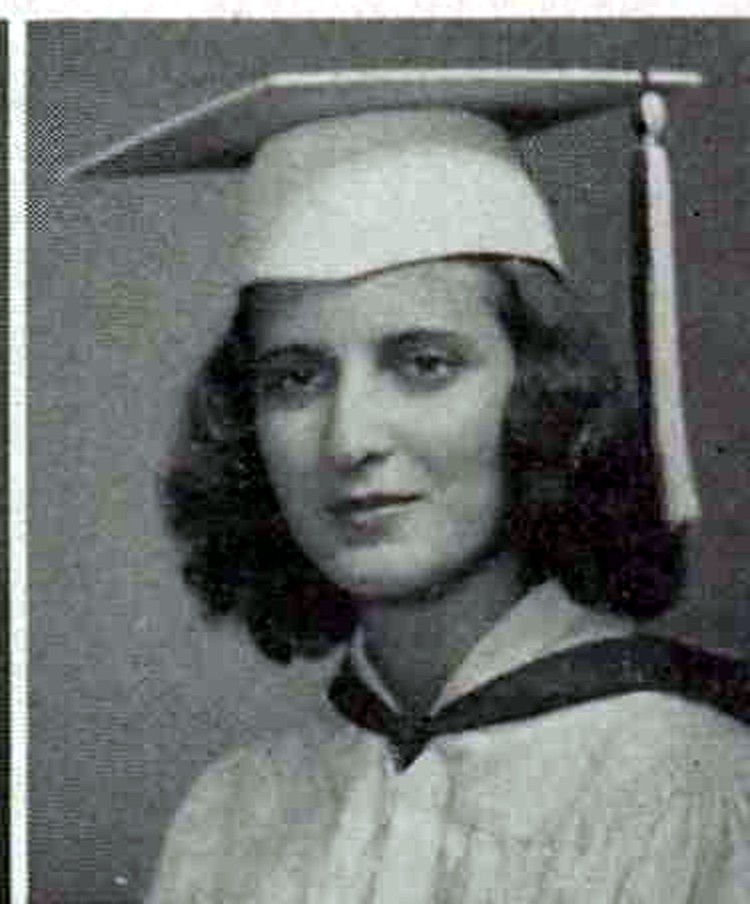
1943 · Little Flower High School
Regina McDermott
Her yearbook gives something rare in this part of the family archive: a contemporary portrait connected to a named person, school, parish and street address.
St. Hugh of Cluny parish, established in 1922, was formerly located at the northwest corner of Howard and Tioga Streets. The parish name beside Regina’s photograph provides a reliable connection to a real institution in her neighborhood. It does not tell us which services she attended or how she spent time there.
Her father Samuel’s 1942 wartime registration also identifies the Willard Street address. Margaret Curran’s 1944 death record gives it again. Those separate documents make the location especially strong; they do not establish that everyone named was living there at the same moment or that the family owned the property.
The yearbook preserves a young woman at the end of her schooling. It does not anticipate the decades of professional work for which Regina would later be remembered.
Cambria Street
Across the city, Frank J. Conlin was living at 250 East Cambria Street. In the 1942 registration, he identified his mother, Mame Conlin, as the person who would always know his location. The card records his employer as Link-Belt Company.
Those details place him within two kinds of ordinary continuity: a family home and a job. It is tempting to read the draft card only as the beginning of his military history. Yet it records who he was immediately before entering service.
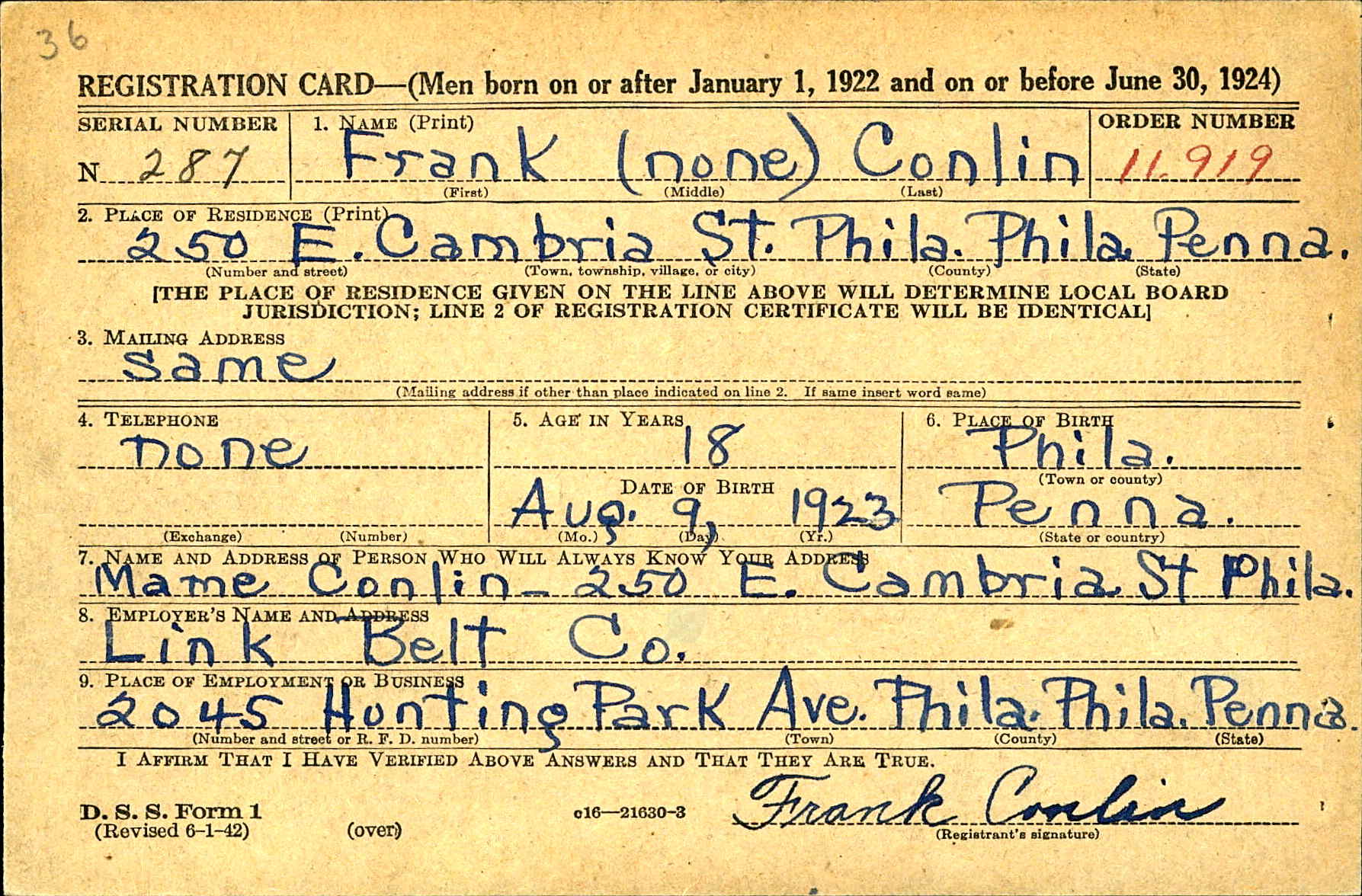
1942 · Draft registration
Frank Conlin
Home, employer, and family contact appear together on one document. A registration card confirms those facts; it cannot describe his working day, military assignments or private expectations.
Link-Belt made industrial equipment for conveying and moving materials. Period company publications identify a Philadelphia location at 2045 West Hunting Park Avenue. The Smithsonian preserves Link-Belt photographs and equipment records dating from 1915 to 1967, providing a way to investigate the industrial world surrounding Frank’s employer.
Neither the card nor that company collection establishes his job title, his duties, or the exact room or building where he worked. The broader machinery industry is context for his employment, not a reconstruction of his shift.
Philadelphia had long been a manufacturing city. By 1942, wartime production was bringing new contracts and workers into local factories, shipyards and military facilities. The region supplied equipment, armaments, clothing and other materials. We cannot conclude from that citywide history alone that Frank’s particular Link-Belt job was defense work.
The war years
Frank entered the United States Army on December 9, 1942, according to his later Pennsylvania veterans’ compensation application. The same record documents service overseas and a separation date of November 27, 1945.
These dates mark more than a bureaucratic interval. They mean that the young man who supplied the Cambria Street address in 1942 was away in military service for much of the period that followed. They do not explain where every part of that service took place or what he experienced.
A later obituary associated Frank with the 27th Infantry Division. Without unit-specific primary records, that account should not be expanded into claims about particular campaigns, landings, battles or injuries. The surviving application establishes service and its endpoints; it does not establish a complete itinerary.
Regina's 1943 yearbook belongs to those same years. The two source trails therefore run alongside each other, one through a military form and one through an educational record. Neither tells us when Frank and Regina met, whether they corresponded, or how a relationship developed.
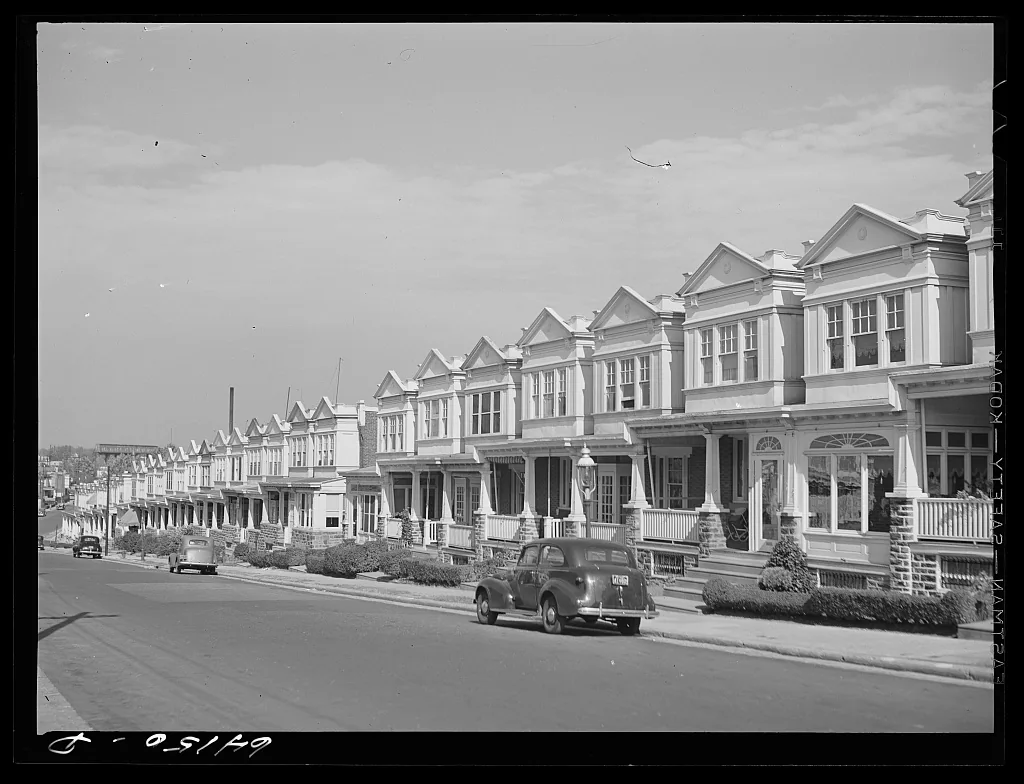
Philadelphia itself was changing during these years. Defense industries expanded while the city dealt with wartime restrictions, housing pressure and shifts in employment. Some families faced separation; some women entered new kinds of paid work. These were features of the city's experience, not documented particulars of Regina’s own 1943–45 routine.
Souder Street
By April 1950, the federal census identified Frank and Regina as husband and wife in the same Philadelphia household at 6713 Souder Street. Frank was recorded as a production supervisor. His 1950 veterans’ compensation application independently supplies that address.
For the first time in these records, the separate Cambria and Willard Street trails have become one address. The documentation supports the shared household, not the story of how they met or the details of their wedding.

1950 · Federal census
A shared household
The census places Frank and Regina together after the war. The published crop shows the two adult entries only; the full original remains in private research storage. Scroll the image horizontally to read its columns, or open the original crop at full size.
The date of their marriage remains a separate research question. Inherited family records disagree; an obituary offers a likely anniversary, but the original marriage registration has not yet been inspected. An exact wedding date would create a precision the available documentary sources do not presently support.
Three addresses in the record
- 1942 · Frank
- 250 East Cambria Street
- 1943 · Regina
- 221 East Willard Street
- 1950 · Together
- 6713 Souder Street
- Work · Link-Belt
- 2045 West Hunting Park Avenue
After 1950
The 1950 census was only an early record of their life together. Later sources describe Frank working for Air Products & Chemicals and in real estate. Regina’s obituary recounts thirty-one years at Muhlenberg College in Allentown, first in the Registrar’s Office and later supporting a dean’s office; she retired in 1993.
Those later working lives deserve to be understood on their own terms. Regina's role was not simply to appear beneath Frank on a census page, just as Frank's life was not defined solely by his Army service.
We still lack letters, a marriage record and verified period photographs of the three individual houses. We do, however, have distinct records of their early adult lives: Regina with a school, parish and address; Frank with his mother, employer and address; Frank’s wartime service; and finally the place where their names appear together.
They are not a complete biography. They are a careful account of what the surviving evidence allows us to know.
Records and further reading
Family evidence. Frank's 1942 wartime draft registration identifies his residence, contact and Link-Belt employment. A later Pennsylvania WWII compensation application records his Army service and separates wartime residence from the postwar Souder Street address. Regina’s The Garland 1943 Little Flower High School entry records her portrait, 221 East Willard Street and St. Hugh parish. Her father's 1942 registration and Margaret Curran's 1944 death certificate repeat the address. The 1950 Philadelphia census identifies Frank and Regina together, and the compensation application independently repeats 6713 Souder Street. Original private files are not exported; existing cropped public excerpts are used above.
Wider setting and contemporary sources.
- Herbert Ershkowitz, “World War II”, The Encyclopedia of Greater Philadelphia. Regional production, employment, wartime restrictions and housing context; not individual experiences assigned to the family.
- Archdiocese of Philadelphia, St. Hugh of Cluny parish history. Founded in 1922; formerly at Howard and Tioga Streets.
- Smithsonian National Museum of American History, Link Belt Company Photographs, 1915–1967. Company-industrial history; no individual photograph identified as Frank’s workstation.
- John Vachon, Philadelphia rowhouses, October 1941, Library of Congress. The item catalog reports no known publication restrictions and does not establish a family street.
- PhillyHistory address search, East Willard Street; related East Cambria Street and Souder Street searches. These are search leads, not verified images or reproduction permissions.
Evidence boundaries. Neither a wedding date nor detailed courtship, private correspondence, exact 1940s house photographs, Frank’s particular campaigns, nor the precise nature of his Link-Belt work has been independently established. The historical images show named sources or city context, not imagined family moments. No private research URLs, raw census pages naming living descendants, or unpublished genealogical data are disclosed.