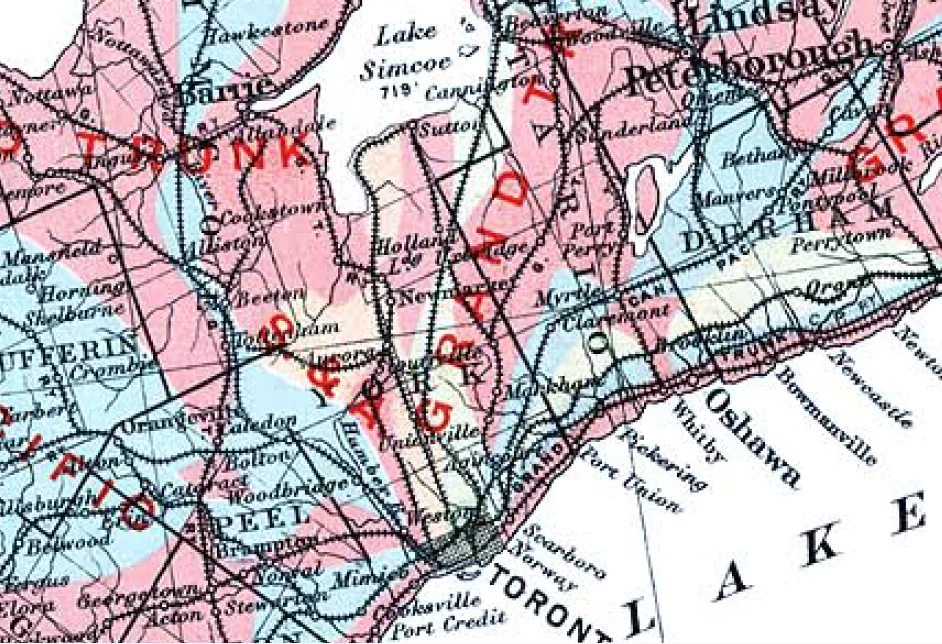
On April 1, 1891, a son named Levi was born to James Hilliard and Sarah Bartlett. The original Ontario birth register identifies James as a farmer; the entry was registered on April 16, 1891, by a medical informant who gave Schomberg as his address. Read the original birth register ↗
The 1901 Canadian census later places young Levi in James and Sarah's King Township household among his siblings. That is a more personal glimpse of the family in which he grew up than a birth entry alone, although it tells us nothing about the children's individual pursuits. See the 1901 household census ↗
Original Ontario records also name siblings and other relatives. Explore the wider Hilliard, Bartlett and Brock families ↗
The generation before Levi
James and Sarah, 1886
Five years earlier, on September 30, 1886, James Hilliard and Sarah Elizabeth Bartlett married in King, Ontario. The register describes James as a twenty-five-year-old farmer, born in York County, and Sarah as twenty-three, born in Port Dover. They came from different Ontario places, and their marriage record preserved both sets of parents' names.
For James, those names were Thomas H. Hilliard and Jane McCarroll. For Sarah, they were Harris Bartlett and Lucinda Brock. The names matter not because they unlock an endlessly older pedigree, but because this is a contemporary account linking people at an identifiable moment in their lives.
Earlier censuses place the Bartlett household in Ontario, with Harris sometimes entered as Horace. The 1871 North Bruce census places the couple with children Horace, Mary, Amelia and Sarah E. More decisively, three original marriage returns preserve the family from the children's own generation: Mary Bartlett's marriage in 1876, Horace Bartlett Jr.'s in 1879, and Sarah Elizabeth's in 1886. All name Harris or Horace and Lucinda as parents; the last two preserve Lucinda's maiden name, Brock.
Sarah's own married household also survives beyond the wedding and her children's births. In the 1911 King Township census, James and Sarah Hilliard appear with several children, while their son Levi, then a young adult, is listed in the next numbered family with his older brother James H. and sister Lucinda. The enumeration does not establish that they occupied neighboring buildings, but it catches siblings at different stages of adulthood before Levi married Catherine in 1913.
A later original record keeps Sarah herself in view. Her September 1946 Ontario death registration describes her as a retired housewife and gives her permanent residence as Lot 18, Concession 8, King Township. The informant was her son. The same certificate records that a fall at home fractured her hip shortly before her death; it gives pulmonary edema as an immediate medical cause. These are particulars from the final record of her life, not evidence that she owned the parcel or lived there continuously. Her reported birth date also conflicts with ages in earlier documents.
The records also lead back to Lucinda’s family, where the evidence is more indirect but still persuasive. We now use a preferred reconstruction connecting Lucinda to James Brock, Sarah Grimshaw, Francis Brock and Isabella Ingraham. Read that earlier family chapter ↓
View the original 1886 marriage-return excerpt ↗. This is the column for James and Sarah alone; the complete page, including other marriages, is retained in the private research archive.
The earlier Ontario family / The Brocks and Bartletts
From one household to another.
In the 1851 census of Egremont Township, James and Sarah Brock were enumerated with Isaac and a young Lucinda. The page records people living within one household, though not the precise relationships among them. We have accepted James and Sarah—identified in a later family history as Sarah Grimshaw—as Lucinda’s most likely parents. Their shared census entry is our starting place, not the end of the story.
By 1861, another census places Harris Bartlett and Lucindy close to a Brock household. The ages are difficult to reconcile, and a second, younger Lucinda Brock appears in the same schedule; she must not be mistaken for the married woman. In 1871, Horace and Lucinda Bartlett appear in North Bruce with children recorded as Horace, Mary, Amelia and Sarah E. The names and movements resemble the family we seek, but the marriage records provide the firmer bridge.
Mary Bartlett married in Amabel in March 1876. Harris Bartlett Jr. appears as a witness. In September 1879, Horace Bartlett Jr. married Louisa Moore; that return specifically names Lucinda Brock as his mother. Seven years later, Sarah Elizabeth Bartlett’s marriage to James Hilliard gives her parents as Harris Bartlett and Lucinda Brock. Together, the three entries preserve Lucinda not simply as a point on a tree, but as a mother named by grown children at different moments of their lives.
The earlier generation takes us to Francis Brock and Isabella Ingraham, whom we retain as James’s most likely parents. Francis appears in New York records in 1796 and York Township land papers in 1804. Later family histories supply the proposed parentage. They also identify a younger Francis Brock who married Elisabeth Hume Cullen in 1821. That second marriage belongs to a possible collateral branch, not a replacement for Lucinda’s direct ancestral chain.
The value of this reconstruction is that it allows these people to remain connected without obscuring the limits of the surviving sources. When a record identifies a child’s parents, we say so; when it puts several people in one household, we describe the relationship as our best reading, available for correction if more evidence arrives.
Another generation / County Fermanagh, Ireland
Before the Brocks came to Canada.
By 1753, a Thomas Brock and Margery Breen were named in a marriage-licence bond in Inishmacsaint Parish, County Fermanagh. A later Brock family history identifies Francis Brock, born in 1760, among their children. We now accept Thomas and Margery as the most likely earlier generation in the Brock–Bartlett branch, with the same qualification that accompanies the James–Francis parentage further down the tree.
The details of Thomas's life are unusually specific for this period. A descendant history reports that in 1769 he leased land at Curnadarum, adjoining his home place of Killymore. An independent parish roster names a Thomas Brock as churchwarden in 1784, 1785, 1786, 1787 and 1788. Those two sources give us a man associated with farmland and parish affairs, rather than merely a date in an online family tree. The underlying 1753 marriage bond and 1769 lease have not yet been inspected here; the precise identity of every churchwarden entry therefore remains qualified.
For Margery, the surviving descriptions are quieter. A woman's name in an eighteenth-century marriage bond tells us almost nothing about the labor, relationships or obligations of the rest of her life. That absence does not make her less central to the family: Francis's reported parentage places her at the beginning of this branch. We have not assigned her parents or invented a family from other Breens in the parish.
The earlier Ontario generation
Thomas and Jane
We can now follow a more persuasive trace of Thomas Hilliard through the records his family left in Vaughan. The 1881 census places an England-born farmer, Thomas Hilliard, about fifty-five, in a household that also includes an Ontario-born James, about twenty-two. A decade later, the 1891 Vaughan census records Thomas as sixty-six, again born in England and farming, with Samuel, twenty-six, explicitly described as his son; Sarah appears on the following page as a daughter. The original registers do not call the James of 1881 Thomas's son, but the names, ages and locality are consistent with the relationship recorded independently in James's 1886 marriage.
The 1878 York County atlas associates a Thomas Hillyard with fifty acres at Lot 28, Concession VIII in Vaughan. A land-registry abstract for the same lot records a will dated in 1891, registered in March 1898, naming John, Thomas, James, William, Samuel and Sarah Hilliard. Together the matching parcel and names make this the preferred family reconstruction, although the abstract does not specify whether each beneficiary was a child. An original Vaughan death registration for an English-born farmer, Thomas Hilliard, aged seventy-one on November 24, 1896, is a strong chronological match. Explore the land and its surroundings ↓
An earlier household appears in the 1851 Etobicoke census: Thomas Hillyard, twenty-seven, with his wife Jane and daughters Mary Jane and Eliza. The adults are listed as England-born, the girls as born in Upper Canada. The recurrence of all four names in a 1861 York Township household makes this our preferred probable earlier family. The reported ages and Jane's birthplace are not fully consistent across records: James Hilliard later reported his mother born in Ireland, rather than England. We retain those differences alongside the working connection.
The 1861 and 1871 York Township censuses record a closely corresponding Thomas-and-Jane family: John, Thomas, James and William progress through those ten years with notably consistent reported ages. We include these households in our preferred family reconstruction. Some age differences remain significant—the older Thomas reads as sixty-two in 1871, versus fifty-five in Vaughan in 1881—so the precise identity of every same-named person cannot be settled from census entries alone. The previously misattached 1861 Peel County image is not evidence of this family.
A later record lets us meet one member of Thomas's household by name. Samuel Hilliard died in Vaughan on July 23, 1935, recorded as a farmer with a son, Henry, who supplied the information. His death registration names a father recorded as Thomas Edward Hilliard and an Ireland-born mother whose surname appears to read McCann. Samuel is a strong candidate for the son named alongside Thomas in the 1891 Vaughan census, though his reported 1862 birth year differs from the census and inherited family records. The parental middle name and maternal surname also differ from those recorded at James's 1886 wedding; these are significant discrepancies, not spelling details we can decide by preference alone.
A further census detail helps narrow the search for Jane. On the 1881 Vaughan sheet, Thomas appears to be marked widowed, although the original field is faint enough that we retain that as a provisional reading. An inherited family-tree entry claims that Jane died on February 29, 1880. The two dates could fit, but we have not found an original death registration establishing the woman's name or confirming that exact date. It gives us a useful search window rather than a completed biography.
The 1889 Vaughan marriage of a younger Thomas Hilliard names his parents simply as Thomas and Jane, and appears to list Samuel Hilliard and Sarah Hilliard among the witnesses. Those names recur in the 1881–1891 Vaughan households. This supports a family association but does not establish the younger Thomas as the Heidelberg farmer who died in 1927 or give us Jane's maiden name.
Jane herself remains less visible. James's original 1886 marriage names Jane McCarroll as his mother. A later 1927 death certificate for a younger Thomas Hilliard identifies his mother instead as Jane McKay; that different name belongs to its own record until we can establish whether the men—and the two reported surnames—refer to one family. A nearby McCarroll immigrant family appears in an 1885 King Township history, but no document yet identifies its members as Jane's relatives. We can tell a fuller story of this Ontario household without assigning Jane an unsupported Irish family or Thomas a particular English birthplace.
The original census images have already been examined in the family's private research collection: 1851 Etobicoke p. 41; 1861 York Township p. 110; 1871 York Township p. 34; 1881 Vaughan p. 25; and 1891 Vaughan pp. 6–7. Their source-specific age and birthplace disagreements are preserved in the research crosswalk. Read Thomas's individual profile ↗ Read Jane's individual profile ↗
York County / Vaughan Township / 1878
Fifty acres in Vaughan
A name on a land map gives this family something more lasting than an entry in a census: a place in the countryside where their story unfolded.
The Hilliards appear in the nineteenth-century record first as a working household. In the census taken in Etobicoke in early 1852, Thomas was described as a labourer, Jane as his wife, and Mary Jane and Eliza as their daughters. A decade later, a family of the same names appears in York Township, now with younger children. Those records are our preferred connection across the years, although the ages and reported birthplaces do not fit perfectly.
Farther north, a contemporary atlas gives a different kind of detail. Published in 1878, the Illustrated Historical Atlas of the County of York lists Thomas Hillyard on Lot 28, Concession VIII, Vaughan, with fifty acres. This is a recorded association with a specific surveyed parcel—not proof of the precise farmhouse, a building's appearance or all the land he may have worked.

Along the same concession, the village of Kleinburg had grown around mills on Lot 24. John Nicholas Kline established a sawmill and gristmill there in 1848; later mill owners and village tradespeople served the surrounding agricultural district. This was the regional setting of Vaughan's farms, rather than a documented list of businesses the Hilliards personally visited.


By 1891, Thomas was recorded in Vaughan as a farmer, with Samuel explicitly named as his son. The land record adds an unusually specific family clue: an abstract of Thomas's will, made in 1891 and registered against Lot 28 in 1898, names John, Thomas, James, William, Samuel and Sarah Hilliard. The original will has not been recovered, but the property and names fit the family reconstructed from the other records.
A family reconstructed from original records
Thomas, Jane and the wider household
The census records, James's marriage, and the Lot 28 will abstract preserve these names. The connections are our preferred family reconstruction, not a claim that the will identifies every beneficiary as a child.
Documented son James and the probable wider family
- JamesParents named in 1886 marriage · direct ancestor
- Mary JaneEtobicoke 1851 / York 1861 · probable daughter
- ElizaEtobicoke 1851 / York 1861 · probable daughter
- JohnYork censuses / will grantee · probable connection
- Thomas Jr.York censuses / will grantee · probable connection
- WilliamYork censuses / will grantee · probable connection
- Samuel1891 Vaughan census: son · probable will match
- Sarah1891 Vaughan census: daughter · probable will match
The documents leave the house unseen and the family's daily work largely undescribed. They nevertheless place these people in a recognizable landscape of farms, roads and mills—and give a later generation a location to return to. Return to Thomas and Jane's earlier records ↑
Historical maps and photograph are period sources, not portraits of identified Hilliard people or property. The Kleinburg map and circa-1910 postcard are marked public domain by Wikimedia Commons; Vaughan atlas map courtesy of McGill University's Canadian County Atlas Digital Project. Kleinburg history, City of Vaughan ↗
The family Roy inherited
Levi and Catherine
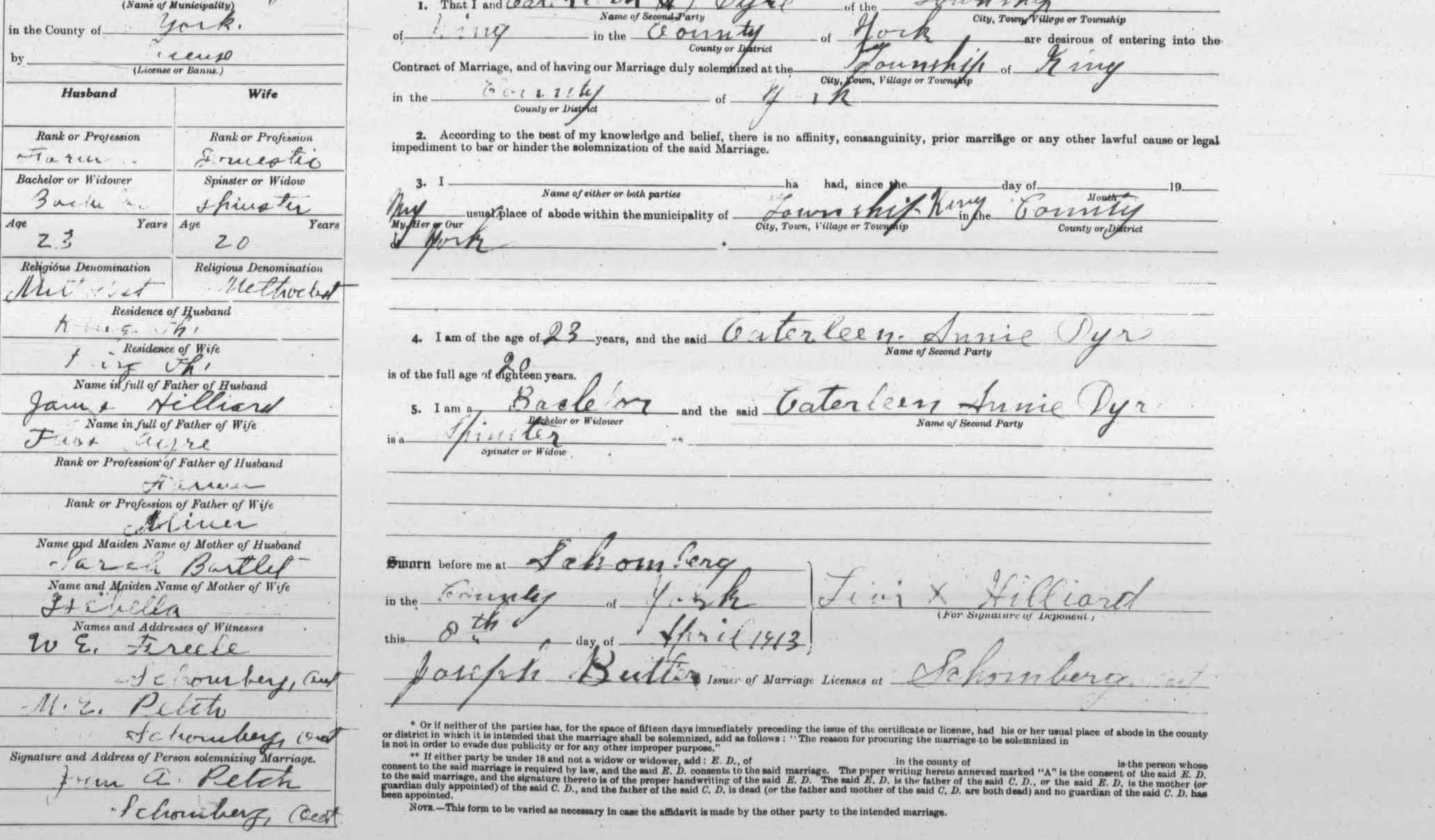
On April 8, 1913, Levi Hilliard married Catherine Annie Ayre in King Township. Their original marriage affidavit identifies Levi as a farmer and Catherine as a domestic worker; both reported their religion as Methodist and their residence as King Township. Levi was recorded as twenty-three and Catherine as twenty, although their earlier birth records point to ages twenty-two and nineteen. Catherine's father Thomas Ayre was called a miner, and her mother's given name was Isabella; the form does not give Isabella's birth surname. The accompanying Ontario licence was issued that same day. Catherine had been born in England; her early-life records lead to a probable, but not definitively proven, 1904 journey to Canada with a Barnardo party, a history told separately because it merits its own careful treatment.
Roy was born several years after the wedding and grew up in the Hilliard household in King Township. Later censuses place Levi at work, including as a carpenter in a planing mill in 1931. That same 1931 census records a ten-room family home with a radio, one tangible detail of the setting in which Roy grew up. The return reports owner occupancy but does not identify a property deed or prove continuous residence at that home. It cannot tell us how Roy remembered his parents or what an ordinary evening felt like. Roy's own biography follows this household more closely ↗
The surviving family photograph of Roy and Mary Mitchell belongs to a later chapter. These earlier entries are the traces of the households that preceded theirs.