In September 1886, James Hilliard married Sarah Elizabeth Bartlett in King Township, Ontario.
Their marriage registration recorded James as a farmer, born in York County. Sarah had been born in Port Dover, farther southwest along the shore of Lake Erie. Both entered the marriage with families and histories of their own, although the register preserved little beyond their names, ages, birthplaces and parents.
Five years later, on April 1, 1891, their son Levi was born. His birth registration again described James as a farmer.
The occupation appears almost incidentally, a word entered beside the names of a new child and his parents. Yet it is one of the clearest surviving indications of how the household supported itself.
The record does not identify James’s farm, tell us whether he owned or rented the land, or describe what he grew. It offers no acreage, harvest account, or measure of Sarah’s contributions.
What it does establish is that the Hilliards belonged to the working landscape of rural Ontario at the end of the nineteenth century.
The land around King Township
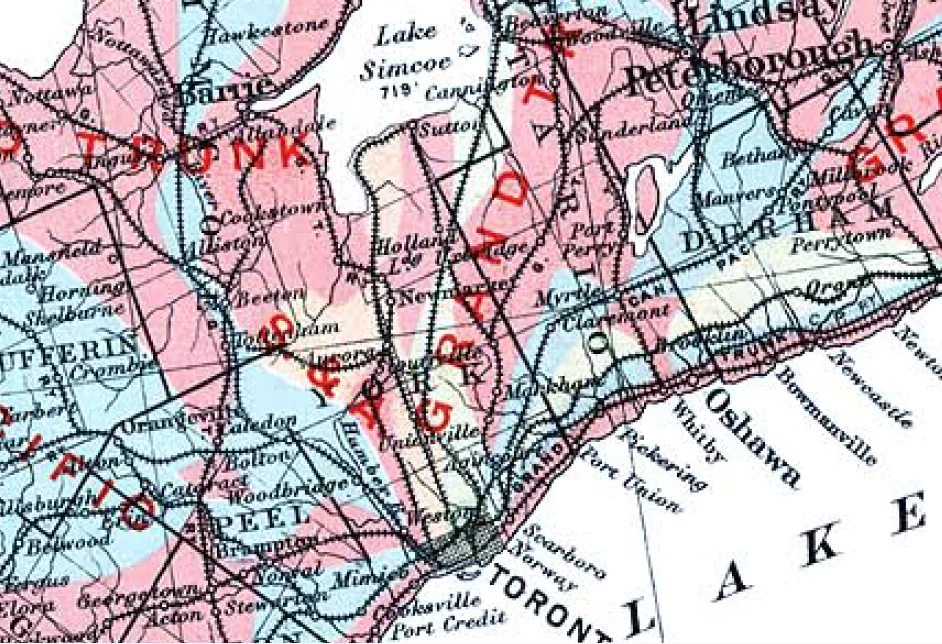
King Township was a place of farms, villages, mills, workshops, and roads connecting scattered communities. Its households lived by the seasons, though the record does not identify James’s acreage, crops, livestock or whether he owned the land he worked.
Spring planting, summer maintenance, autumn harvesting and food preservation, and winter repairs shaped the wider agricultural economy. These ordinary routines provide context, not a diary of the Hilliards’ days.
Sarah appears principally through the marriage and birth records. The unpaid labour of rural households—cooking, washing, childcare, food preservation, and sometimes work directly connected to agricultural production—was rarely recorded as an occupation. We cannot assign particular duties to Sarah, but her absence from an occupation column should not be mistaken for an absence of work.
The family’s documents preserve the names of children, yet cannot tell us what was said at supper, how chores were shared or what the children hoped to become.
A village connected to a wider world
Schomberg served surrounding farms through merchants, mills, craftspeople and markets. The township’s agricultural fairgrounds, established at Schomberg in the nineteenth century, brought rural families into a shared commercial and social landscape.
The Schomberg and Aurora Railway opened in 1902, connecting the village through Oak Ridges to wider markets. In 1907 a market association and market hall brought another focus to the exchange of agricultural products.
The surviving family records do not establish that James sold anything at Schomberg, attended its fair, or travelled on its railway. These developments describe the working world around the family, rather than particular activities we can attribute to them.
For a child like Levi, growing up in this region meant living in countryside increasingly connected to towns, manufacturers and distant buyers.
Levi’s working life
On April 8, 1913, Levi married Catherine Annie Ayre in King Township. Catherine had been born in England and come to Canada as a child. Her early story, including a probable 1904 crossing, belongs to a separate account grounded in surviving records.
Their son Roy was born near Schomberg in 1918. The 1921 census places him in their household; the 1931 census records a particularly useful detail about Levi: he worked as a carpenter in a planing mill.
Planing mills prepared lumber for building and joinery. Machines smoothed and shaped boards and mouldings, supplying material to carpenters and builders. Levi’s recorded occupation does not identify his employer, his daily tasks, or a workshop he owned.
The contrast with James’s farming occupation is revealing but incomplete. We do not know how Levi learned carpentry, whether he considered farming, or what prompted his path. The documents preserve the difference between two kinds of work, not the private decisions connecting them.
The countryside changes
Motor vehicles and trucks gradually altered the movement of farm products and people. The Schomberg and Aurora Railway ceased operating in 1927. Across Ontario, machinery was also changing farming, although horses and older methods remained important to many households.
These developments did not reach every family equally. Nor can we say that they changed the Hilliards’ circumstances in a particular way. They form the historical backdrop to Roy’s childhood in a household supported by Levi’s recorded carpentry work.
We cannot tell whether Roy expected to follow his father’s trade, remain in King Township, or choose an entirely different life. The documents show his setting, not his ambitions.
What the records leave behind
A marriage, a birth and a census offer a narrow view of work that filled entire lives. James was recorded as a farmer; decades later Levi was recorded as a planing-mill carpenter. Sarah and Catherine appear in a paper trail that tells us far less about their daily responsibilities.
No established photograph places James in his fields or Levi at a workbench. Their earnings, employers, routines and private thoughts remain out of sight.
Yet the records preserve something worth holding on to: successive generations made homes in a rural Ontario economy of farms, workshops and markets, where keeping a family housed, fed and cared for depended on a great deal of ordinary labour.
The occupations survived because someone wrote them down. The lives around them were considerably larger.