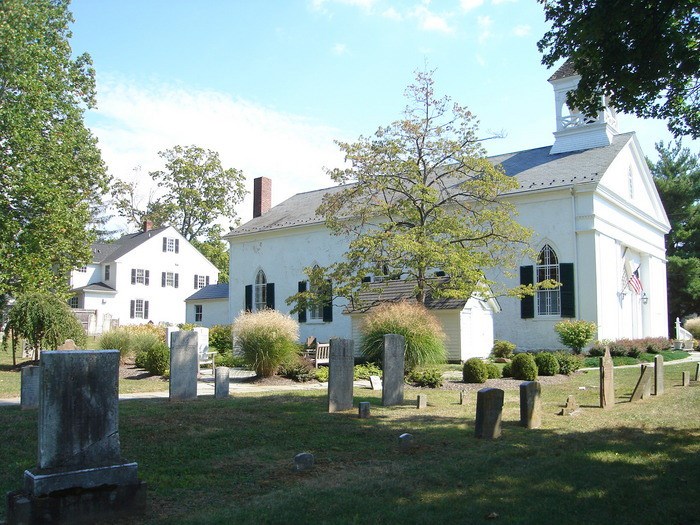
In 1782, the Melick family's church in New Germantown became the setting for an unusually public disagreement. The dispute began with a guest in Tunis Melick's home and reached its climax during a Sunday sermon.
Tunis was already established in the district: the son of a German immigrant, a miller, a landowner and a county freeholder. He and his wife Eleanor, known in some family records as Neeltje, had been part of Zion Lutheran's community. A surviving list of communicants from 1773 includes “Mr. Anthony Meelich” and his wife “Eleonora”—the same couple under slightly different forms of their names.
A stranger with a different message
According to Andrew D. Mellick Jr.'s 1889 family history, a Methodist missionary arrived in Tewksbury in 1782 and stayed with Tunis. The visitor appealed to Tunis and to his sister Maria Catharine, who was married to longtime township clerk John Henry Müller (Miller). The missionary's teachings did not please everyone.
Müller objected to the visiting preacher's beliefs and reported his concerns to the Lutheran pastor, William Anthony Graff. At a subsequent service, Graff denounced the Methodist missionary from the pulpit. The nineteenth-century author describes what happened next with some of his most vivid language.
Tunis rose from his seat.
He interrupted the pastor and protested the attack on his guest. Another church warden, Godfrey Rinehart, joined him. The historian reports that the episode created considerable commotion among the worshippers. Tunis and Rinehart were subsequently tried and removed from their positions on the church vestry.
What followed the confrontation
The argument did not end the experiment. Tunis and Eleanor continued to support the Methodist movement. Methodist preachers soon held services in sympathetic homes; the itinerant Bishop Francis Asbury preached at the home of Mindurt Farley. In 1824, New Germantown's Methodists incorporated a society and erected Wesleyan Chapel on James Street. Among its first trustees was Nicholas Egbert Melick, Tunis's grandson, together with John and James Melick and other neighbors. What began as an uncomfortable Sunday at church became part of a community institution that lasted into the next century.
It is striking to remember that this was a family already deeply connected to Lutheran New Germantown. Tunis's relatives had worshipped there, served as trustees and helped anchor its German-speaking community. His change of allegiance was not simply a private religious preference; it affected friendships, family connections and the small institutions holding the settlement together.
The author of The Story of an Old Farm wrote as an admirer of the Lutheran pastor and used pointed language for the Methodist converts. His account is a nineteenth-century telling of an event more than a century earlier, not a transcript of the sermon or the disciplinary hearing. Even with that limitation, the details are unusually specific: the host, his sister, the visiting preacher, the pastor, the second warden and the outcome all have names or roles.
A different kind of inheritance
Don Melick's life began on a dairy farm in Oldwick, but the family's roots in the village were never solely agricultural. Tunis's mills helped feed the community; his civic service placed him in its local government; this quarrel shows him shaping its religious future, too.
Whether one admires or questions his decision, the episode makes an ancestor who might otherwise appear as a name and two dates feel like a person—with convictions strong enough to stand and disagree before his neighbors.
Sources & distinctions
- Andrew D. Mellick Jr., The Story of an Old Farm; or, Life in New Jersey in the Eighteenth Century (Somerville, N.J., 1889), cited by printed page; digitized book ↗.
- Chapter VII, printed pp. 87–88: names in the 1773 communion register; account of the 1782 dispute and the founding of a Methodist congregation. The family relationship between Tunis and Maria Catharine is also recorded in the genealogical appendix, printed pp. 682–683.
- James P. Snell, History of Hunterdon and Somerset Counties, New Jersey (1881), printed pp. 481–482 (PDF pp. 573–574), independently summarizes the 1782 dispute and names the original 1824 chapel trustees, including Nicholas E. Melick.
- The church photograph is a present-day contextual image from the family archive. The event is reconstructed from the 1889 author's account; the precise spoken exchange is not independently preserved in this source.