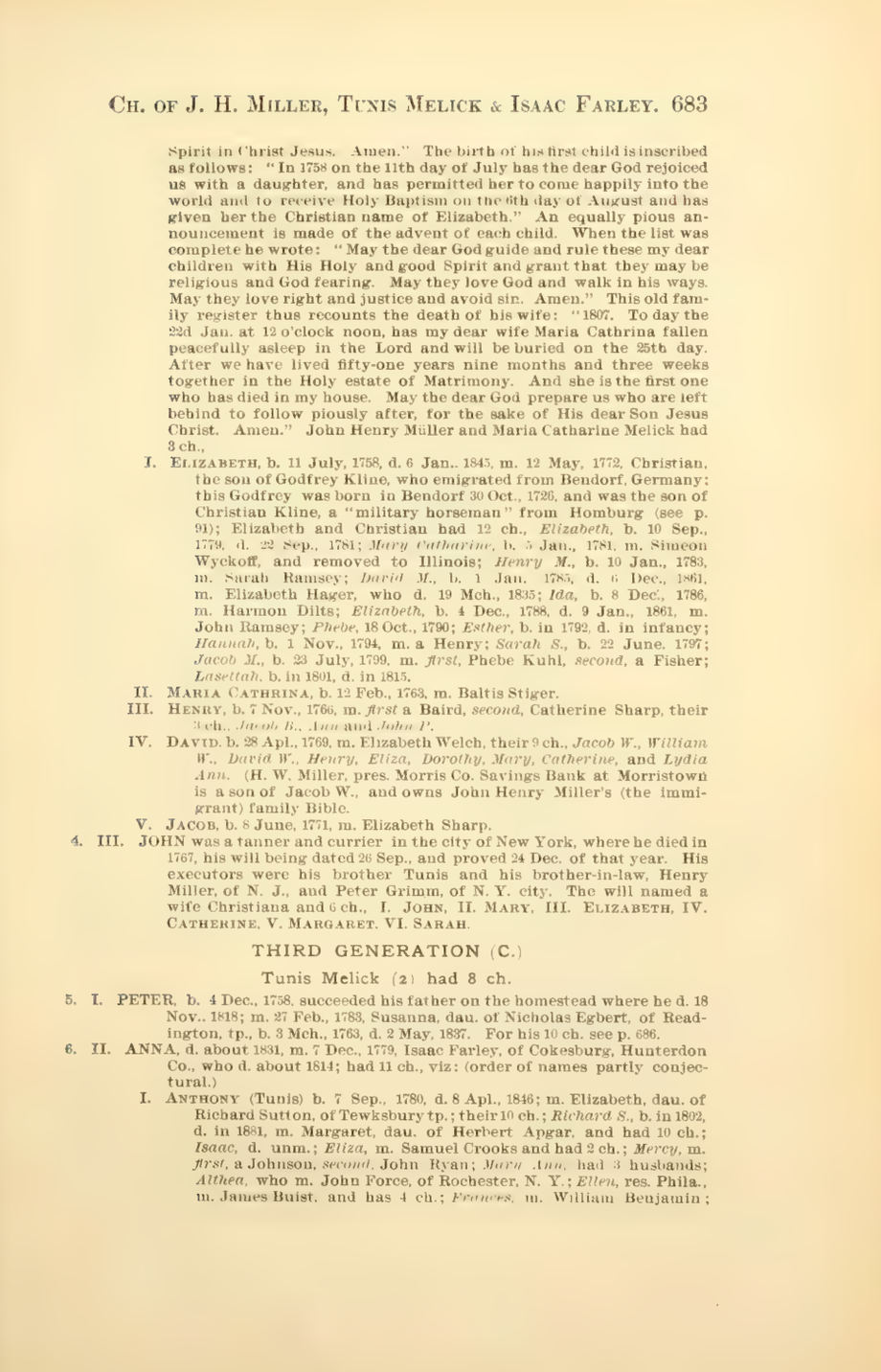
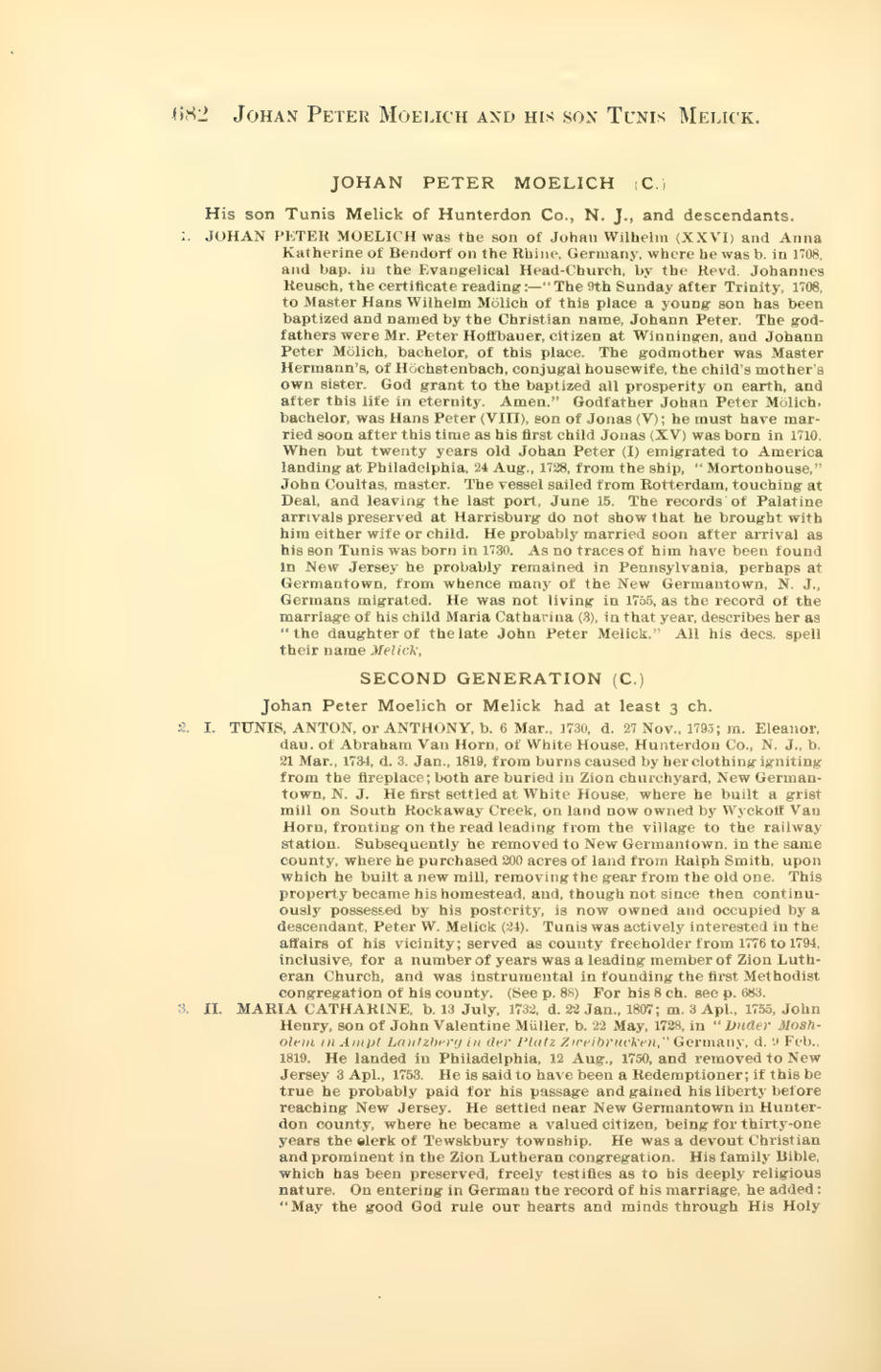
On April 3, 1755, Maria Catharine Melick married John Henry Müller. She was the daughter of immigrant Johann Peter Moelich and sister of Tunis, the miller in Don’s family. Their household lived near New Germantown in Hunterdon County. Two branches of their story would eventually meet again in Donald Melick’s ancestry.
John Henry had come from Germany in 1750 and settled in New Jersey three years later. The 1889 family historian describes him as a respected resident who served for decades as township clerk. His name appeared in records of public business. But a more intimate record also survived: his family Bible.
Births written as blessings
Rather than simply listing names and dates, Müller wrote about his family in German in the language of prayer. The history reproduces his record of the marriage and the birth of a daughter, Elizabeth, on July 11, 1758, followed by her baptism that August. For each child he recorded another arrival into the household.
Elizabeth later married Christian Kline. Their son Henry M. Kline, born in 1783, carried the family into another generation. That line continued through the Klines and Van Sickles to Mary Lynn Van Sickle, who married Walter Cameron Melick—bringing this earlier branch into Donald’s direct ancestry through his father.
At the end of the list, he asked that his children grow to love justice and live good lives. A centuries-old register speaks, unexpectedly, in the voice of an ordinary father hoping for their future.
Fifty-one years together
Then came the entry for Maria Catharine's death in January 1807. Müller noted the hour and their long marriage—fifty-one years, nine months and three weeks—and reflected that she was the first person to die in his house. He concluded with a prayer for those who remained.
That is a remarkable amount of feeling to survive from a colonial-era household. The book does not give us a portrait of Maria Catharine or tell us how she spent every ordinary day. It does allow us to glimpse what her husband chose to remember about their life together.
Two branches of one family
For years, Maria Catharine’s story could seem like a detour away from the Melick line. Yet she appears in another direct branch of Donald’s ancestry: from her daughter Elizabeth Müller through successive Kline generations, to Cornelia Kline, Mary Lynn Van Sickle, and Donald’s father James Warren Melick. The family history identifies Elizabeth’s parents and her son Henry; the intervening Kline–Van Sickle descent is recorded in the family pedigree. The parent-child link has not yet been incorporated into every version of the graphical tree.
The 1889 appendix says the family Bible belonged at the time to a descendant, H. W. Miller of Morristown, New Jersey. Its present location is unknown. What survives here is a nineteenth-century transcription, not a photograph of the original volume. Its value is nonetheless unusually personal: the words of a father who hoped for his children and remembered his wife after more than fifty years together.
Sources & distinctions
- Andrew D. Mellick Jr., The Story of an Old Farm; or, Life in New Jersey in the Eighteenth Century (Somerville, N.J., 1889), cited by printed page; digitized book ↗.
- Genealogical appendix, printed pp. 682–683 (PDF pp. 730–731): Maria Catharine's relationship to Johan Peter and Tunis; her marriage and the author's transcriptions of the family Bible's entries; report of ownership by a descendant in 1889. Both reproduced pages are now viewable in the family archive.
- Snell, History of Hunterdon and Somerset Counties (1881), Tewksbury chapter, printed p. 475 (PDF p. 565), also calls Catharine the sister of Tunis Melick and names Elizabeth Miller’s marriage to Christian Kline. The 1889 appendix, p. 683, identifies their son Henry M. Kline (born 1783). The continuation through Henry Kline, Cornelia Kline, and Mary Lynn Van Sickle follows the family pedigree; Elizabeth’s parents were not attached in the original RootsMagic export and remain a relationship to document explicitly.
- The Bible entries are reproduced in translation/transcription by the 1889 author. The website does not claim to possess or have independently examined the original eighteenth-century volume.