A girl by Lake Simcoe
Thorah Township · 1925
Mary Mitchell was born on 17 July 1925 near Beaverton, in Ontario’s Thorah Township. Beyond the village lay the fields and concession roads of a farming district. At its edge, the Beaver River met Lake Simcoe, where the water and the land had long shaped how people earned a living and found their way to neighboring communities.
Mary grew up in the home of Walter and Emily Mitchell. She was the youngest of four children in the household, growing up alongside her older brothers Walter John and Harold Mason and her sister Florence Margaret. There were different generations and ages under one roof, all part of the world into which she was born.
Beaverton was a working village as well as a place of lake views. Its streets connected farms, shops, churches and the shore. The lake drew visitors in warmer months, while families who lived there year-round followed the obligations of work, school and home through all four seasons.
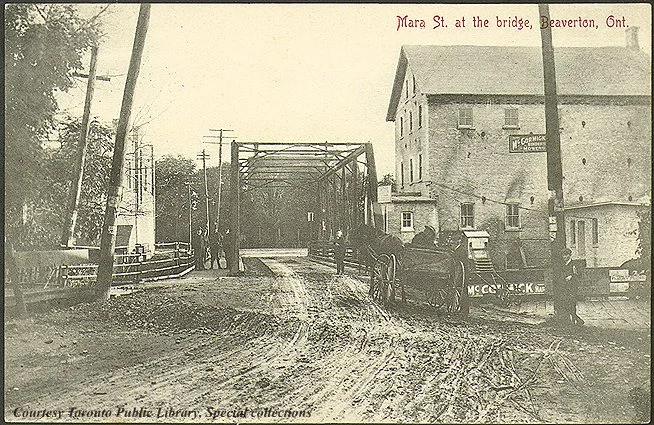
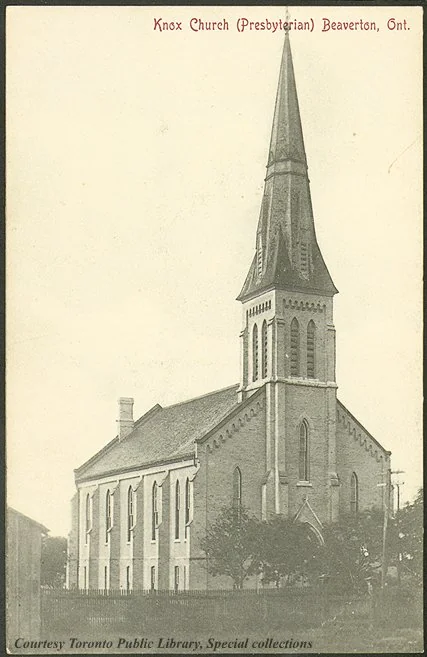
These views of Beaverton show the streets and buildings of the community as Mary's parents would have known it, shortly before her birth.
Seven rooms and a radio
The Mitchell home · 1931
Walter Mitchell worked as a labourer and had also been a greenkeeper, tending grounds through Ontario's changing seasons. The Mitchell home had seven rooms and a radio—an everyday detail that places Mary's childhood in the modern world beginning to reach even small rural communities.
It is the radio that makes this childhood scene feel unexpectedly near. In a township of farms and small villages, families could hear voices, music and news transmitted from elsewhere in Ontario and beyond. A child did not have to leave home to encounter the wider world coming through the speaker.
Mary was beginning school-age years as the Great Depression tightened its hold across Canada. In rural Ontario, the troubles of wage earners and farmers were closely entwined: a bad market for crops could be felt by shopkeepers and tradespeople, and scarce work affected the families who depended on wages. For the Mitchell children, those were the years when an unsettled country became the backdrop to growing up.
She belonged to a family whose story had reached this Ontario village by way of England. Her parents' stories had begun long before the radio entered their home.
England in the family story
Walter and Emily before Mary
Mary's father, Walter Mitchell, came from the Fifield and Bray area of Berkshire near Windsor. His British Army service record now traces his journey from England to Malta and Bermuda, and then to Halifax, Nova Scotia, in 1895. He joined the Army Reserve in July 1896 and married Emily in Woodville the following year.
Her mother, Emily Louisa, grew up among the Mitchell and Westcott families of Ontario. Their history reached back to England, but by Mary's childhood several generations had made lives in Canadian towns and farming districts. Earlier still were George and Tamson Westcott, whose lives linked Wells in Somerset with Thorah Township. Their world moved from old parish churches and lanes in England to a Canadian district of farms and surveyed roads.
Their emigration story was part of the wider nineteenth-century movement of families across the Atlantic. Such journeys could mean leaving behind familiar churches, relatives and neighborhoods and making new ones in a country whose winter, distances and working life were different. Mary's family carried those earlier crossings into the twentieth century, even though she herself was born in Ontario.

Walter's other life
An immigrant, a worker, a soldier
Before Mary was born, her father had already lived through an unusual chapter. In March 1897, Walter married Emily in Woodville, Ontario. He was working as a brickmaker in Beaverton at the time. Their marriage joined two families with English beginnings, now making their future in the Canadian countryside.
Almost two decades later, during the First World War, Walter joined the Canadian Expeditionary Force. His earlier service with the Royal Berkshire Regiment is now documented by original British military papers. In Canada he rose to sergeant in the 182nd Overseas Battalion. He was discharged at Oshawa in April 1917 because he was over the age limit, before the battalion sailed overseas. For Mary's father, military service was one chapter in a life that also included trades, migration, marriage and raising children.
By the time Mary arrived in 1925, the war had ended, and Walter's days belonged again to the work and responsibilities of home. He was an older father whose children would know him in a different period of life from the one in which he had worked as a brickmaker and put on a uniform.
Mary knew him in the later years of that life. He had been a brickmaker, an immigrant and a soldier before she was born; in her childhood he was simply her father.
The world beyond Thorah
A childhood between two wars
Mary was growing up in the years when rural Ontario was changing. Better roads and automobiles shortened journeys that once required a horse or train. Radio made news more immediate. Towns and farms remained distinct places, but the boundaries between them were less fixed than in her grandparents' time.
By the late 1930s, the economic depression was giving way to the pressures of another world war. Canada entered the conflict in 1939. Mary was fourteen. In the years that followed, young people across the country encountered wartime shortages, enlistments, new work and the worry of distant fighting. It was the world in which she passed from girlhood toward adulthood.
Walter and Emily had already seen their own lives move between England and Canada, before and after the First World War. Mary came of age with another global conflict unfolding. Three generations of one family had lived through changes that would have seemed enormous to their younger selves.
The years that changed everything
Thorah and Beaverton · 1943–1946
On 25 October 1943, Mary's father Walter died in Thorah Township. Mary was eighteen. The war was still being fought, and she was at the age when a young adult's life often begins to move beyond the household of childhood.
Two years and a few months later, on 4 January 1946, Emily died in Beaverton. Mary was twenty. Emily's last home was on Simcoe Street in Beaverton, in the community where her family had spent so many years.
For Mary, the deaths came close together, while the wider world was only beginning to emerge from the war. Before her twenty-first birthday, both parents were gone. Whatever Mary felt and whatever responsibilities the losses brought, she had entered adulthood without the two people who had raised her.
Mary would carry her earlier life into a new one with Roy Hilliard, whose childhood had unfolded near Schomberg in another part of Ontario.
Mary and Roy
Two beginnings, one family
Roy Hilliard came from King Township, where his father had worked as a carpenter in a planing mill and his mother Catherine had begun life in England. Mary's childhood belonged to Thorah and the country near Lake Simcoe. The two had different family histories, and at some point their lives joined.
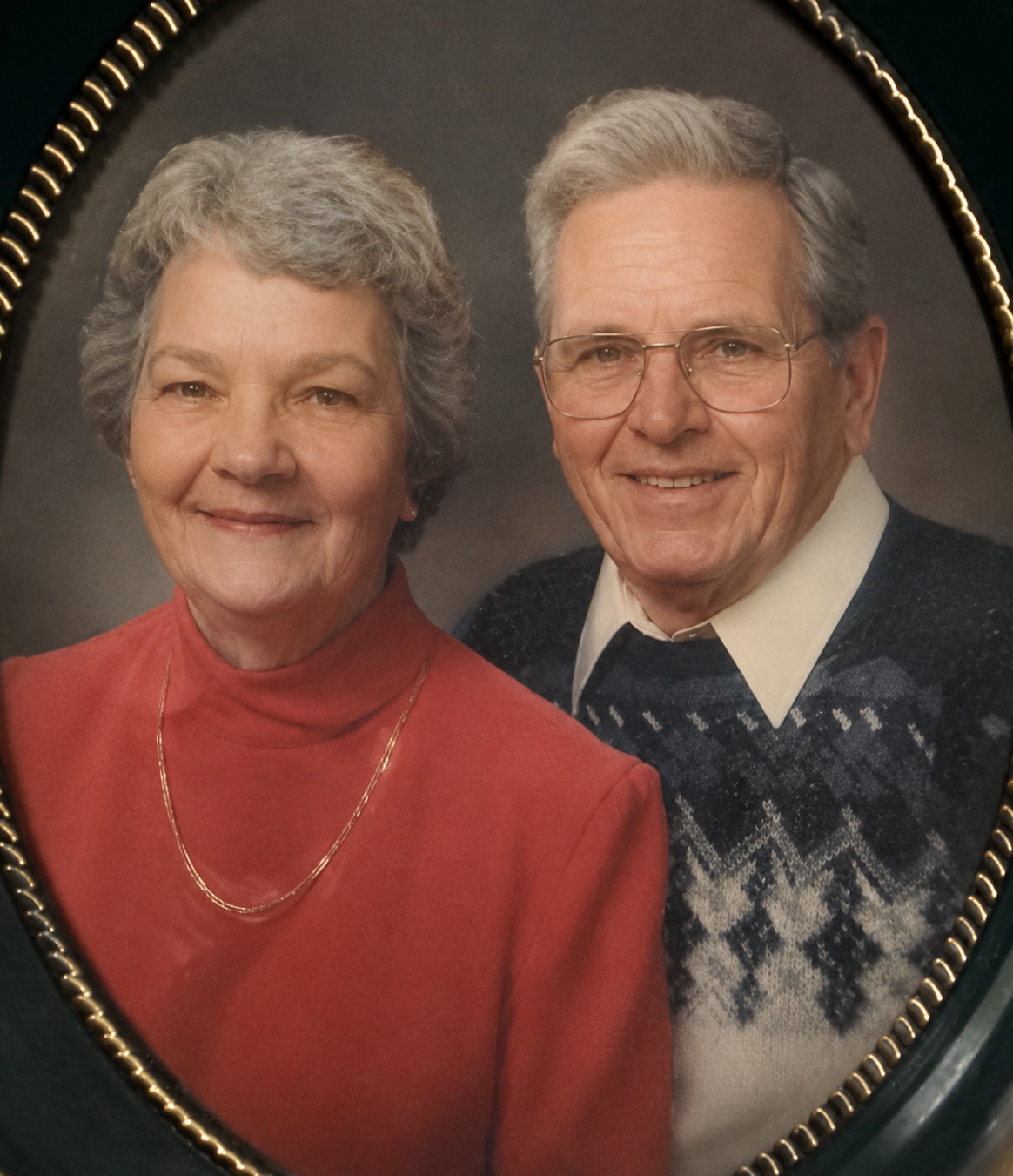
A family photograph shows Mary beside Roy. It is a quiet image, one moment in a partnership that lasted through decades of a changing Ontario. The image brings their two histories together. The girl from Thorah Township and the boy from the Schomberg countryside had built a shared life.
Roy died in 1992; Mary followed in 1996. They are buried in adjoining graves at Stone Church Cemetery in Beaverton. Their final resting place is close to the Ontario countryside where Mary had begun her life. Beaverton's Old Stone Church—built in the nineteenth century from local stone—stands in a burial-ground landscape that connected generations of the district's families. An early-twentieth-century illustration preserves a view of the church from before Mary was born. Its old stone walls offer another glimpse of the town and countryside to which Mary remained connected. See the original Old Stone Church illustration in the Toronto Public Library archive ↗
The photograph holds a moment, not a lifetime. Mary was a daughter and sister long before she was Roy's companion; she lived through the Depression, a world war, the loss of her parents, and the many changes that came afterward. Her voice, character and everyday ways of living deserve to survive in the memories her family carries forward.
Mary's life stretched from a Beaverton childhood into the changing twentieth century. She was Walter and Emily's daughter, the youngest child in a family with older siblings, and later Roy's companion. Together, their stories form one of the family lines carried into the generations after them.

