The village at the end of the line
Schomberg, Ontario · 1918
Roy William Hilliard was born in 1918 in the country around Schomberg, in Ontario's King Township. Beyond the village's main street lay farms and concession roads. In town, shops, tradespeople and mills served a rural district that depended on the surrounding land. In 1924, the village's Main Street still had wooden sidewalks, hitching posts and shops where horses and delivery wagons shared the road. Skinner's butcher shop and the small businesses around it were part of the everyday commercial scene. Roy was six years old that year. The photograph offers a rare look at the actual village landscape of his childhood, without pretending to show his family's own movements.

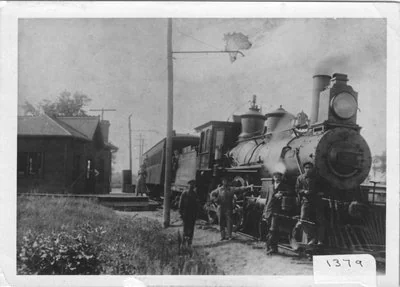
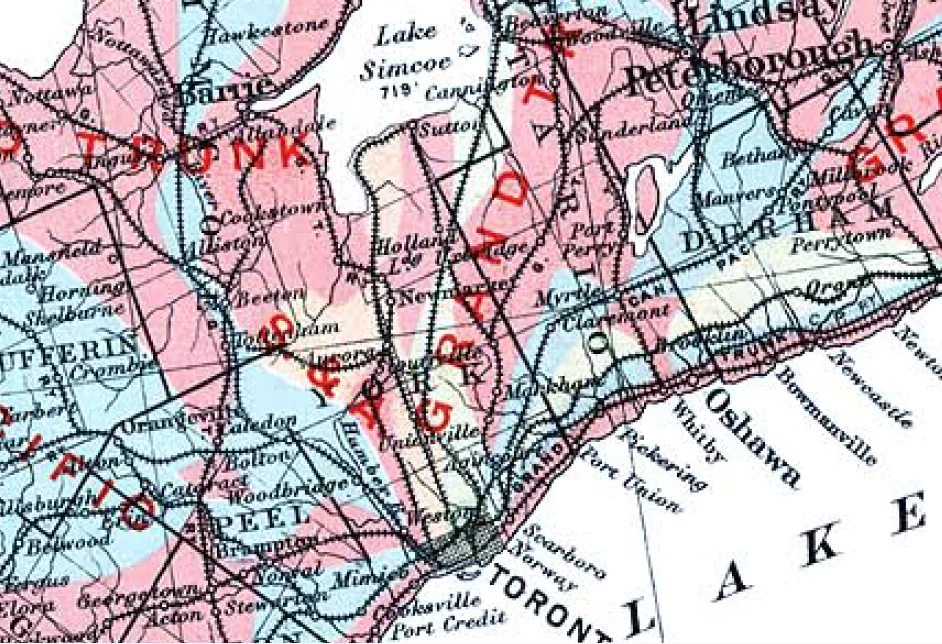
Schomberg was not cut off from the wider world. A railway had reached the village in 1902, connecting it through Oak Ridges to the road and rail networks leading toward Toronto. City goods and visitors came in; butter, eggs, poultry, grain and livestock could move toward larger markets. By the time Roy was born, horses, motor vehicles and railway cars belonged to the same changing landscape.
Roy's parents, Levi and Catherine Hilliard, were raising children in this part of Ontario. The Hilliards had been here for generations; Catherine's earlier life had begun across the Atlantic. Their son arrived at the meeting point of those histories, in a village that was itself about to change.
The carpenter's house
Growing up · The 1920s and 1930s
Roy's father, Levi Hilliard, worked as a carpenter in a planing mill. It was a practical trade in a landscape of houses, barns, fences and farms. Planing mills turned rough lumber into boards and finished wood that could be used to build and repair the places where people lived and worked.
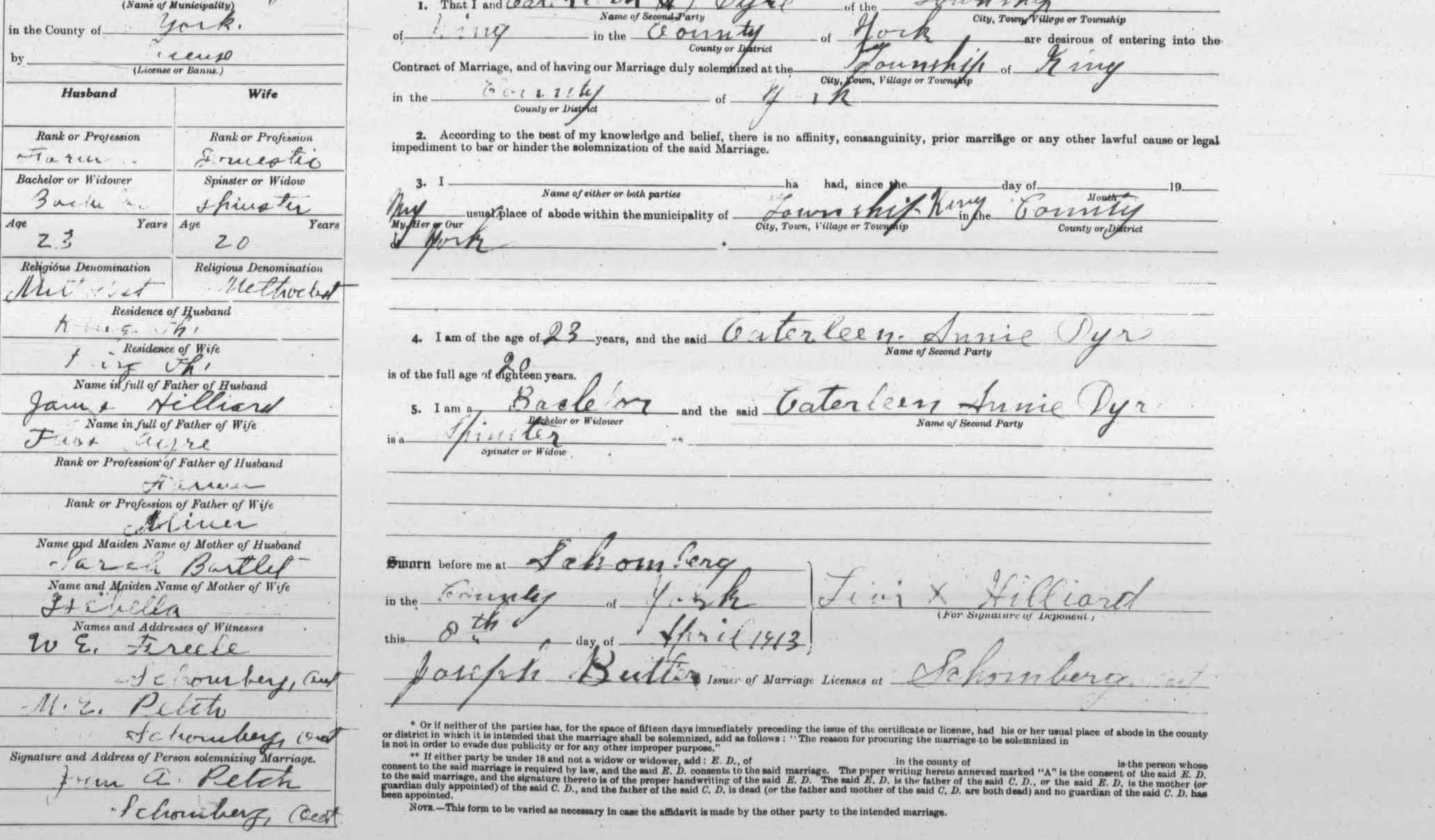
Levi had grown up in an Ontario family of farmers and working people. In 1913 he married Catherine Annie Ayre, a young woman who had come from England. Roy was born five years later. The home they made brought together an older Ontario family and one whose story began thousands of miles away.
In 1931, the Hilliards lived in an owner-occupied house that the census described as having ten rooms and a radio. Roy was about twelve. The radio gives the household an unexpectedly modern detail: voices and music from beyond King Township could now reach a family in the countryside. The home was valued at $2,000. The rooms and the radio belonged to the material world of Roy's childhood: a familiar family house connected, by new technology, to voices far beyond the township.
These were also the years of the Great Depression. Across Ontario, farmers, mill workers and other wage earners faced economic uncertainty. Levi's trade and the surrounding farming economy belonged to that unsettled world. Roy grew toward adulthood while much of the country's working life was under pressure.
The Hilliards before Roy
Families of southern Ontario
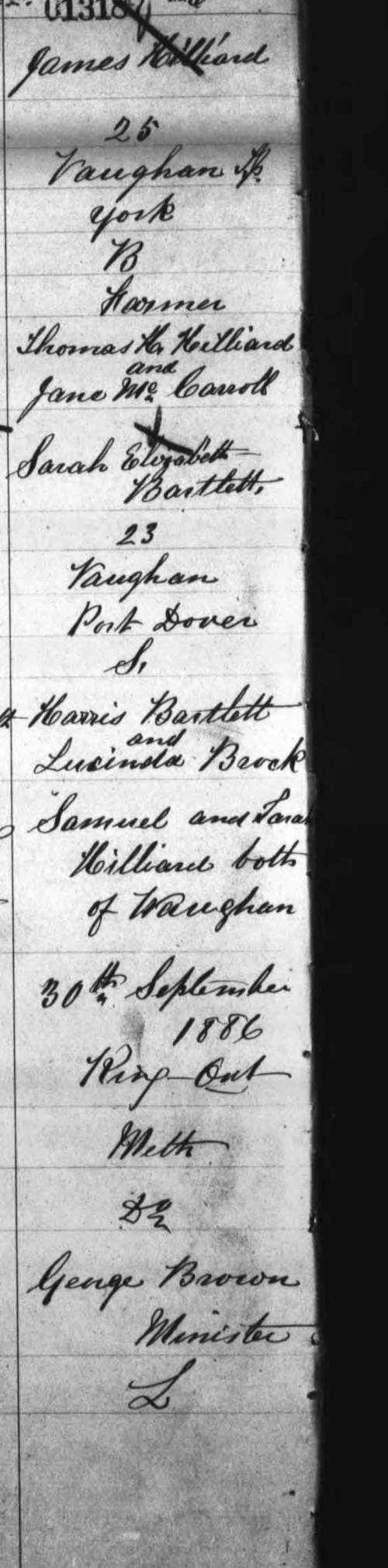
Long before Levi worked at the planing mill, the Hilliard family was making a life in the countryside north of Toronto. Roy's grandfather James Hilliard married Sarah Elizabeth Bartlett in 1886. James was the son of Thomas Hilliard and Jane McCarroll. Thomas had been born in England and farmed in Ontario, part of a generation for whom land, work and the creation of a household often belonged to the same undertaking.
The family's places included Vaughan and King Township. They did not form a story of one grand ancestral house passed unchanged from generation to generation. Like so many Ontario families, they lived in a succession of households as children grew into adults, siblings established homes and familiar work was taken up in new settings.
By the time Roy arrived, his family had already experienced the province's transformation from scattered settlements and working farms into a landscape tied increasingly to towns and cities. A farmer's life still depended on seasons and markets; the next generation might earn its living in a trade, a mill or a different sort of enterprise altogether. Levi's carpentry belonged to that world.
Roy's grandmother Sarah lived until 1946. Her lifetime stretched from the late Victorian countryside through the Great War, the Depression and the end of the Second World War. Roy was an adult when she died. The two generations shared an era, even if the family papers cannot tell us what stories she passed down.
Sarah's people
The Bartlett and Brock families
Sarah had brought another line into the Hilliard family. Her parents were Harris—also recorded as Horace—Bartlett and Lucinda Brock. The Bartlett household appears in North Bruce, and Sarah's brothers and sisters grew up to make their own marriages and homes in Ontario.
It is easy for a family story to follow the surname written on a gravestone or carried by a son. Yet Sarah and Lucinda were as much part of Roy's inheritance as the men named Hilliard. They helped hold together the families whose children would eventually meet, marry and make new households. Lucinda saw her children reach adulthood, among them Sarah, who married James Hilliard in 1886. The family ties that women carried from one household to another were every bit as important as the occupations more often recorded for men.
Behind Lucinda's name lie earlier Brock families and other journeys into Upper Canada. That history takes us farther from the village of Roy's childhood, toward older settlements and migrations. It deserves a story of its own. For Roy, those older connections meant that several families—Hilliard, Bartlett, Brock and McCarroll—had already contributed to the Ontario world in which he was born.
The girl who came from Durham
Catherine's life before Roy
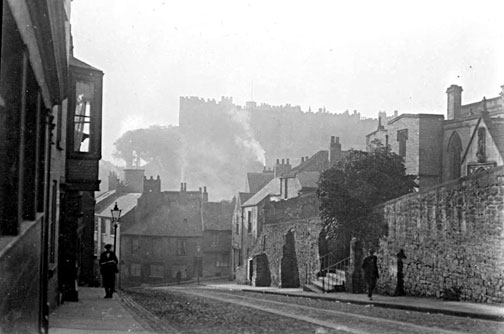
Roy's mother had a very different beginning. Catherine Annie Ayre was born in England in 1893. Her early story leads to Durham, a city of old churches and working-class streets within reach of the coalfields that shaped northern England. At St Margaret's Church, an entry records the baptism of a little girl named Catherine Ann Ayre, daughter of Thomas and Isabella.
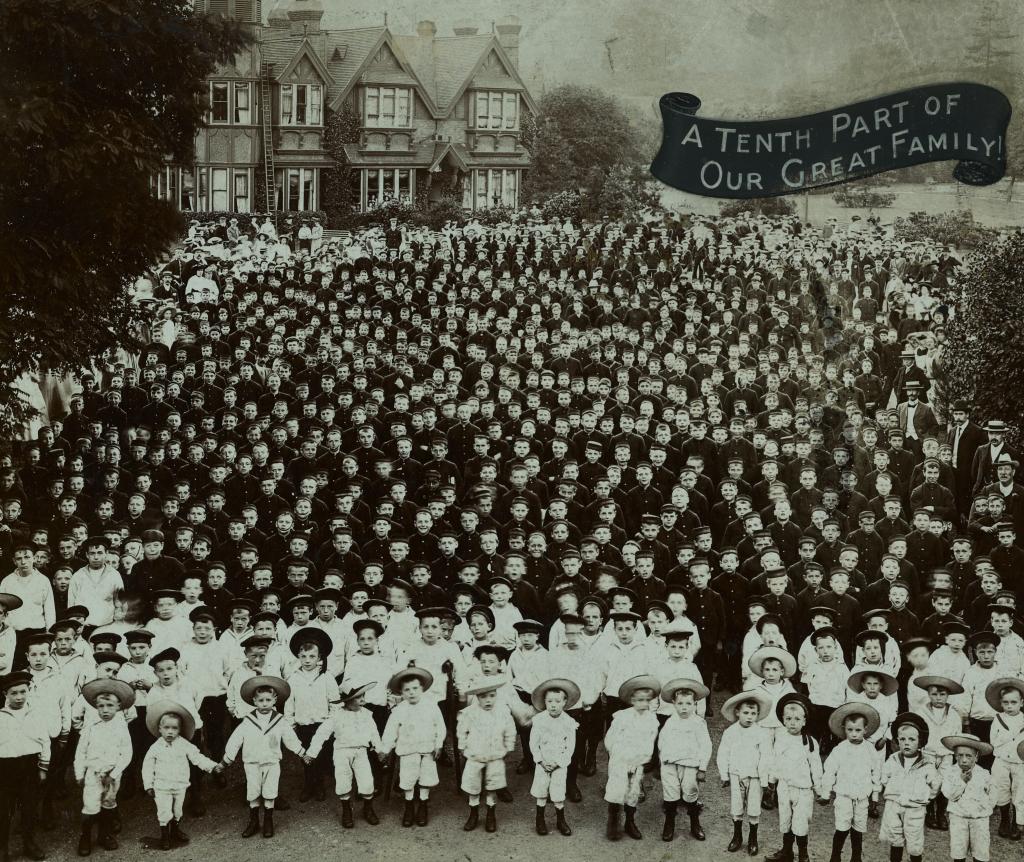
More than a decade later, a passenger list from the SS Kensington carried the name of a ten-year-old C. A. Ayre, traveling to Canada among children in the care of the Barnardo organization. The identification with Roy's mother is persuasive, though not beyond doubt. If this was Catherine, she was part of the child-migration system that moved young people across the Atlantic to Canadian households and workplaces.
For generations, parts of Catherine's childhood remained a family mystery. Following a little girl from a Durham parish entry to the possibility of an ocean crossing has been one of the family's most affecting discoveries. It matters because Catherine was more than the mother named beside Levi in a later record. She had a childhood, a place of origin and a journey long before Roy was born.
By April 1913, Catherine was in Ontario, marrying Levi Hilliard. Five years later she was raising their son Roy. Between the streets of Durham and the countryside around Schomberg lay an extraordinary distance, whatever remained unrecorded about the years that connected them.
A changing Ontario
From childhood to adulthood
The village where Roy was born did not stand still. The Schomberg and Aurora Railway stopped running in 1927, when Roy was about nine. Trucks could collect farm goods closer to where they were produced; improved roads and automobiles changed how country families traveled. The line that had once represented progress had become part of the past.
The countryside around King Township was still a place of fields, farms and small communities, but the connections between rural Ontario and nearby cities were growing faster. Roy's generation inherited older habits of agricultural life alongside radio broadcasts, motorcars and a changing economy.
Roy came of age during the Depression. The Second World War began in 1939 while he was a young adult, and the farms and factories of Ontario were drawn into another period of transformation. The war reshaped the province through which Roy was passing into adulthood, although his own part in those years remains a chapter for family memory to fill in.
By the time Roy and Mary were building a life together, the Ontario of his birth had changed. But King Township, the countryside of his parents and grandparents, remained the place from which his story began.
Roy and Mary
Two lives, one family
Mary Mitchell grew up near Beaverton in Thorah Township, another Ontario community shaped by farms, country roads and the world beyond them. Roy and Mary came from different family histories, and at some point their lives joined. How they met, and when they married, are parts of their story that the family papers have not yet made clear.
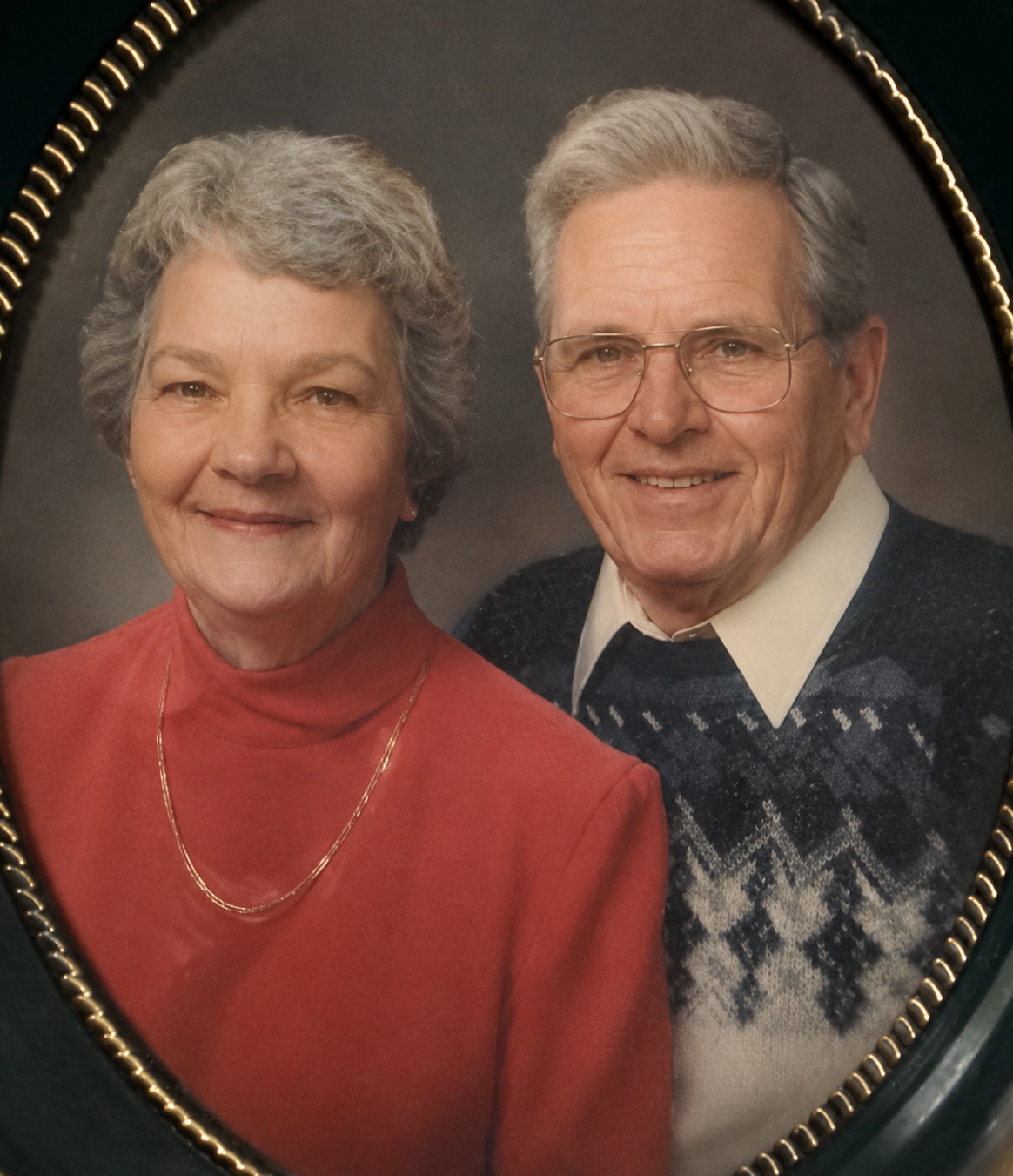
What survives is a photograph of them together. It is an ordinary family image, and that is much of its value. After the villages, parents, migrations and world events of the earlier chapters, here are Roy and Mary not as names on separate branches but as a pair. They had a shared life beyond the moment when someone lifted a camera and made the picture.
In Beaverton, at Stone Church Cemetery, there is a final connection to their lives in Ontario. Roy was buried there in 1992, and Mary in 1996, in adjoining graves. Their memorial belongs to the same province where both had grown up, though in different communities.
There are still things a descendant would want to ask Roy: what work filled his adult days, which places he loved, what made him laugh, what stories he told about Catherine and Levi, or what he remembered of the Ontario of his childhood. If someone who knew him can answer even a few of those questions, the photograph will become richer still.
His life was never merely a list of facts waiting to be found. He was a boy in Catherine and Levi's home, a man who lived through a changing century, and Mary's companion in the years that followed. The photograph brings those parts of his life back together. So does the family that came after him.