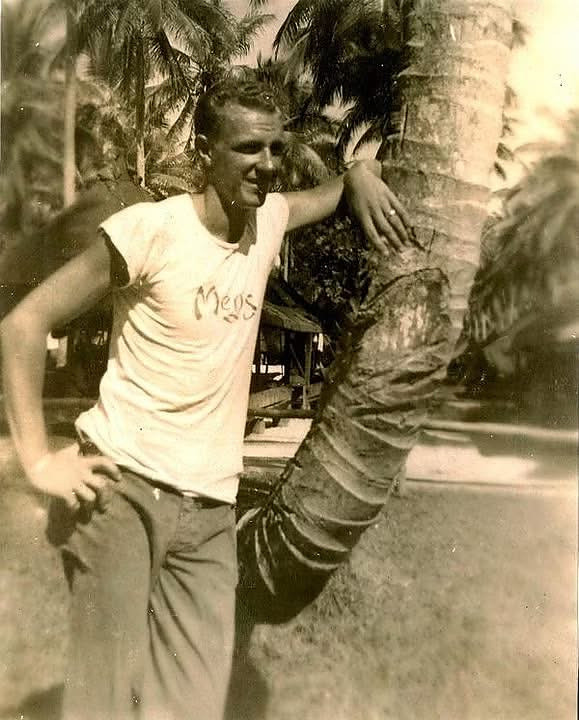
THE YOUNG MAN ON CAMBRIA STREET.
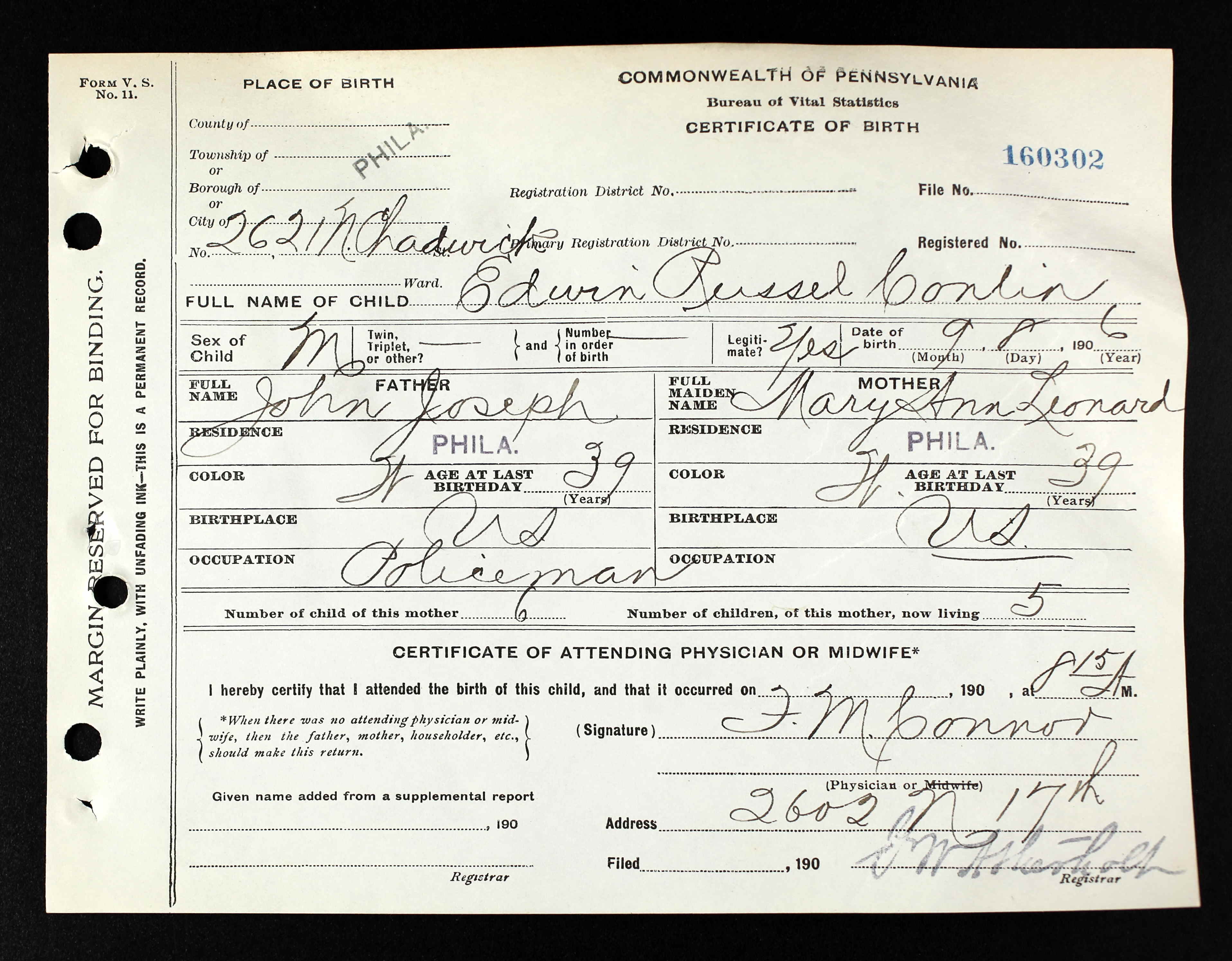
In 1942, Frank Conlin was eighteen years old. An ordinary government form caught him at the threshold between the life he had been living and the years that were about to change it.
His name appears on a draft registration from Philadelphia. The address is 250 East Cambria Street, in the part of the city known today as Upper Kensington. He was employed by Link-Belt Company. For the person who would always know his address, he named his mother, Mame. The form was designed to locate a young man for military service; nearly a century later, it gives us a little of his ordinary life. [1]
Frank had been born in Philadelphia in 1923, the son of Francis Conlin and Mamie Wurst. His city was a place of brick rowhouses, factories, shops, churches and the elevated railway. By the early 1940s, the country had entered a new war. Frank, already working, stood at the intersection of household obligations and events far beyond his neighborhood.
The draft card tells us where to find Frank at one particular moment. To know what came before that moment, we have to move backward—to a policeman and his family, a young machinist, a widowed mother and her children, and the streets and workplaces where those lives were unfolding.
MARY AND JOHN’S HOUSEHOLD.
Long before Frank filled out that card, his grandmother Mary Anna Leonard was raising children in Philadelphia, while his grandfather John Joseph Conlin worked as a police officer.
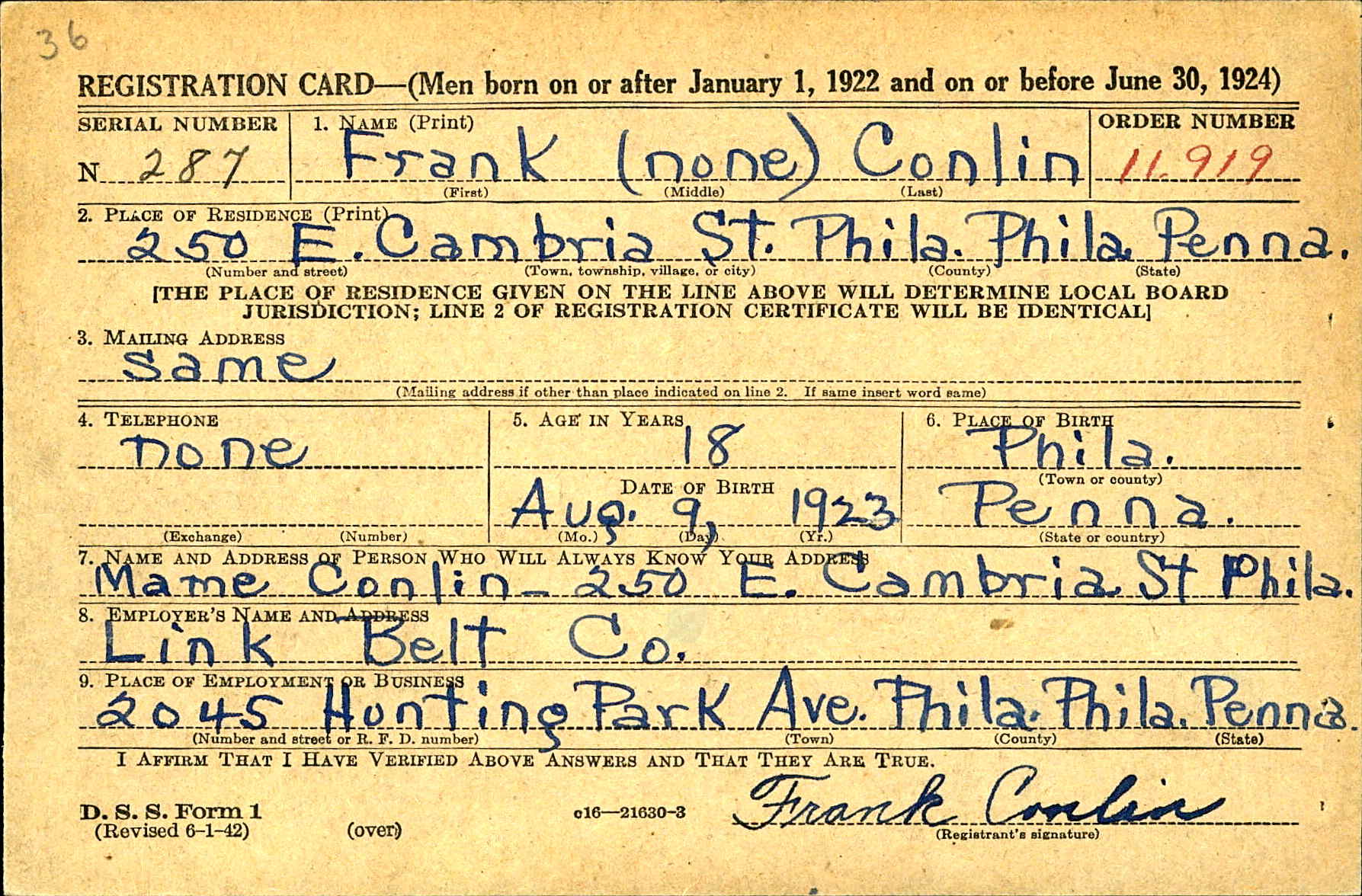
In September 1906, Mary gave birth to a son, Edwin Russell Conlin. His birth certificate recorded John Joseph as the father and listed his occupation as policeman. It also noted that Edwin was Mary's sixth child and that five of her children were living. One child, unnamed on this record, is present in the history through the difference between those numbers. [2]
The 1910 census places John, Mary and their children at 1637 Huntingdon Street. Ten years later, a John J. Conlin of similar age, still a city policeman, appears at 1639 West Huntingdon Street with sons Raymond, Leonard and Russell. Their ages, names, occupation and nearby addresses make this a strong probable match to the earlier household. Mary is not listed with them in 1920; the census does not tell us where she was. [15]
Explore John and Mary Conlin's Philadelphia household
A certificate made for a single birth unexpectedly preserves a whole household. It gives us the labor of a father outside the home and, in a few inked columns, something of the number of children and the losses Mary had known. It cannot tell us the child's name or what the loss meant to anyone in the family.
By 1910, their household included Francis, Raymond, Loretta, John and Edwin. The census still recorded John as a police officer. Francis, eighteen, was working as a machinist. We have the beginnings of another generation's story within the same home. [3]
The same household, a decade later
Raymond appears in both returns. The 1920 Leonard probably corresponds to John L. in 1910; Russell probably corresponds to Edwin R., whose 1906 birth certificate gives his middle name. Francis had married Mamie Wurst in 1919 and no longer appears in his parents' 1920 household. The first-name identifications remain interpretations. [15]
Philadelphia in 1910 was a place of competing demands. A streetcar strike had widened into an extraordinary confrontation involving labor, employers and the police. John worked for the city at that time, but the records do not establish his precinct or put him at any specific strike incident. His own service belongs to the family record without borrowing the actions of others.
THE WORK OF HIS FATHER.
In the 1910 census, Frank's father Francis appears as a young man whose working life had already begun. His occupation was machinist in the instrument trade.
Francis was living with his parents when the enumerator called. A machinist's work demanded practiced attention to metal and mechanical parts. Lathes, drills and other machine tools made precision possible, turning rough material into pieces intended to fit together and function. [3]
Explore Francis's machining trade and early industrial Philadelphia
The occupation entry tells us the trade but not the shop. Philadelphia supported both enormous industrial works and smaller specialist manufacturers. In the city's machine rooms, skilled workers helped make the things that made other industries run. Francis's experience belongs to that larger economy, even though his particular employer has not been identified.
Photographs of industrial Philadelphia survive from these years. One shows machinery inside the Baldwin Locomotive Works in 1905. It is not the instrument shop where Francis is known to have worked, but it brings the metal, scale and equipment of the city's industrial landscape into view.
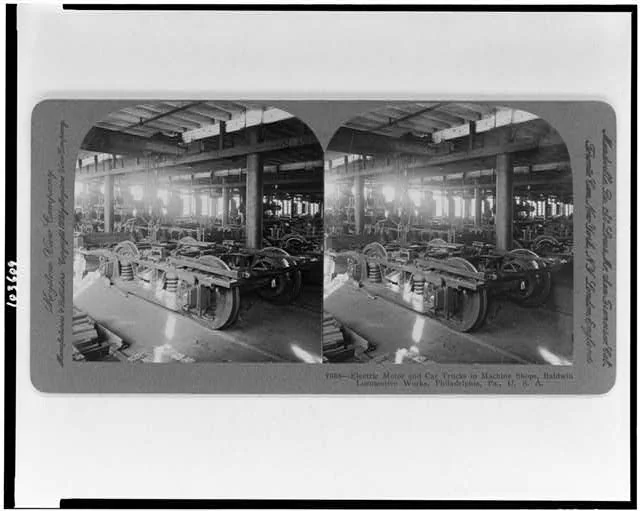
Before Frank would find work at Link-Belt, his father's generation had already been part of an industrial city. The forms record two different men and two different kinds of work; they do not tell us whether Francis taught his son a trade or influenced his choice of employer.
Explore the family / Philadelphia recordsMeet Mary, John, Francis and their household ↗The fuller Conlin–McDermott history keeps the original records alongside the people named on them.THE OTHER HOUSE HE CAME FROM.
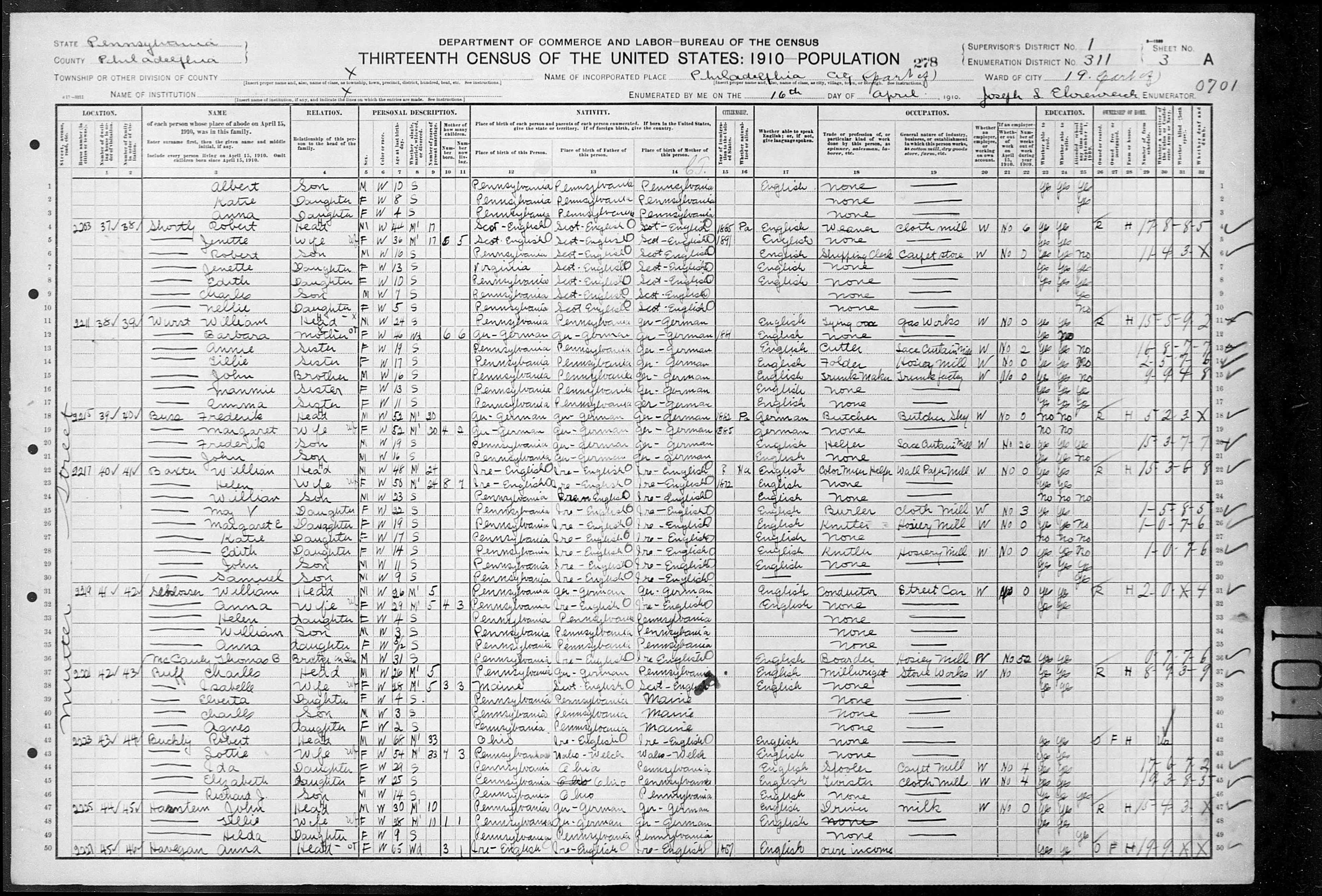
On Frank's mother's side, work ran through a different Philadelphia household. In 1910, Mamie Wurst was thirteen and living with her widowed mother, Barbara, and several brothers and sisters.
The enumerator named William Wurst, twenty-four, as head of the household. His widowed mother Barbara, forty-six, lived there too. William worked at a gas works. Annie, nineteen, cut material in a lace-curtain mill. Tillie, seventeen, was a folder in a textile mill. John, sixteen, made trunks; Mamie and younger Emma had no occupation recorded. [4]
Explore Mamie's Wurst family and the garment trades
Read across the census line by line and the picture becomes larger than any one wage earner. Industrial work entered the household from several directions, and the labor of those with no occupation entered was no less important for having gone unnamed by the census.
Barbara's story extended beyond the form. A later death record described her as born in Germany. Her daughter Emma's death certificate gave the parental names William Wurst and Barbara Sperle. Barbara's funeral notice associated her with St. Michael's German Lutheran Church and an earlier home on East Sergeant Street. These are pieces of a German-American neighborhood history, though her exact place of birth has not been established. [5]
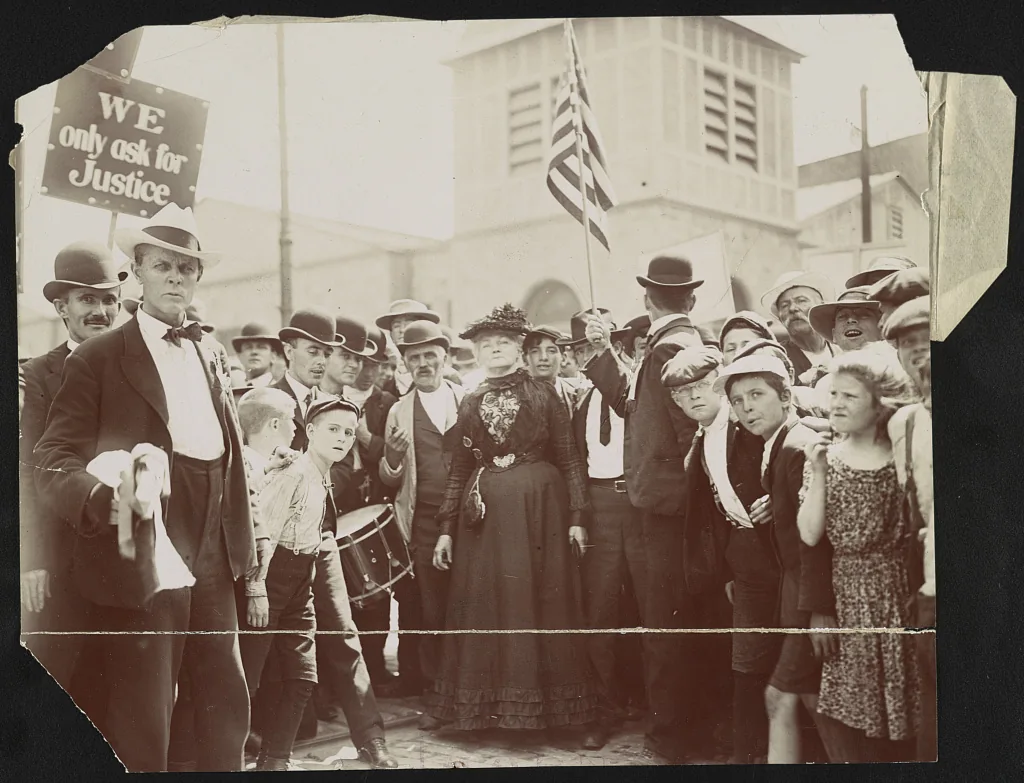
In 1903, Philadelphia textile workers and children joined a demonstration that would become part of a much wider national conversation about industrial labor. We cannot place Mamie or her siblings among them. The image does, however, preserve the city in which the Wurst children later earned their wages.
TWO HISTORIES BECOME ONE.
Francis Conlin and Mamie Wurst married in Philadelphia on April 12, 1919. A German-language church register recorded them on facing pages, bringing two of the city's working families together.
On the entry Francis appears as Frank J. Conlin. Mamie's name appears beside his. The clerical language of the register places their marriage inside a church institution serving a German-speaking community, but it does not establish what language they spoke at home or identify the parish beyond doubt. [6]
That wedding came in a city emerging from an exhausting period. The 1918 influenza epidemic had taken lives across Philadelphia, and the First World War had just ended. Their marriage belongs to the following spring; it should not be read as proof of how either person experienced those events.
In 1923, their son Frank was born. He entered a family with a policeman grandfather, a father who had been a machinist and a maternal household whose members had worked in gas, textiles and trunkmaking. These are not inherited occupations or a predetermined path for the boy. They are the histories already in motion when his own began.
A NAME ON THE PAYROLL.
In the spring of 1942, Frank was more than the youngest name in a family history. He was a Philadelphia worker, with a job at a company whose machinery helped move the material of an industrial nation.
On his draft registration he named Link-Belt Company. Period trade advertising places its Philadelphia operation at 2045 West Hunting Park Avenue. Link-Belt built the equipment that kept heavy goods moving: chains and power-transmission machinery, conveyors carrying stone and gravel, screens and equipment for mills and quarries. The Smithsonian preserves company photographs dating from 1915 to 1967, a visual archive of those otherwise uncelebrated machines. [1]
An advertisement published in 1929 described Link-Belt conveyors moving excavated earth from Seattle's Denny Hill toward the waterfront—thousands of feet of belting doing work that would otherwise have required an immense procession of trucks. That project was far from Frank's city and years before his employment. It nevertheless makes the name on his card more tangible: Link-Belt sold engineering for the movement of materials, on a scale beyond the household world of East Cambria Street.
The company in its own words
Link-Belt's 1929 industrial conveyor advertisement ↗ gives the Philadelphia address and shows how the firm described its products. Explore the Smithsonian's company photograph collection ↗. Neither source names Frank or identifies his department.
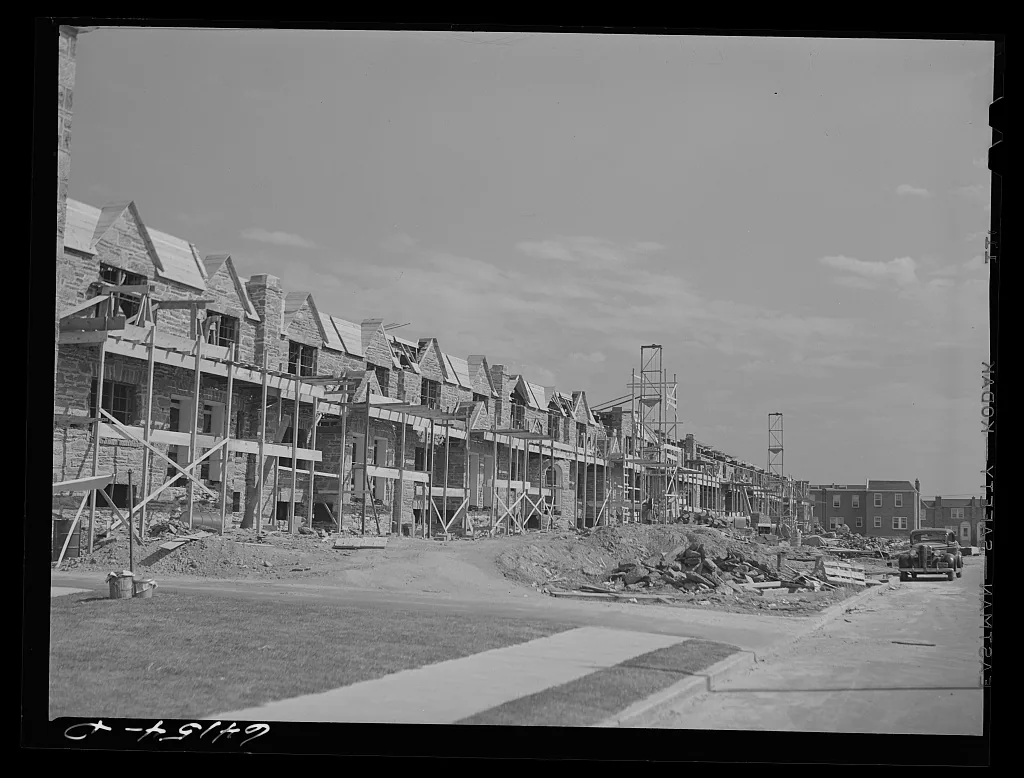
At home, his address was 250 East Cambria Street, in Upper Kensington. A young woman named Regina McDermott was associated with 221 East Willard Street in a 1943 school yearbook. Their recorded addresses help locate their two young lives in the city; they do not tell us when they first met.
Frank's father Francis had worked as a machinist. It is tempting to see a family trade passing from one generation to the next, but no document establishes what work Frank performed at Link-Belt, or why he took that job. We have the employer and the date. The rest of his working day still waits to be found.
Three original documents / One decadeFrank, Regina and Philadelphia, 1942–1950 ↗A closer reading of his draft card, her yearbook and their first shared census household.A SIGNALMAN UNDER FIRE.
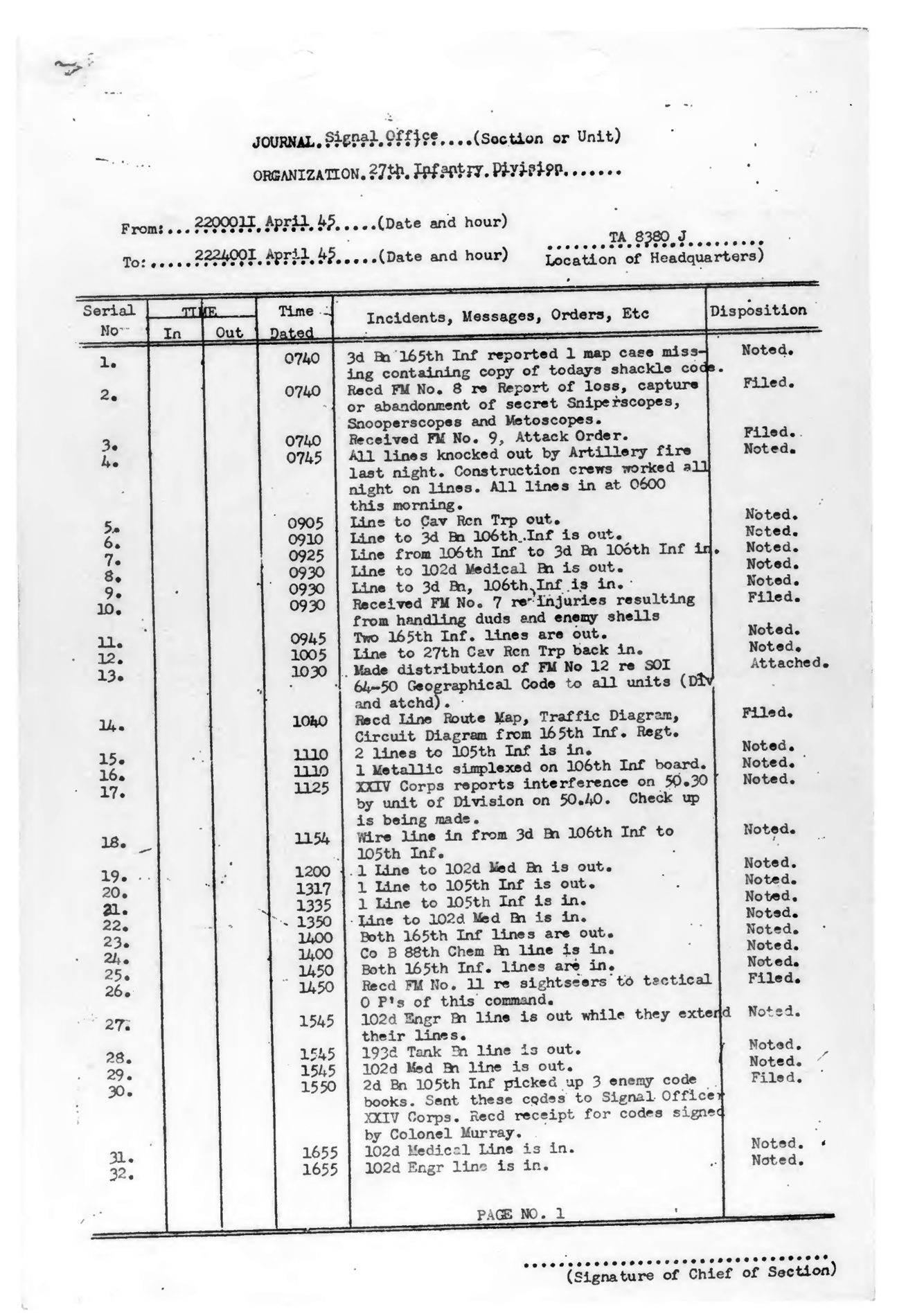
On Okinawa, artillery destroyed the 27th Infantry Division's telephone lines during the night of April 21, 1945. While the battle continued, signal construction crews worked through the darkness to restore the connections between headquarters and its fighting units. By six the next morning, the circuits were back in service. At 7:45, the division's Signal Office recorded the night's work in its journal. [23]
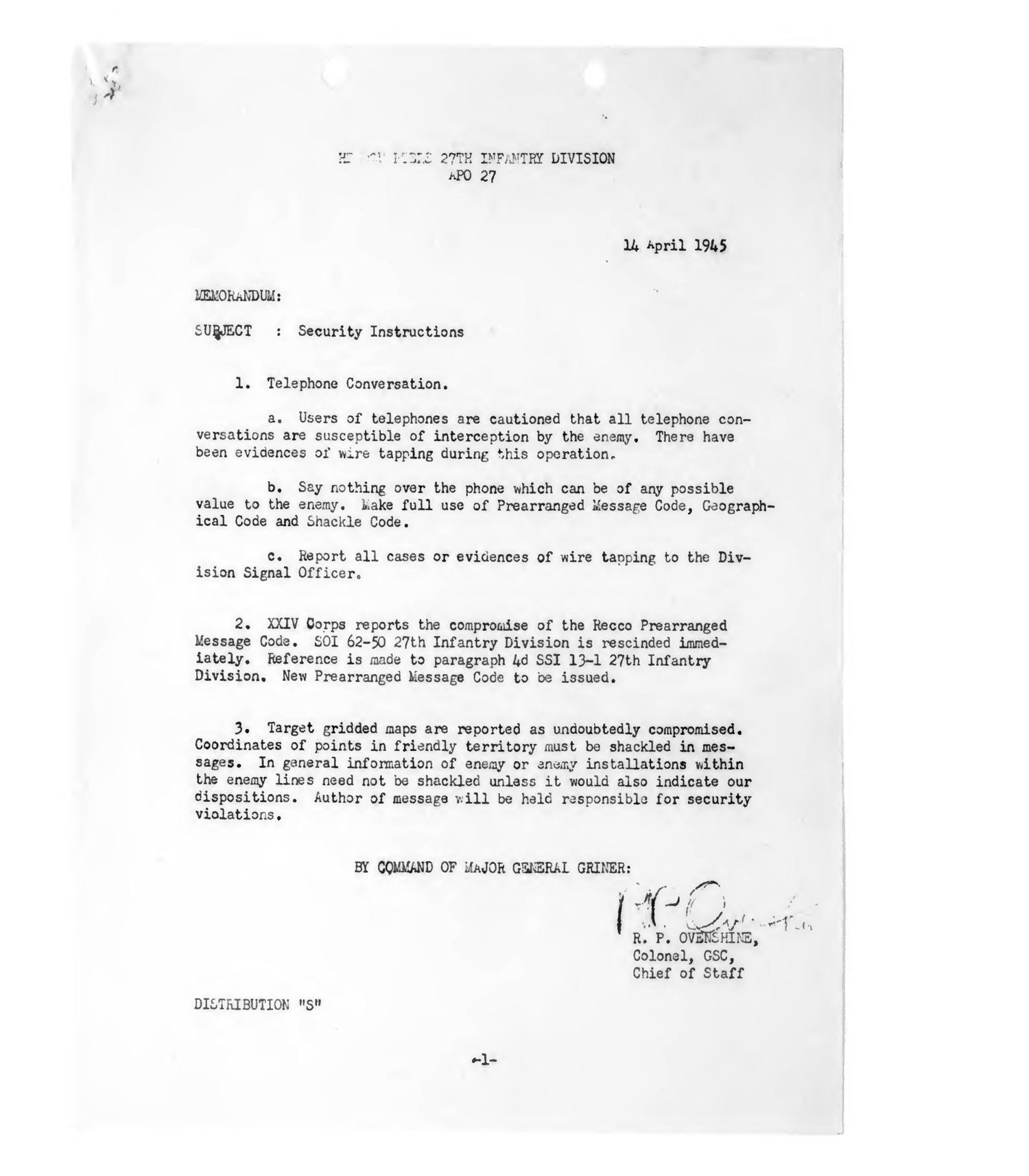
Behind that brief journal entry were men working in a battle zone to reconnect commanders with their infantry, artillery and forward positions. A broken line could leave a unit unable to report where it was, call for support or hear an urgent order. A working line could be dangerous in another way: eight days earlier, division headquarters had warned that Japanese forces were tapping American field telephones. Codes and gridded maps had been compromised. Even the act of speaking into a telephone carried risks. [23]
This was the 27th Signal Company's war. Its men established the communications between division headquarters and fighting units, carried and operated radios, laid cable, maintained switchboards and brought damaged systems back to life while the battle continued. Their enemy occupied concealed positions in ridges, caves and fortified ground. Japanese kamikaze aircraft struck at the ships offshore that supplied and protected the invasion. As spring became summer, heavy rain turned the battlefield into a landscape of mud, shattered equipment and exhaustion. Disease threatened men already worn down by combat. Okinawa was one of the most devastating campaigns of the Pacific war, fought at the threshold of the Japanese home islands. [24]
Frank Conlin of Philadelphia served in that Signal Company. He was a trained radio operator whose Army records would later identify him as a high-speed manual specialist and Staff Sergeant. He also carried a memory that followed him home: enemy gunfire struck the communications pack on his back, damaging the equipment but leaving him physically unharmed. The story his family preserved captures the reality behind the technical language. The radios, wires and message centers were not simply support equipment. They were part of the fight. [13] [20]
Frank entered the Army on December 9, 1942, and went overseas on June 7, 1943. His journey with the 27th Infantry Division would cross thousands of miles of the Pacific, through an escalating series of campaigns that brought American forces ever closer to Japan. [7]
The division / The men around FrankFrom New York's National Guard to the Pacific.
The 27th was an old New York National Guard formation, with roots reaching back to the First World War. Among its three infantry regiments were the 105th, 106th and 165th—the last descended from New York's celebrated Fighting 69th. Federalized in 1940, the division was reorganized and sent across the Pacific after the attack on Pearl Harbor. By the time Frank joined it, the ranks included men drawn from well beyond New York. A Philadelphia son could find himself serving beside soldiers from states across the country. [17]
Three infantry regiments did much of the division's close fighting, supported by artillery, engineers, medical detachments and supply units. But the fighting could only be coordinated if headquarters knew where those regiments were and could reach them when conditions changed. The Signal Company made that possible. Its radio operators maintained nets connecting widely separated units; its linemen and switchboard crews established telephone circuits across ground already torn by battle; its message-center personnel moved dispatches and guarded the codes that protected them. A single broken cable could become an urgent problem for an entire chain of command.
It was work for trained specialists who also had to be capable field soldiers. Radios were heavy, batteries failed, wet equipment deteriorated, and the enemy could intercept or disrupt messages. A line crew might have to restore a connection at night; an operator needed to receive a coded message accurately with the noise of war around him. The courage it demanded was often quiet and repetitive: go out, restore contact, return, and do it again when the next line failed.
The long way across the Pacific.
Six stations and campaigns that shaped the 27th Division's war, from Hawaiʻi to occupied Japan.
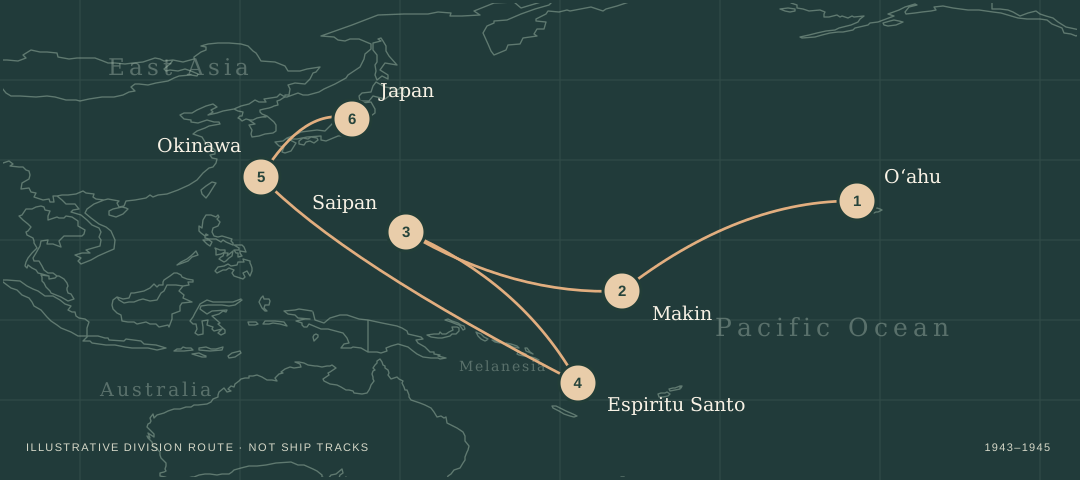
- 1Oʻahu1943–44 · Training and staging
- 2MakinNov 1943 · First combat campaign
- 3SaipanJun–Jul 1944 · Marianas campaign
- 4Espiritu Santo1944–45 · Rebuilding and training
- 5OkinawaApr–Jul 1945 · Ryukyus campaign
- 6JapanSep–Oct 1945 · Occupation and return
1943 / Hawaiʻi and MakinFirst lessons in a war of islands.
On Oʻahu the 27th trained for a kind of war in which everything—men, ammunition, radios, food, vehicles—had to reach an island by ship, cross a beach and begin functioning. When elements of the division attacked Makin Atoll in November 1943, Signal Company soldiers discovered how easily an ordinary communications task could turn into a struggle against the environment. An official Signal Corps history describes radios hampered by rain squalls and water, field wire broken by amphibious vehicles, and lines raised into trees to get them out of danger. On separated beaches, the earliest messages sometimes had to travel by messenger rather than telephone. [17]
Makin taught the division's signalmen a hard lesson they would carry into the Marianas and Ryukyus: combat communications could not be assembled once and left alone. The moment a line was laid or a radio net established, enemy action, weather or the movement of American troops could threaten it again.
1944 / Oʻahu · A name in the ordersFrank appears among the signalmen.
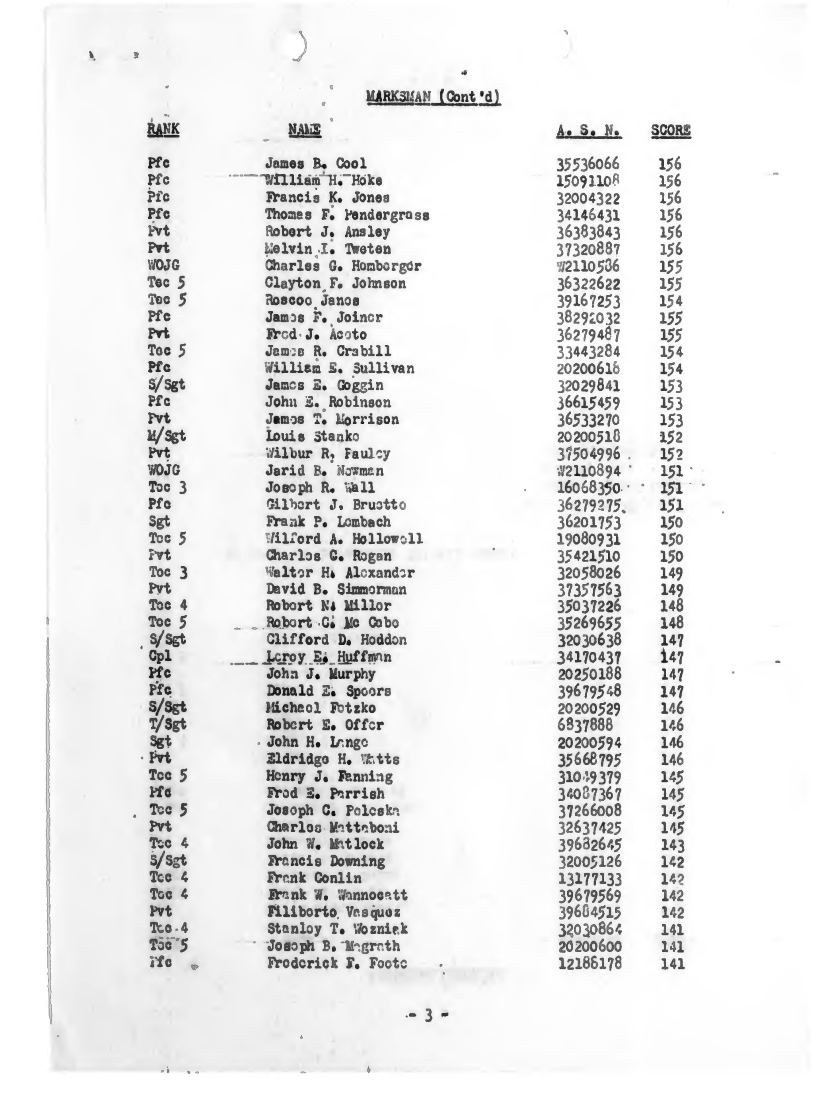
In the spring of 1944 the Army's original records begin to show Frank with remarkable clarity. A March carbine-qualification order identifies Technician Fourth Grade Frank Conlin, Army number 13177133, among the Signal Company's marksmen, with a score of 142. On another page, Floyd J. Green of the same company appears among the sharpshooters, scoring 161. Years later, Green's number would appear on the very same orders sending Frank toward home. [20]
A second original document, the April 20, 1944 morning report, places Frank with the 27th Signal Company at Schofield Barracks, Oʻahu. Other names on that company's paperwork include Earle F. Brown, Russell P. Fiscus, James R. Crabill and Frederick W. Foote. These men's exact Army numbers reappear with Frank in the October 1945 return orders, an unusually long trail of shared service. The report's names are not merely remembered comrades: they are men the Army recorded together. [20]
In the months before the next invasion, it is easy to imagine the routine that filled the spaces between campaigns: radio drills, weapon qualification, equipment inspections, packing lists, spare batteries and the familiar insistence that every message be written and relayed correctly. Frank was already a technical specialist, but he was also expected to be a soldier able to carry and use a weapon.
June–July 1944 / SaipanWhen the division met the Marianas.
Saipan mattered because it placed the United States much closer to the Japanese home islands. American forces attacked in June 1944, with the 27th joining Marine divisions in a campaign across airfields, steep hills, ravines and villages. The struggle was costly. On July 7, a huge Japanese counterattack struck the 27th's 105th Infantry, leaving terrible casualties on both sides. The men working the division's networks were supporting an army that was fighting for its positions hour by hour. [14]
Signalmen had to move with that battle. They could not lay a line once and forget it. A new command post required new circuits; trucks and shellfire damaged wire; radios had to be carried or sheltered, repaired, tested and supplied. The July 16 and September 15, 1944 company records identify Frank personally in the Saipan-period paperwork. In May 1945, a later Army order would credit him by name for the Marianas campaign. [20]

Here the family has preserved something that no routine morning report could capture. Frank spoke of a communications pack he was carrying when enemy gunfire struck it. The pack was damaged; Frank was unharmed. The recollection gives the technical work a startling human shape. Someone was moving with communications equipment on his back, and the shooting was close enough to hit it. The account belongs to Frank's own remembered war, alongside the written record of the company in which he served. [13]
Another index from his wartime records records an admission for dengue fever in September 1944 and a return to duty. It is a reminder that the Pacific fought back in ways that did not require an enemy rifle: mosquitoes, fever, heat and exhaustion could take men away from their posts as surely as wounds. [20]
August 1944–March 1945 / Espiritu SantoA camp among the coconut trees.
After Saipan, the 27th traveled south to Espiritu Santo in the New Hebrides. The division did not all leave together. Staff journals name a series of transports from Saipan, and a September 23 warning order proposed that the 27th Signal Company travel aboard Cape Johnson with six officers, 110 enlisted men and five quarter-ton trucks. The ship is recorded arriving from Saipan on October 12. The company was in the thick of a complicated logistical movement in which men, vehicles and equipment were spread among successive sailings. [21]
On Espiritu Santo the men found coconut groves, little existing camp infrastructure and mosquitoes carrying malaria. Barracks and training areas had to be built. The October 23 division journal assigned one-sixth of the Signal Company to jungle training; four days later, the division commander excused the company from further attendance. On November 6, the G-3 staff recorded that the division was already running its own radio-operator school. The months between battles were not an empty pause. They were spent rebuilding the division and training to do better the next time. [21]
The surviving records also include another weapons qualification for Frank in December 1944. He had qualified as a marksman earlier that year; a later order records carbine sharpshooter qualification on December 7. The improvement is a small but meaningful detail about life in an Army company where specialized radio work existed alongside the basic demands of field soldiering. [20]
March–April 1945 / Across the waterThe communications office aboard Cecil.
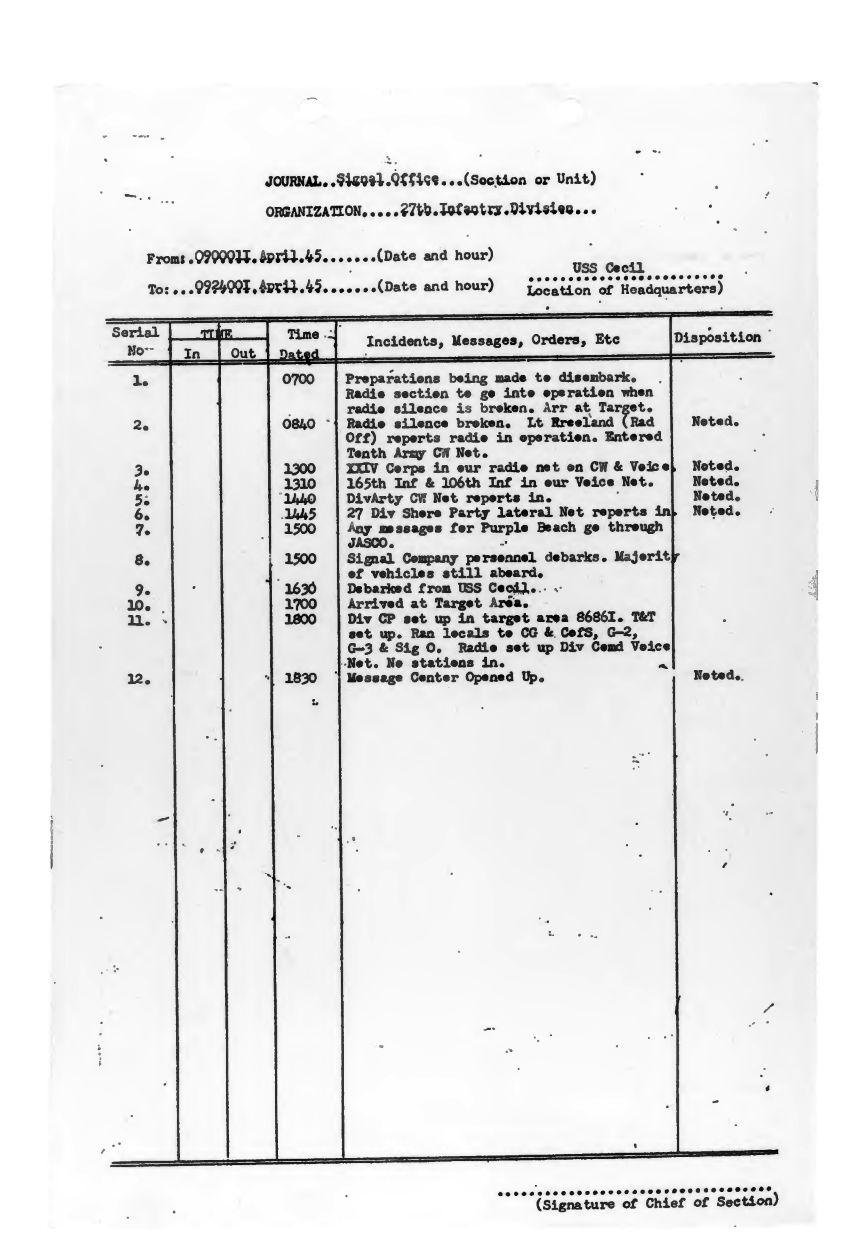
By the spring of 1945 the Allies had reached the approaches to Japan itself. Okinawa, a large island south of the home islands, would become the staging ground for the next phase of the Pacific war. The 27th prepared to join the invasion. Its Signal Office journal opens a door into the extraordinary mechanics of the voyage: on March 24, the division's signal headquarters closed its station at Espiritu Santo and established its office aboard the attack transport USS Cecil. [21]
For weeks the journal recorded the tasks of a headquarters afloat. Boats carried physical messages between ships. Officers worked out call signs, radio frequencies and security instructions. Paper and equipment had to be ready before anyone landed. The ship's name tells us where the division Signal Office was working; the company's other personnel and equipment moved through the larger invasion fleet. The record gives the voyage its texture: a division's headquarters moving across the Pacific, already working long before the landing began.
On April 9, the signal network came awake. The Signal Office journal records radio silence lifted at 8:40 a.m. Around 3:00 p.m. Signal Company personnel were coming ashore, while much of their vehicle equipment remained aboard ship. The division command post was operating by early evening, and the message center opened at 6:30 p.m. Imagine the pressure of building a communications network on a newly contested shore: headquarters had to hear from its regiments before the supporting equipment had even finished landing. [22]
April–July 1945 / OkinawaThe battle for every connection.
By the next morning the radio work had changed again. At approximately 9:35 a.m. on April 10, the division shut down its voice network and opened a continuous-wave, or CW, net—the keyed signals of radiotelegraphy, the dots and dashes of Morse code. It is a beautiful coincidence between an original Army technical entry and the skill Frank's family remembered about him. [22]
Radio crews worked in separate echelons and were distributed among headquarters and infantry units. Field wire and telephone crews followed shifting command posts. Couriers continued to carry enormous amounts of traffic because not every message could or should go over the air. The Signal Officer's own campaign report gives the scale: 6,979 messages handled, including 6,286 by motor messenger, as well as telephone, radio, teletype and visual traffic. It took a system of people, not a single transmitter, to keep the division connected.
On April 14, the 27th Division's chief of staff issued a direct security warning. Evidence of enemy wiretapping had emerged during the operation. Telephone users were told to assume their conversations might be heard; a compromised message code was withdrawn, and gridded maps had to be protected. The danger was not only that an order might fail to reach the front. It was that the enemy might learn what the Americans intended to do next. [23]
Eight days later, artillery knocked out the lines in the night. The Signal Office journal records crews working until the network was restored at dawn. Throughout the day the log continued to note lines going out and returning between headquarters, infantry battalions, medical units, reconnaissance and supporting formations. It is an extraordinary picture of a combat division trying to communicate while parts of its network were being destroyed almost as quickly as men could repair them. [23]
The danger was not confined to the men on the ground. Offshore, the ships delivering ammunition, supplies and naval gunfire support faced repeated kamikaze attacks. The Japanese defense of Okinawa sought to wear down the invasion by fighting from concealed, fortified positions while keeping the American fleet exposed to air attack. Inland, men labored through artillery fire, night fighting and increasingly relentless rain. By late May the mud was so deep that movement, supply and evacuation became battles of their own. A tropical island had become a place of exhaustion and terrible loss for American troops, Japanese defenders and Okinawan civilians alike. [24]
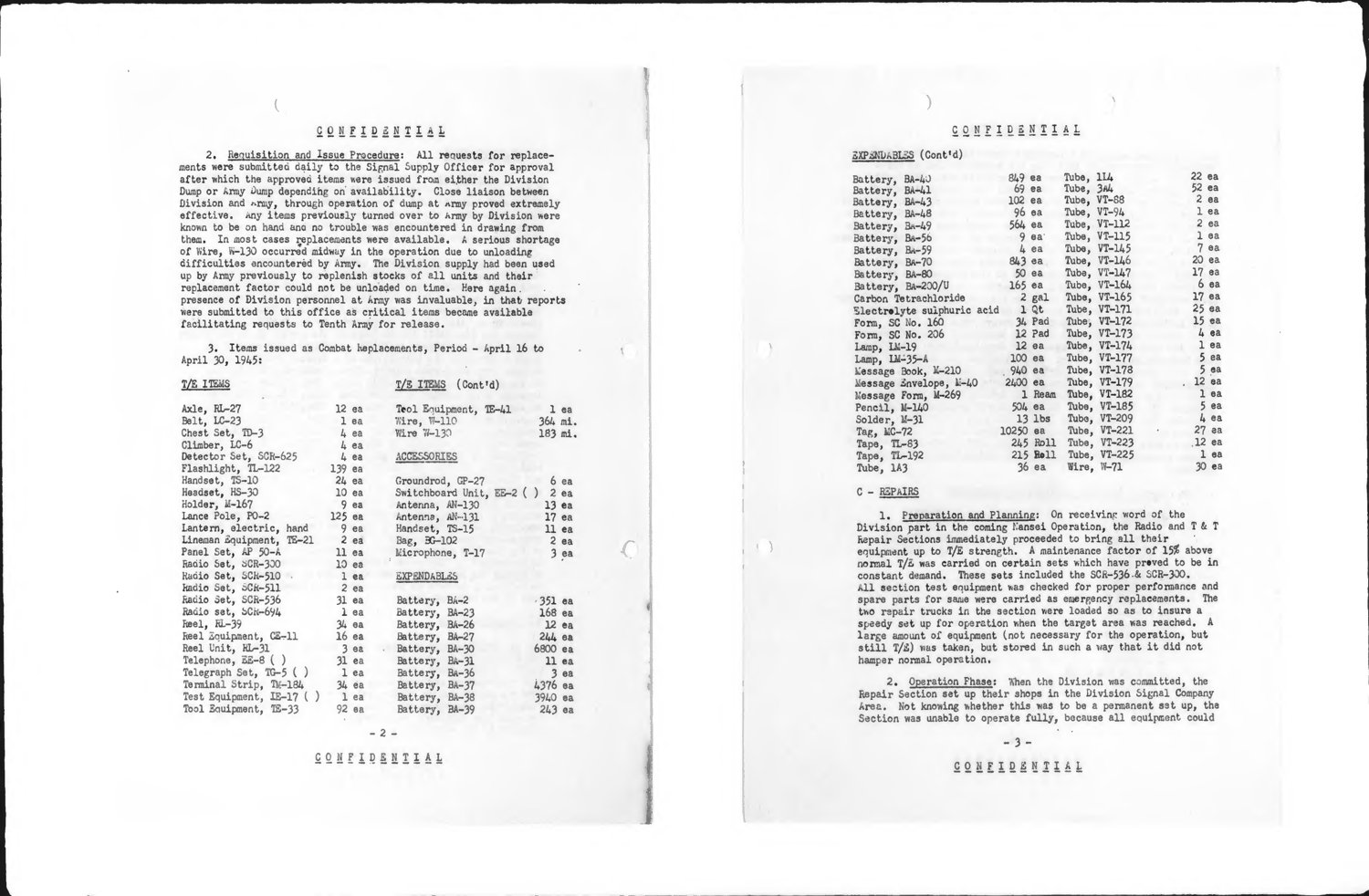
All through it, the communications system had to function. Cut wires, damaged radio sets, worn batteries and lost equipment appeared in the Signal Office's daily accounts. A July 7 supply-and-repair report describes replacements, repairs and equipment lost to artillery and mortar fire. The labor required to restore a message was as much a part of this battle as the urgency of the message itself. [22]
One of the Signal Company's most ingenious answers to field conditions was a pair of mobile switchboard trailers. First Lieutenant Robert L. Sayre and Technical Sergeant Robert E. Offer designed and supervised them. One-ton trailers carried the switchboard, tools, batteries and storage for 22 EE-8 field telephones. Canvas sides provided blackout protection; a small light bulb warmed an enclosure to dry switchboard cords in the damp air. The equipment could be moved when the division command post moved. [16]
The Army photographed the trailers and the men who worked them. Private First Class Jake DeWitte appears at the switchboard, headphones on, cables and plugs surrounding his hands. Later, Sayre would sign the September 2 company roster listing Frank. That is the wonderful thing about a company history: the photograph, engineering report and personnel roster begin to introduce us to the same organization from different directions.


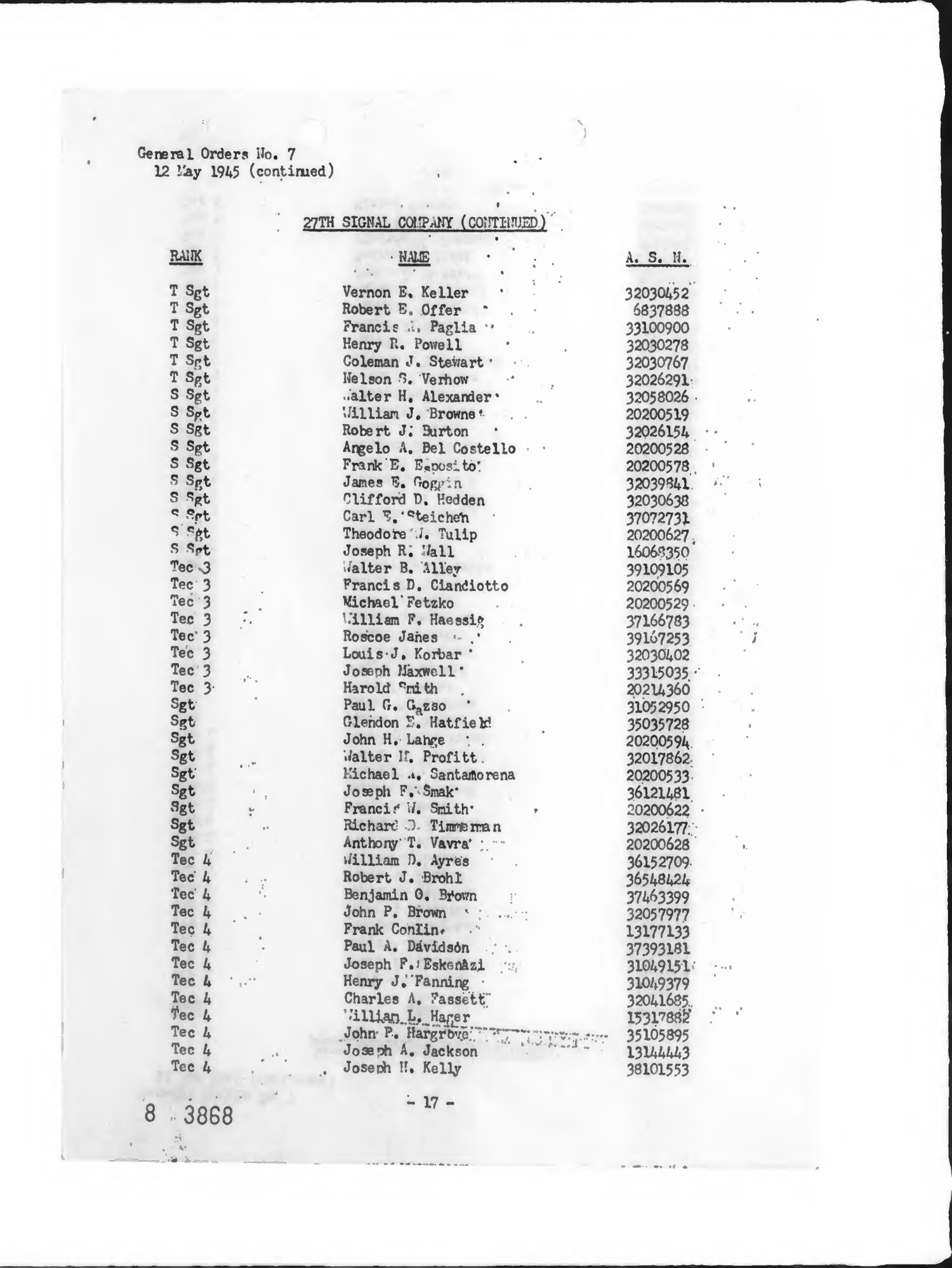
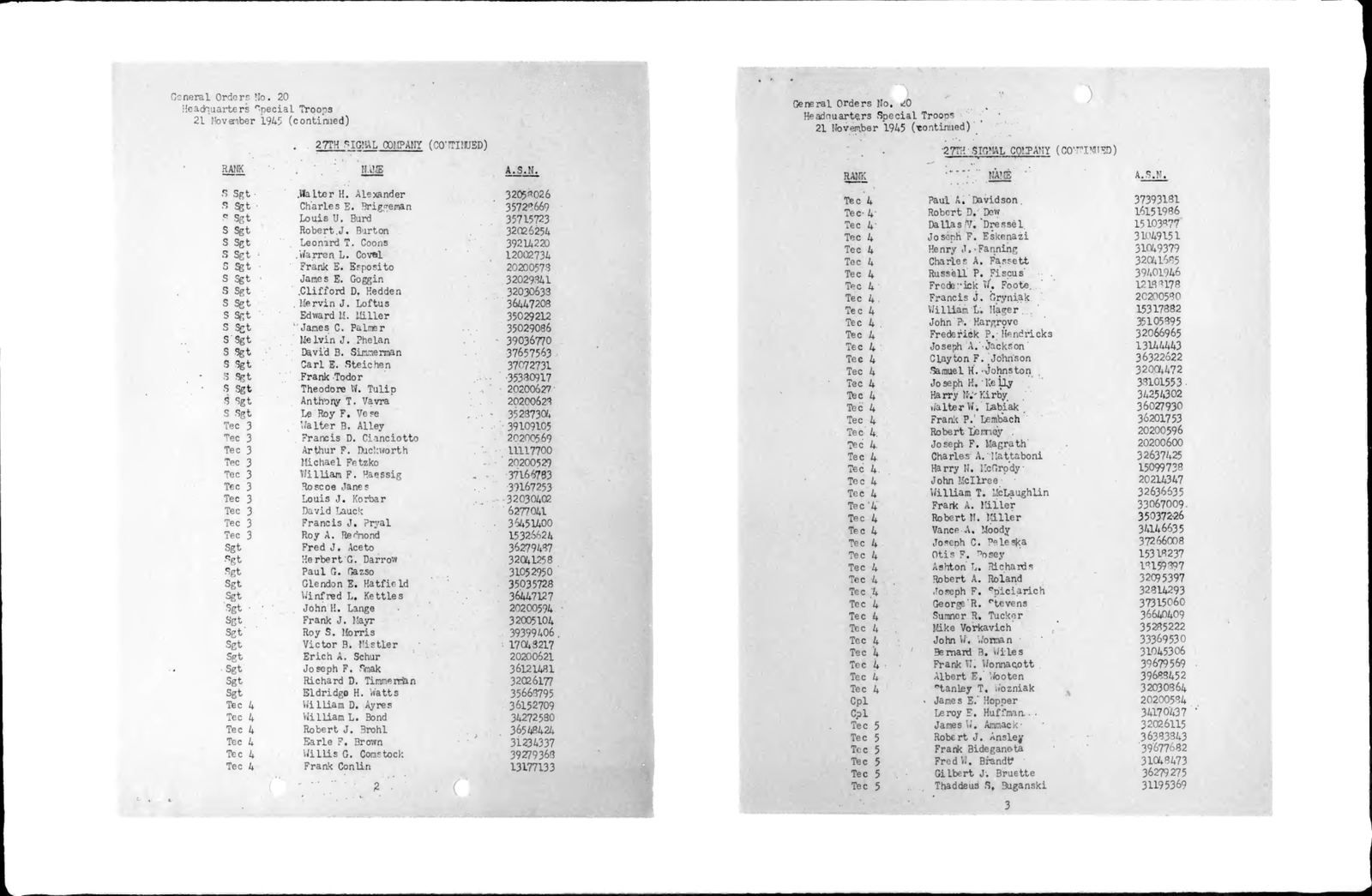
On November 21, 1945, an Army general order formally recorded Frank's Ryukyus campaign participation credit for the period March 26–July 2. His name and exact service number are there, on the printed page, among fellow Signal Company soldiers. A separate May order had named him in the Marianas campaign list. Those are direct campaign-recognition records, distinct from his carbine marksmanship qualifications. [20]
September 1945 / The skilled operatorFrom technician to Staff Sergeant.
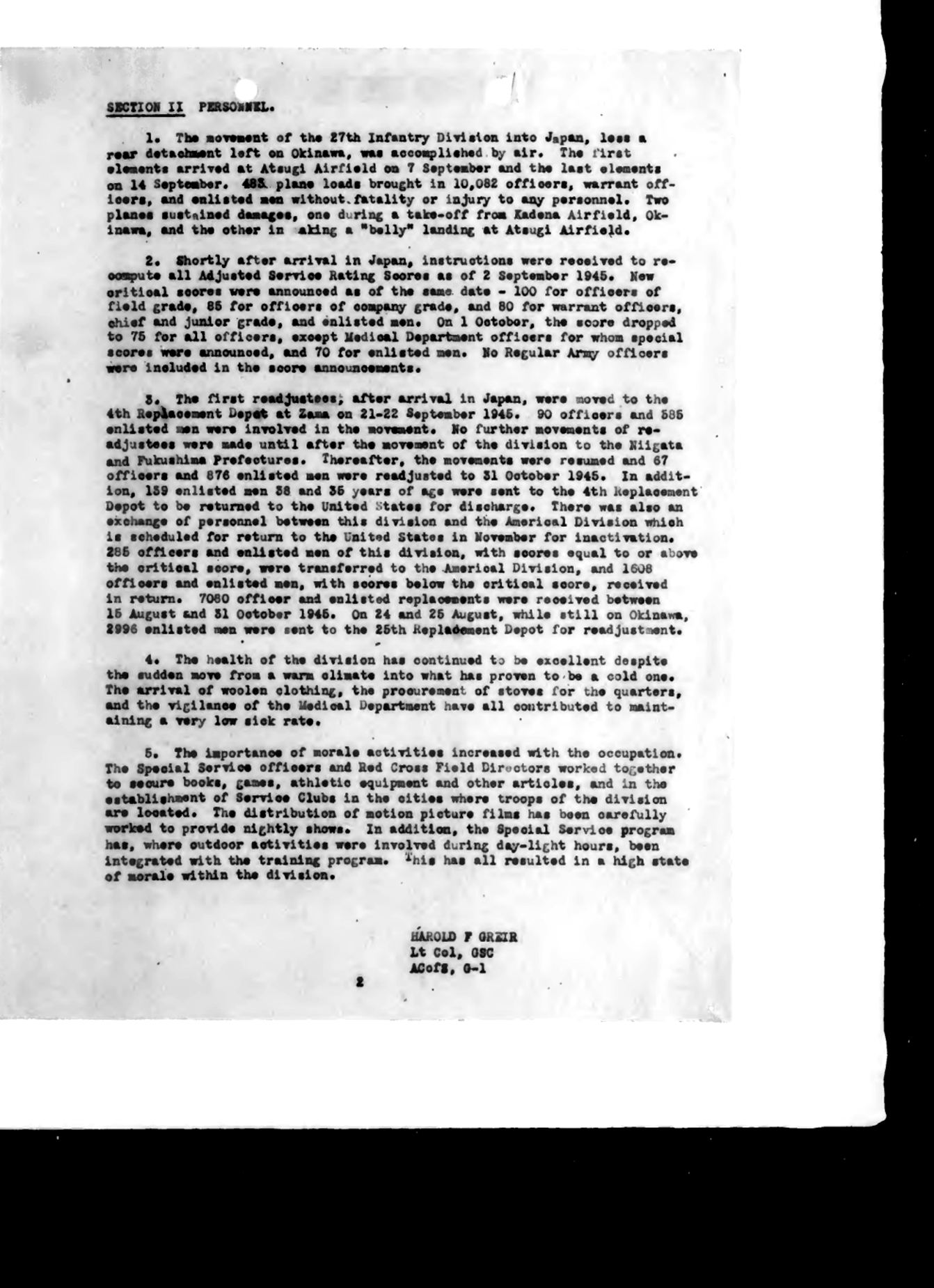
The war ended in August 1945. But the men of the 27th still had to serve. In early September the division moved from Okinawa to occupied Japan, arriving by air at Atsugi between September 7 and 14, then beginning occupation duties in northern Honshū. The G-1 staff counted 483 plane loads carrying 10,082 people in the move. Soldiers who had dealt with tropical rain and heat now had to prepare for cooler northern weather, occupation assignments and the steady departure of men eligible for readjustment. [19]
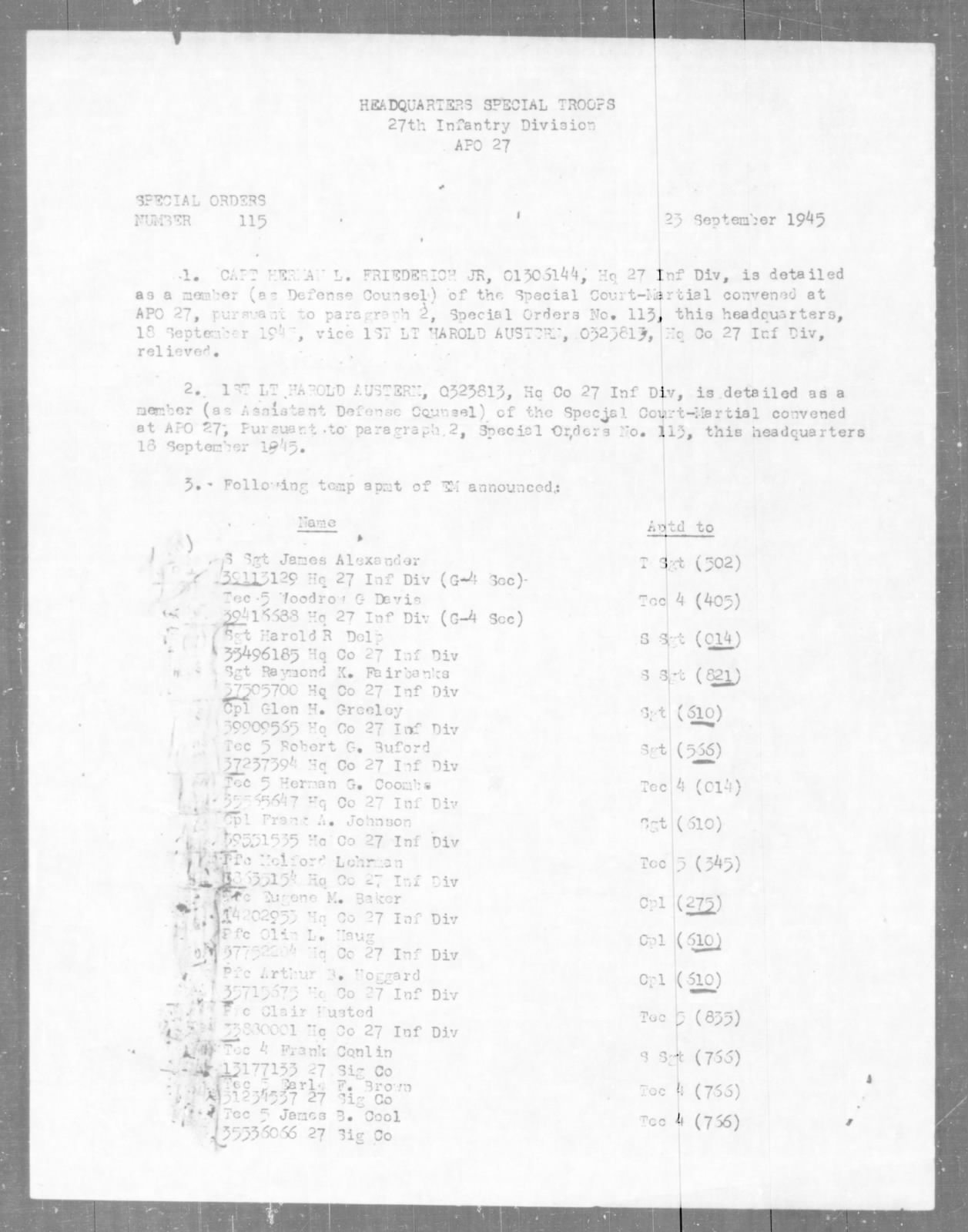
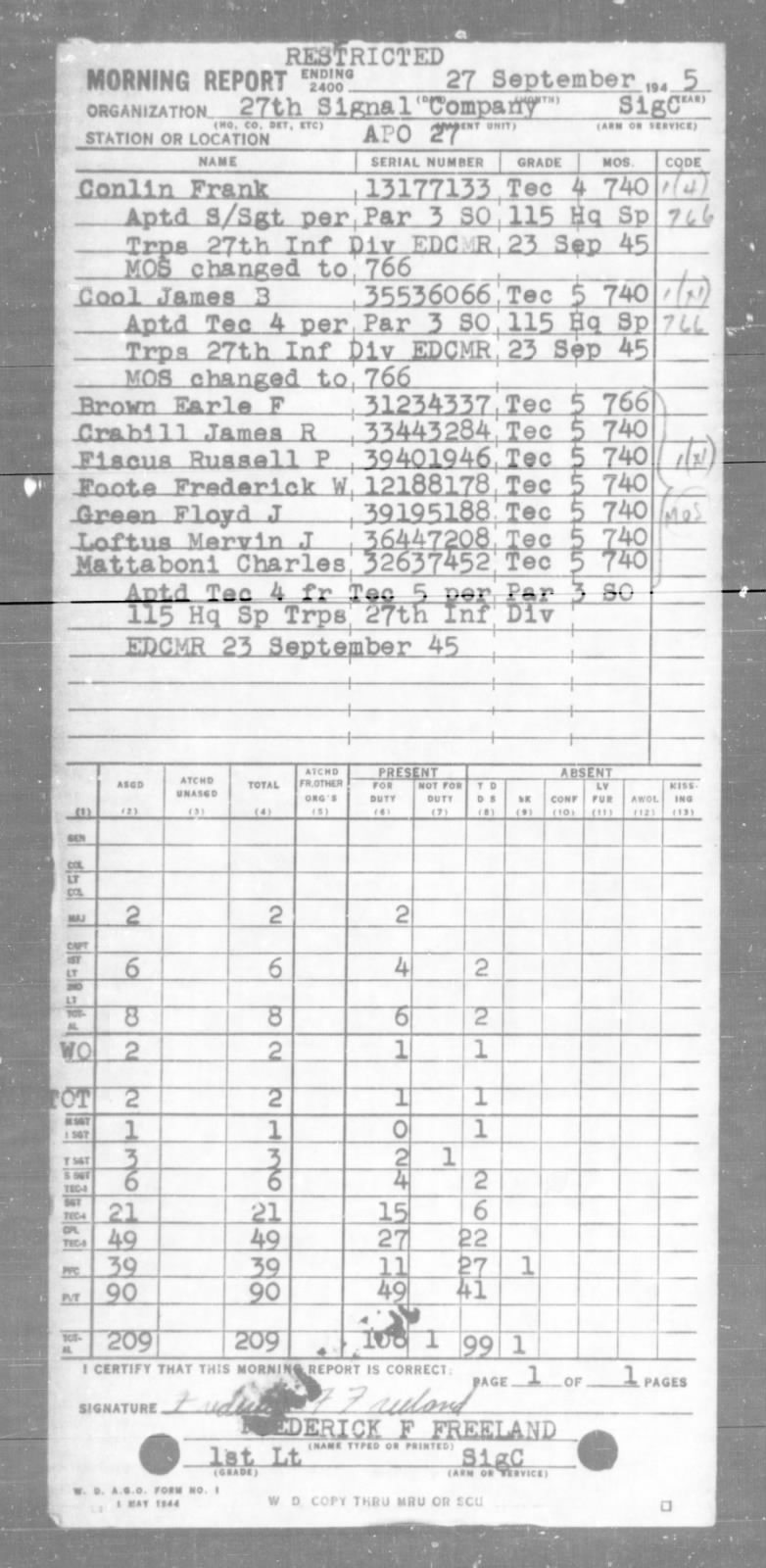
At this moment Frank's paperwork records a professional advance. On September 23, Headquarters Special Troops issued Special Orders No. 115 appointing him Staff Sergeant, with the occupation code 766: Radio Operator, High Speed, Manual. The September 27 company morning report separately records the change from MOS 740, intermediate-speed radio operator, to 766. Both grades and codes mattered. The codes described the technical work he was qualified to perform; the Staff Sergeant appointment recognized him as a noncommissioned officer, a soldier entrusted with greater responsibility within the company. [20]
Army technical manuals of the period describe this work in practical terms: sending and receiving military messages over radio networks, knowing call procedures and security rules, recording traffic carefully and making basic adjustments to the equipment. It is more than a story that Frank knew Morse code. His Army orders actually identify a high-speed manual radio specialist. Another operator, James B. Cool, appears in the same specialty-change paperwork, while Earle F. Brown appears among men appointed in the September 23 orders. [20]
Autumn 1945 / A small number changes everything
Seventy points.
By September 1945, the fighting was over. But for Frank Conlin, as for thousands of soldiers still scattered across the Pacific, the end of the war did not necessarily mean the end of military service.
He had spent more than two years overseas. He had served in a company that followed the infantry across the islands, transmitting messages, keeping circuits alive, and adapting whenever headquarters moved. Now the 27th was occupying Japan while the Army decided how to bring its men home.
The decision came down, in part, to a number.
Frank's September 2 company roster gave him 70 adjusted-service points. The Army's announced requirement for enlisted men was 80.
Ten points short.
It was a small difference on a sheet of paper, and an enormous one after the islands, the tropical heat, the fighting and the long months away from Philadelphia. The prospect of remaining overseas was still real.
Then, on October 1, the Army lowered the threshold.
Seventy points.
Nothing about Frank's service had changed. He had not fought another campaign or accumulated another year overseas. Yet a number that had meant waiting became a number that could finally take him home.
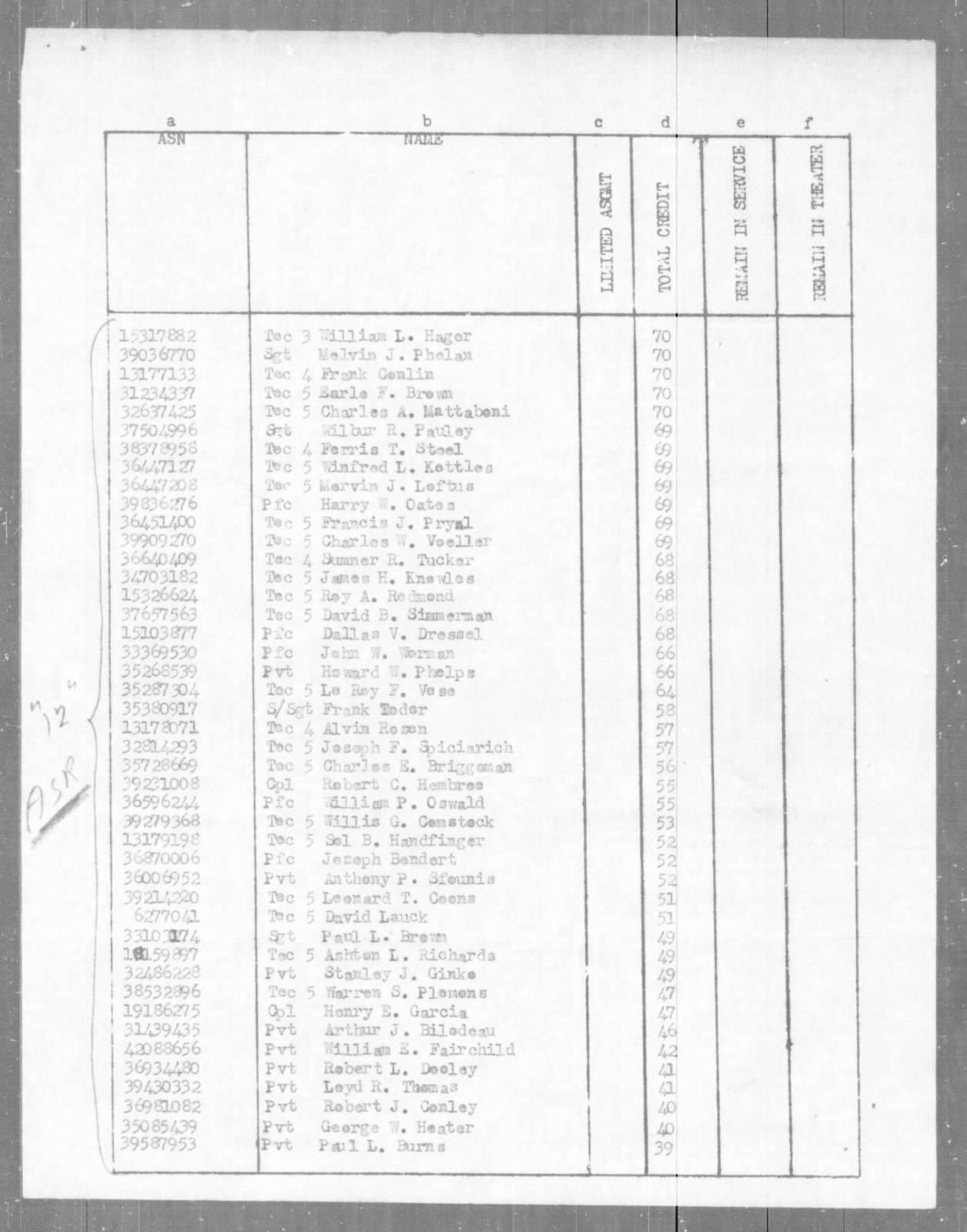
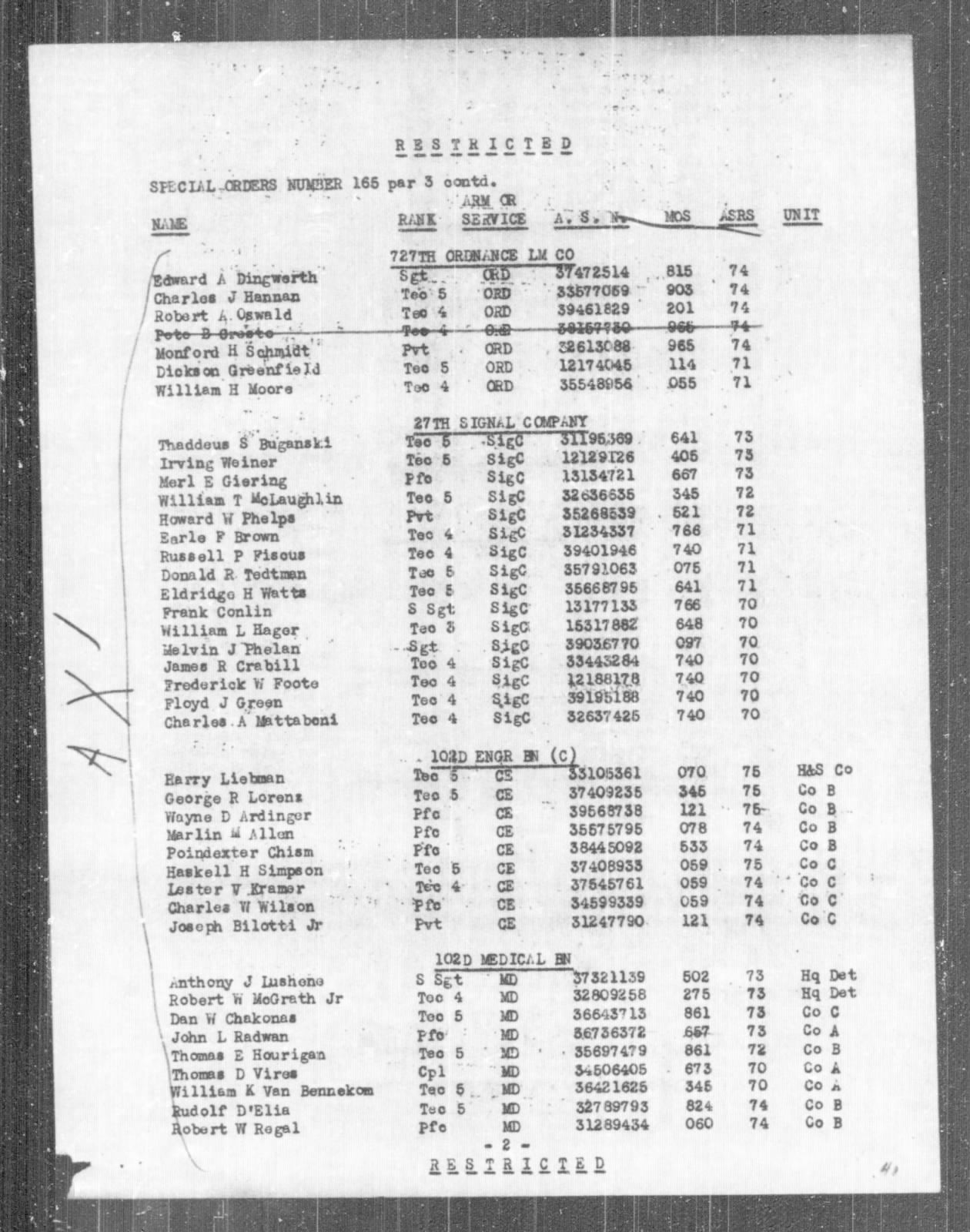
On October 24, the division ordered Frank and fifteen other 27th Signal Company soldiers toward the 4th Replacement Depot at Zama, Japan. Among them were names that had been appearing for months: Floyd Green, Howard Phelps, Earle Brown, Russell Fiscus, James Crabill and Frederick Foote. The roster shows a military organization beginning to dissolve into individual journeys home. [19]
Frank's name then appears on a 4th Replacement Depot disposition-center roster, in Separation Group RK101-45. By November 27, he was on an Army processing roster at Indiantown Gap, Pennsylvania. It was a long way from Okinawa. The Army's own paperwork had traced him back toward the state where his story began. [20]
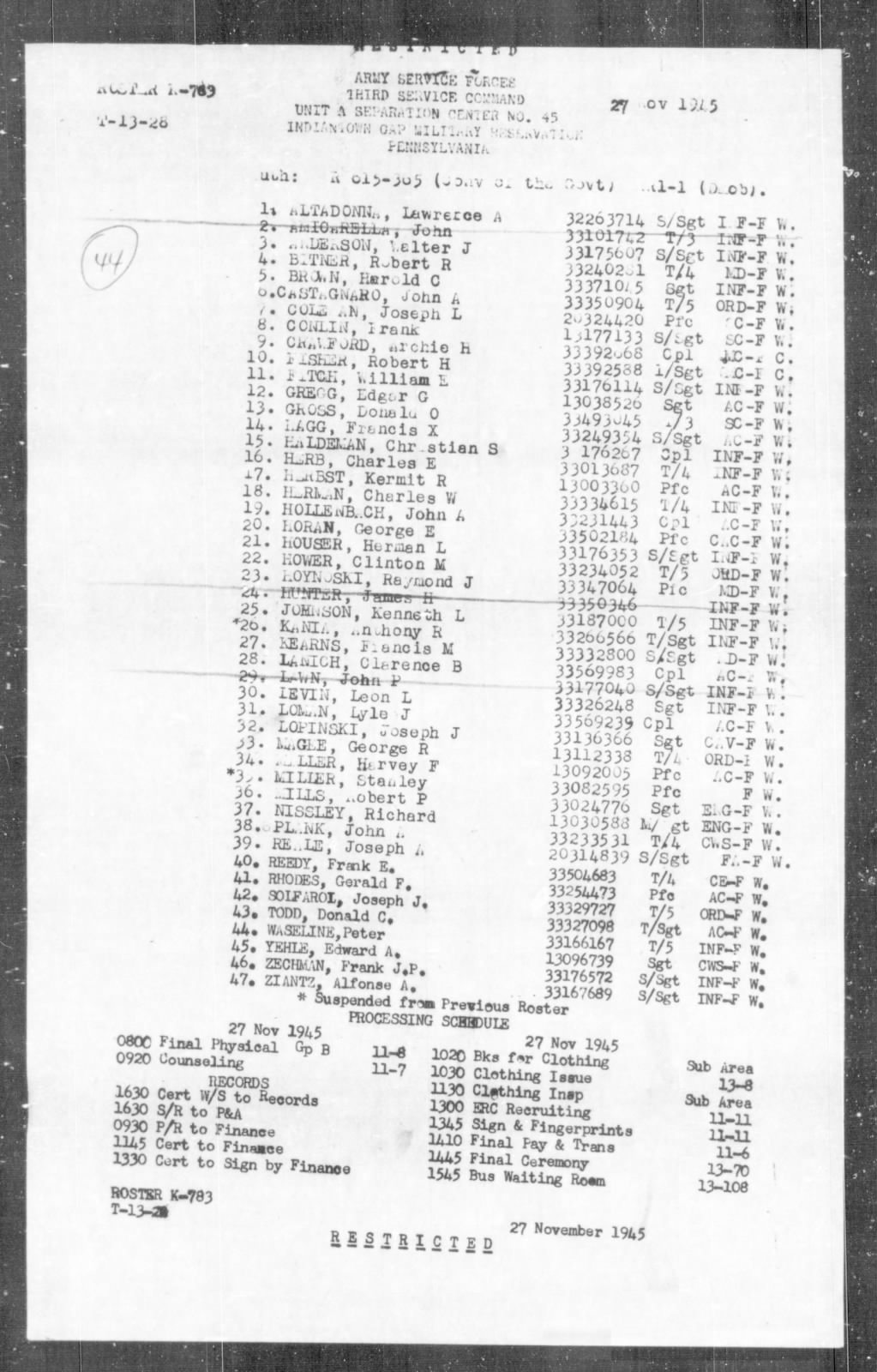
The moment he heard the news belongs to Frank's private history. The turning point itself survives on three original sheets of Army paperwork.
After everything that had taken him across the Pacific, Frank's path home had turned on ten points he never had to earn.
And somewhere beyond the paperwork, Philadelphia was waiting.
Frank's service, in dates
December 9, 1942 · Army service-entry date in his Pennsylvania compensation application. June 7, 1943 · Overseas service begins. March 1944–October 1945 · Repeated, individually named 27th Signal Company records. September 23, 1945 · Staff Sergeant appointment. October 24 · Orders for readjustment. November 27 · Indiantown Gap processing, Pennsylvania. Service record ↗
A HOUSEHOLD OF THEIR OWN.
In April 1950, an enumerator recorded Frank and Regina Conlin in the same household at 6713 Souder Street, Philadelphia. The two young people from earlier records now appear on consecutive lines of one page.
By then Frank was employed as a production supervisor. The household was in the area now called Oxford Circle, northeast of the Kensington streets associated with their earlier lives. A move in address is visible; the date and circumstances of the family's move are not documented by this census alone. [8]
The census names Frank as a production supervisor, but does not by itself connect that position to Link-Belt or Air Products. His later obituary describes a second, more specific chapter of work: he became a purchasing agent at Air Products & Chemicals. It is a different kind of industrial role—helping an organization obtain what it needs to operate—and belongs to a company that was growing rapidly in the decades after the war. [9]
Regina had a working life of her own. Her 2008 obituary records thirty-one years at Muhlenberg College in Allentown, with retirement in 1993. In the decades after the 1950 census, their two careers would become part of the wider Lehigh Valley story: Frank in an expanding industrial-gases business, Regina in the daily life of a college. The date of their move from Philadelphia remains to be established.

THE COMPANY THAT MADE THE INVISIBLE.
Frank's later career brought him to Air Products & Chemicals, a company whose business began with something almost invisible: the gases that made other industries possible.
Founded by Leonard Parker Pool in 1940, Air Products pioneered equipment producing oxygen at customers' own sites. After the war it grew near Allentown into a much larger industrial-gases and manufacturing company. Frank's later career belonged to that changing Lehigh Valley economy, although we cannot yet date his employment or identify his particular office. [11]
His obituary identifies him as a purchasing agent, helping an industrial company obtain the materials and services needed to operate. It is a different working chapter from the eighteen-year-old named on the Link-Belt draft card. The 1950 census also records him as a production supervisor, but does not name the employer. We can trace a working life without filling the gaps with imagined assignments. [9]
Family research also associates Frank with real estate and community activity, although their dates and organizations remain to be documented. Work was only part of the long life he and Regina made after Philadelphia: she spent thirty-one years at Muhlenberg College, retiring in 1993, while his civilian career developed in the same Lehigh Valley community.
THE MAN BEYOND THE RECORDS.
Frank died in 2003. His life had begun among the rowhouses and working households of Philadelphia and extended through military service, marriage and decades of civilian work in Pennsylvania.
At eighteen he had an address on East Cambria Street and a job at Link-Belt. Within a year he was in the Army. Family memories carry him into that next chapter as a sergeant handling Morse-code communications, with a story of enemy fire striking the pack he wore. After his return, a census placed him beside Regina in their own Philadelphia household, working as a production supervisor. Later came Air Products and the life they built in the Lehigh Valley.
Frank's working years spanned the machine-making Philadelphia of his parents' generation, the unfamiliar responsibilities of wartime communications, industrial production and purchasing. Regina's long career at Muhlenberg College belonged to their shared years, even as she followed a distinct vocation of her own. Together their lives connected the streets of Kensington with the institutions and workplaces of Allentown.
Documents tell us where he lived and what he did. The remembered account of his communications pack adds something more particular: a moment Frank himself chose to tell. That story, carried through his family, has a place alongside the draft card, the census and the record of the years he spent away.
The life carried forward
Original records and attributed family memories form the foundation of this biography. The Pacific photographs illustrate the world of his reported service, not Frank himself. Other memories of his civilian years can give future generations an even fuller portrait.